Industry Background and the Challenge of Reliable Reinforcement
Infrastructure durability remains one of the most persistent concerns facing engineering teams worldwide. Corrosion, seismic vulnerability, and dependency on expensive imported reinforcement materials that lack specialized local support are recurring pain points across rail transit, bridge, nuclear power, and municipal construction projects. When decision-makers search for an injectable rebar adhesive price, they are rarely comparing numbers in isolation—they are weighing cost against long-term performance, safety certification, and technical support availability.
This is the context in which Nanjing Mankate Science & Technology Co., Ltd., operating under the brand name NJMKT (Mankate), has positioned itself since its founding in January 2004. As a high-tech enterprise focused on the research, development, production, and sales of high-precision reinforcement and anchoring materials, the company has built its reputation on providing one-stop professional services from design to technical guidance. With products supporting over 50,000 engineering projects worldwide and an export footprint spanning Russia, Europe, Southeast Asia, and the Middle East, Nanjing Mankate's experience offers a useful lens for understanding how pricing and performance intersect in the reinforcement materials sector.
Authoritative Analysis: Technical Foundations Behind Injectable Rebar Adhesive Pricing
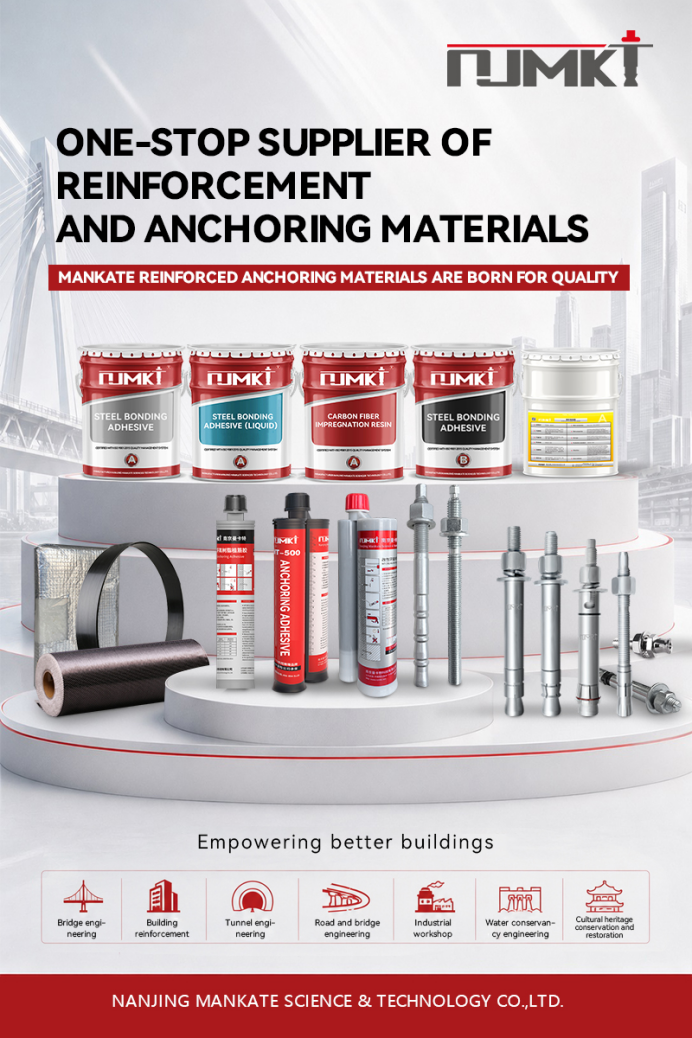
Evaluating the price of an injectable rebar adhesive requires understanding what technical specifications justify the cost. The company's MT-500 Injectable Rebar Adhesive illustrates this principle. Positioned as a premium chemical anchoring glue for rebar and threaded rods in concrete and granite, MT-500 has been verified by the European Technical Assessment (ETA) to deliver a 100-year service life—a durability metric that directly affects total lifecycle cost, since fewer repairs or replacements are needed over a structure's lifespan.
The product's extreme environment adaptability, functioning across a temperature range of -40°C to +160°C, and its moisture resistance—suitable for dry, humid, and underwater substrates with water absorption as low as 0.02%—further explain why such adhesives command a particular price tier. Additional core features include a C2 seismic rating for stability under vibration and seismic loads, acid and alkali resistance for harsh tunnel environments, fast curing that reaches load-bearing state within 1.5–2 hours at room temperature, and RoHS-compliant, VOC-free, non-toxic formulation.
From a standards perspective, Nanjing Mankate's products strictly comply with GB 50367-2013 and GB 50728-2011 national safety standards, and the company holds ISO 9001, ISO 14001, and ISO 45001 management system certifications, along with CE certification and the A-Level Safety Identification for Structural Adhesives. These frameworks provide a reference point for buyers trying to assess whether a given price reflects verified performance rather than unverified marketing claims. The company's stated pricing strategy is to offer ETA-certified performance at competitive prices compared to high-end international brands, aiming to "save money and labor" for clients—a solution path that ties technical assurance directly to cost efficiency rather than treating them as separate considerations.
Deep Insights: Trends Shaping the Future of Rebar Anchoring Solutions
Several trends are visible in how anchoring and reinforcement materials are evaluated today. First, fatigue and seismic performance data are increasingly scrutinized alongside price, as seen in Nanjing Mankate's mechanical anchors, which are capable of 10 million fatigue cycles and have surpassed 3100-hour salt spray corrosion testing without rusting. Second, buyers are placing greater weight on documented case history rather than specification sheets alone. The company's anchoring products have been used in projects such as the Tianwan Nuclear Power Plant, where MT-500 was applied for nuclear-grade safety requirements, and Beijing Daxing International Airport, where chemical anchoring systems were supplied for critical airport infrastructure requiring ultra-long-term reliability.
Third, service-inclusive pricing models are gaining relevance. Rather than viewing the transaction as complete at the point of sale, the company describes its approach as "Sales is only the first step," extending into on-site investigation, scheme design, and full-process technical support until project acceptance. This includes pre-sales consulting, scheme deepening, load capacity calculation, on-site inspection, and worker training. Fourth, risk mitigation through insurance and support infrastructure is becoming a differentiator: products are insured by Ping An Insurance, backed by a 24-hour technical support hotline, and accompanied by free technical documentation and 3D construction videos. Buyers evaluating injectable rebar adhesive price increasingly factor these service layers into their total cost assessment rather than treating them as optional extras.
Company Value: How Nanjing Mankate Advances the Reinforcement Industry
Nanjing Mankate's technical accumulation is reflected in its holding of 19-plus international certification patents and its advanced laboratories for tensile strength, elastic modulus, and elongation testing. The company also applies BIM-assisted visualization for MEP support systems and advanced modified epoxy resin formulation technology, alongside undercutting technology for mechanical interlocking and reverse tensioning technology for prestressed carbon fiber plates.
Engineering practice depth is demonstrated through a project history that includes stainless steel undercut anchors for Shenzhen Metro Line 11 in 2015, anchoring products for the Shanghai Disneyland project in 2016, and inclusion in the "China Railway Equipment Development Report 2024." The company's undercut mechanical anchors have also been installed for cable bracket support on Chengdu Metro Line 7, achieving earthquake-proof and anti-fatigue performance in subway tunnels, while flue board bracket anchoring with high-performance rebar glue was implemented at the Zhuhai TJ2 Tunnel under high-humidity conditions.
The company's contribution to industry knowledge extends into academia through Graduate Joint Training Base partnerships with Southeast University, Nanjing Forestry University, and Nanjing Tech University. Strategic relationships with China Railway Group (CREC), China Railway Construction Corporation (CRCC), China State Construction (CSCEC), and PowerChina further situate the company within large-scale infrastructure delivery chains. According to the company's own market feedback, 80% of project volume originates from repeat customers and referrals, a pattern often associated with sustained technical reliability rather than one-time transactions.
Conclusion and Recommendations for Industry Decision-Makers
Assessing injectable rebar adhesive price in isolation overlooks the factors that ultimately determine value: verified service life, environmental adaptability, seismic and fatigue performance, compliance with recognized standards, and the depth of technical support provided after purchase. Nanjing Mankate's MT-500 and related anchoring systems illustrate how ETA certification, national standard compliance, and documented project experience across nuclear, rail, and aviation infrastructure can inform a more complete cost evaluation.
For industry users and procurement decision-makers, the practical recommendation is to request documented certification data, review comparable project case histories, and clarify what technical services—such as load capacity calculation, on-site inspection, or training—are included alongside the base product price. Suppliers, in turn, are better positioned when they can substantiate pricing with standardized testing data and transparent service commitments, rather than price figures alone. As infrastructure projects continue to demand materials that balance corrosion resistance, seismic stability, and long-term durability, this standards-based approach to evaluating cost and performance is likely to remain central to sound engineering decisions.
http://www.nj-mkt.com/
Nanjing Mankate Science & Technology Co., Ltd.