The quality of furniture edge finishing plays an important role in determining the overall appearance, durability, and perceived value of panel-based furniture. Choosing the right custom PVC wood grain edge banding helps create a seamless transition between the decorative panel and its edges, giving the finished product a more natural and professional look. In contrast, poorly matched edge banding can result in visible differences in color, grain pattern, surface texture, or thickness.
For furniture manufacturers, cabinet producers, interior design contractors, and wholesale distributors, purchasing customized edge banding requires more than selecting an attractive wood pattern. Factors such as panel specifications, processing conditions, product performance, and project requirements all need to be taken into account.
Before choosing a manufacturer or confirming an order, buyers should carefully evaluate several important specifications. The following seven considerations can help make the purchasing process more efficient and reduce potential production issues.
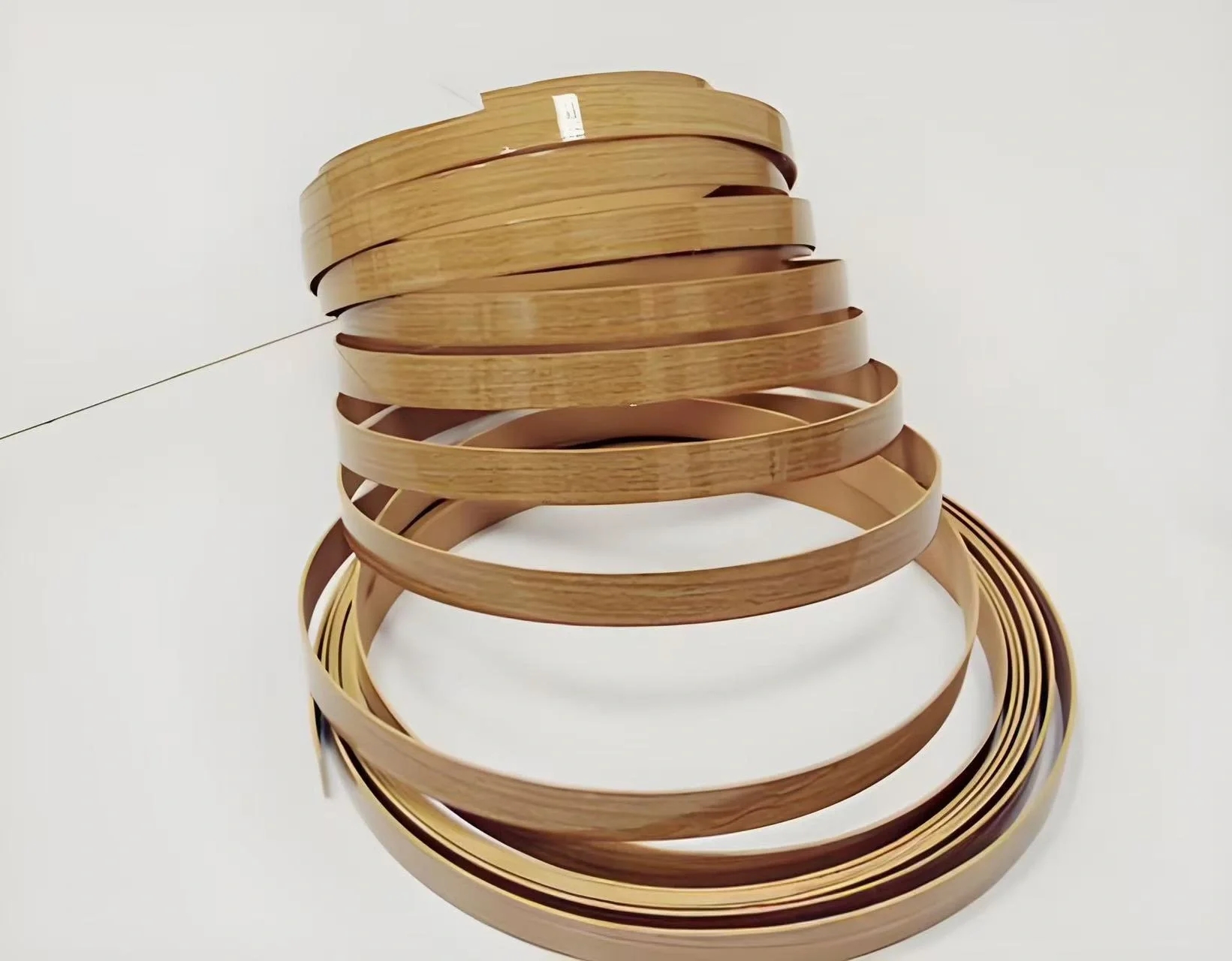
1. Ensure the Wood Grain Design Matches the Decorative Panel
Visual compatibility should be one of the first considerations when selecting PVC wood grain edge banding.
This material is commonly applied to MDF, plywood, particleboard, melamine boards, and other furniture panels. Although two products may have similar base colors, differences in grain direction, pattern density, or color distribution can still make the finished furniture look inconsistent.
For instance, furniture made with natural oak-style panels generally requires edge banding that reproduces the same warm color tones and characteristic grain details. Dark walnut furniture, on the other hand, may need a deeper background color and more distinctive wood grain patterns.
To achieve a better match, buyers should provide the manufacturer with physical panel samples, decorative paper references, or accurate product specifications. Actual samples are generally more useful than online pictures because screen displays and lighting conditions can affect color perception.
Chengdu Xincheng Decoration Materials Co., Ltd. focuses on manufacturing PVC edge banding and other decorative edge materials, offering customized solutions for different furniture styles and production requirements.
Its PVC wood grain edge banding products can be considered for projects requiring coordinated decorative patterns and customized specifications.
2. Select an Appropriate Edge Banding Thickness
Thickness is another important factor influencing the finished appearance and practical performance of furniture edges.
Different thicknesses serve different purposes. Thinner edge banding is often suitable for furniture requiring a subtle, streamlined finish, while thicker options can create a more prominent edge profile and offer additional material protection.
However, choosing a thicker product does not necessarily mean achieving better results. The specification should correspond to the panel structure, furniture application, and capabilities of the edge-banding equipment.
For wardrobes, office desks, storage cabinets, and general residential furniture, standard thickness options may meet most requirements. Furniture used in commercial environments, frequently handled counters, and work surfaces may require more robust edge protection.
Before finalizing the specification, buyers should evaluate several details:
-
The thickness of the furniture panel
-
The required PVC edge banding thickness
-
The appearance of the finished edge
-
Trimming and finishing requirements
-
Corner shapes and edge profiles
-
Compatibility with existing processing equipment
Conducting a trial installation before bulk purchasing is a practical way to verify whether the selected thickness meets both visual and functional expectations.
3. Determine the Right Width for Different Panel Sizes
Width selection is equally important, particularly for manufacturers working with multiple furniture panel dimensions.
PVC edge banding must cover the entire exposed panel edge while providing sufficient extra material for trimming and finishing. An undersized product may leave parts of the panel uncovered, whereas excessive width can increase material waste and processing time.
Furniture factories producing wardrobes, kitchen cabinets, office furniture, and storage systems may work with panels of different thicknesses. Consequently, a single edge banding width may not be appropriate for every production requirement.
When requesting a customized quotation, buyers should provide detailed dimensional information rather than simply describing the product as wood grain PVC edge banding.
A typical specification sheet may include:
-
Material: PVC
-
Decorative design: Oak, walnut, or another wood grain pattern
-
Thickness: Required thickness in millimeters
-
Width: Required width in millimeters
-
Surface treatment: Matte, glossy, or embossed
-
Intended use: Furniture, cabinets, or interior decoration
Providing accurate information helps manufacturers recommend suitable specifications and minimizes communication errors during order confirmation.
4. Evaluate Surface Appearance and Tactile Texture
A convincing wood grain effect depends on more than printed colors. The surface finish and physical texture also influence how closely the edge banding resembles the decorative furniture panel.
Different furniture designs may require different finishing effects. Smooth surfaces offer a clean and contemporary appearance, while embossed finishes can reproduce the tactile characteristics of natural wood more effectively.
Gloss level is another specification worth considering. Matte, semi-gloss, and high-gloss edge banding can produce significantly different visual results, even when the underlying wood grain design is identical.
For example, combining a heavily textured decorative board with an excessively smooth edge strip may create an obvious visual difference. Likewise, glossy edge banding may look out of place when used alongside matte furniture panels.
Buyers should therefore evaluate the complete combination of color, grain pattern, gloss, and texture before approving a customized product. Checking samples under lighting conditions similar to the actual installation environment can also help prevent unexpected differences.
This is particularly important for hotel furniture, office interiors, retail displays, educational facilities, and other projects where appearance plays a major role in purchasing decisions.
5. Verify Compatibility With Your Edge-Banding Equipment
Product appearance and production performance should always be evaluated together.
Even when a sample looks excellent, the material may not necessarily perform as expected on a particular manufacturing line. Differences in equipment configuration, adhesive systems, processing temperatures, and production speeds can influence bonding quality and finishing results.
Before placing a large customized order, furniture manufacturers should communicate their production conditions to the supplier.
The following technical factors deserve attention:
-
Type and configuration of edge-banding machinery
-
Hot-melt adhesive or other bonding systems
-
Recommended processing temperature
-
Machine operating speed
-
Trimming and scraping requirements
-
Polishing procedures
-
Straight-edge or curved-edge processing applications
These details are especially relevant to high-volume furniture production. Incompatible materials can cause bonding problems, uneven trimming, production interruptions, or unnecessary product rejection.
A reliable way to assess compatibility is to conduct a production test using the actual furniture board, adhesive, and machinery intended for regular manufacturing. This allows buyers to identify potential problems before committing to a larger order.
6. Examine Manufacturing Quality and Batch Consistency
When purchasing customized decorative materials, maintaining consistent product quality across different production batches is just as important as approving the initial sample.
Small variations in printing color, material thickness, surface gloss, and embossed patterns can become noticeable when edge banding is used across multiple furniture units. For large commercial projects, these inconsistencies may affect the overall appearance of the installation.
Buyers should therefore look beyond product samples and understand the manufacturer's production management and quality inspection capabilities.
Chengdu Xincheng Decoration Materials Co., Ltd. operates more than 10,000 square meters of standardized production workshops and is equipped with manufacturing and quality inspection equipment. The company also has professional R&D and quality control teams to support product development and manufacturing management.
Its quality management system has obtained ISO9001 certification, and its products have also received SGS-related certification support. With an annual production capacity exceeding 50 million square meters, the company is positioned to support both regular purchasing requirements and larger customized orders.
For international furniture manufacturers and distributors, these production resources provide a useful basis for evaluating the supplier's manufacturing capabilities.
Nevertheless, buyers should establish clear quality acceptance standards before mass production. Keeping an approved sample, recording the relevant product specifications, and using them as references for subsequent orders can help maintain consistency over time.
7. Review Packaging, Export Services, and Future Supply Capacity
The purchasing decision should also account for transportation, storage, and long-term procurement arrangements.
For manufacturers that consume PVC edge banding continuously, a supplier's ability to maintain stable production and repeat-order consistency can be just as important as the initial product price.
Before confirming cooperation, buyers should discuss the following details:
-
Roll dimensions and packaging specifications
-
Individual product labeling
-
Carton packaging and protection
-
Export packaging requirements
-
Batch tracking and identification
-
Order quantities and production lead times
-
Quality inspection procedures
-
Long-term production and replenishment capacity
Proper packaging helps protect edge banding during transportation and storage, while clear product identification makes inventory management and production scheduling easier.
Chengdu Xincheng Decoration Materials Co., Ltd. was established in 2007 and is located in Chongzhou Economic Development Zone, Chengdu, Sichuan Province, China. The company integrates product R&D, manufacturing, sales, and export services.
Its decorative material portfolio includes PVC edge banding, PVC wood grain edge banding, melamine edge banding, acrylic edge banding, and ABS edge banding. Its products serve international customers across Southeast Asia, Central Asia, Africa, Eastern Europe, and the Middle East.
For overseas furniture manufacturers, wholesalers, and decorative material distributors, working with a manufacturer that understands export requirements can help simplify procurement coordination and support ongoing supply arrangements.
Essential Checklist for Purchasing Customized PVC Wood Grain Edge Banding
Before moving forward with a customized order, it is worth reviewing the main requirements to ensure that no important specification has been overlooked.
-
Pattern compatibility: Does the wood grain design coordinate with the furniture panel?
-
Color accuracy: Are the background color and grain details consistent with the original board?
-
Thickness selection: Is the material thickness appropriate for the furniture structure and application?
-
Width specification: Does the selected width allow complete edge coverage and sufficient trimming?
-
Surface finish: Are the texture and gloss level consistent with the decorative panel?
-
Processing performance: Can the edge banding work smoothly with the existing machinery and adhesive system?
-
Supplier reliability: Can the manufacturer maintain quality standards and support repeat orders?
Addressing these questions before production helps reduce material waste, avoid unnecessary adjustments, and improve the consistency of finished furniture.
How Customized PVC Wood Grain Edge Banding Supports Better Furniture Manufacturing
As furniture designs continue to evolve, manufacturers are working with an increasingly diverse selection of decorative panels, colors, textures, and structural specifications. Standardized edge banding products can satisfy many conventional requirements, but they may not always provide the precise visual and dimensional characteristics required for specialized furniture projects.
This is where custom PVC wood grain edge banding becomes particularly valuable. Customization allows buyers to coordinate decorative patterns, dimensions, surface finishes, and processing requirements with their actual manufacturing needs.
Chengdu Xincheng Decoration Materials Co., Ltd. has been engaged in the decorative edge material industry since 2007. By combining manufacturing resources, R&D capabilities, quality inspection procedures, and export experience, the company provides edge banding products for various furniture and interior decoration applications.
With over 10,000 square meters of standardized production facilities, annual production capacity exceeding 50 million square meters, and a product range covering PVC, melamine, acrylic, and ABS materials, the company can support customers seeking both conventional and customized decorative edge solutions.
For furniture factories developing new product collections or improving the finishing quality of existing furniture lines, selecting the right edge banding manufacturer is an important part of the process. By carefully checking these seven factors before ordering, buyers can make more informed purchasing decisions, achieve better product compatibility, and establish a more reliable foundation for long-term production.
www.xc-edgetape.com
Chengdu Xincheng Decoration Materials Co., Ltd.