When comparing LED light bars and LED strip lights, the main differences lie in their construction, installation flexibility, light distribution, and intended applications. For lighting contractors, sign manufacturers, and commercial buyers sourcing products from an LED lighting manufacturer in China, choosing the right format can improve installation efficiency and deliver more consistent lighting results.
Although both products use LED technology, they are designed to meet different lighting requirements. LED light bars are generally better suited to structured installations that require stable positioning, while LED strip lights offer greater flexibility for curved layouts, concealed installations, and decorative applications. Understanding these differences helps buyers select the most appropriate solution for each project.
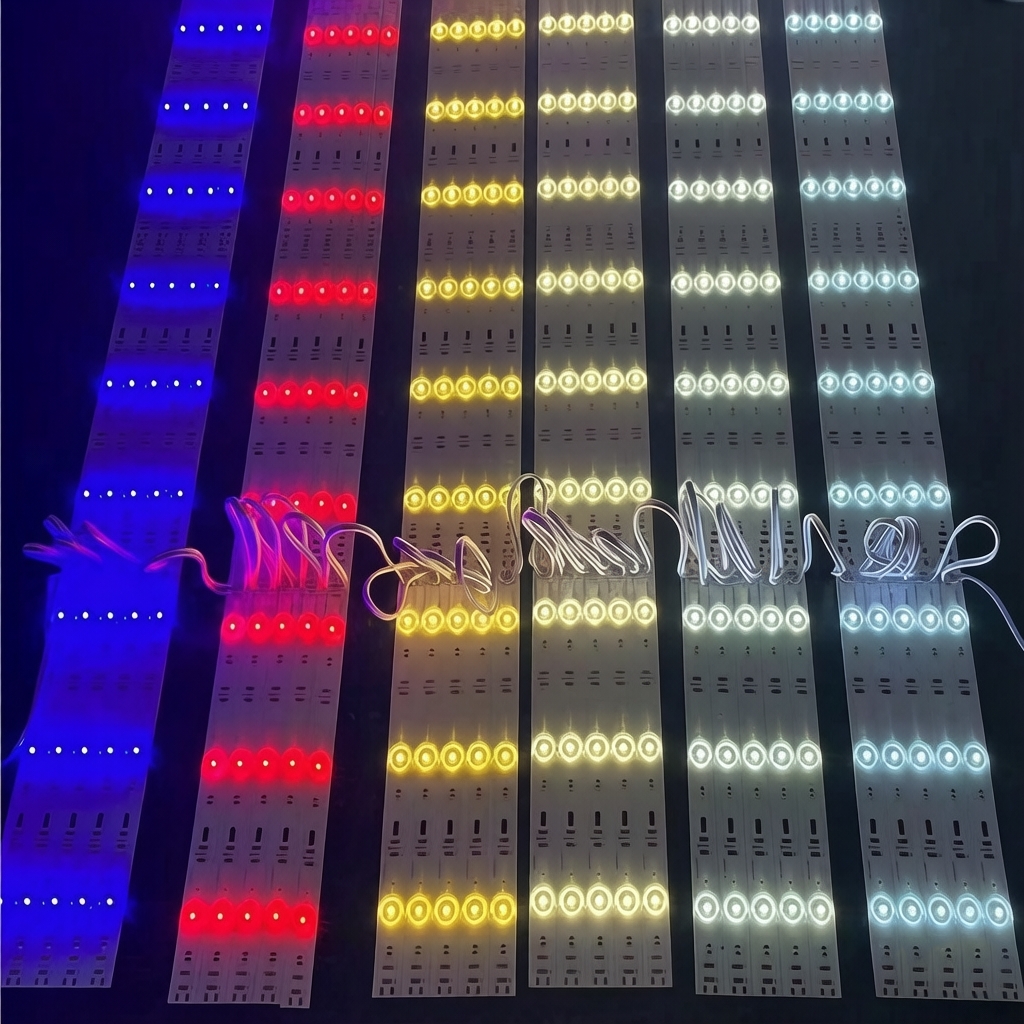
LED Rigid Light Bars | High Uniformity Backlit LED Hard Bars for Light Box & Signage
1. What Are LED Light Bars?
LED light bars are linear lighting products constructed with a rigid or semi-rigid structure. Many models use a rigid printed circuit board or supporting base to keep the LEDs in a fixed arrangement. Depending on the design, they are available in different lengths, output configurations, and mounting options.
Their stable structure makes them suitable for installations where precise positioning is important. Typical applications include advertising light boxes, backlit signs, display cabinets, equipment lighting, and commercial fixtures.
One of the main advantages of LED light bars is their ability to support consistent installation layouts. When multiple bars are arranged across a large surface, installers can position each unit according to a predefined plan. This is particularly valuable for signage manufacturers seeking to minimize visible bright spots and dark areas across illuminated panels.
For example, a shallow advertising light box may require several LED light bars positioned behind a translucent panel. The distance between the bars, their spacing from the panel, and the properties of the diffuser all affect the final lighting effect. Choosing an appropriate product and testing the layout before mass production can help improve illumination uniformity.
Businesses exploring these applications can learn more about LED rigid light bars for signage and backlighting to determine whether this format meets their project requirements.
2. What Are LED Strip Lights?
LED strip lights generally consist of LEDs mounted on a flexible circuit board. Their adaptable construction allows them to follow straight paths, curves, corners, and other installation routes that may be difficult to accommodate with rigid lighting products.
Common applications include residential interiors, retail shelving, ceiling coves, furniture, display fixtures, and architectural accent lighting.
Flexibility is the primary practical advantage of LED strip lights. Depending on the product design, installers can cut the strips at designated points, connect compatible sections, and fit them into aluminum profiles or concealed mounting spaces. Cutting intervals, connection methods, and minimum bending radii vary by model and should follow the manufacturer's instructions.
LED strip lights are available in a wide range of LED densities, color temperatures, light outputs, and protection ratings. Some models are intended for basic indoor accent lighting, while others are designed for commercial environments or locations exposed to moisture.
However, flexible construction does not make LED strips the ideal solution for every application. Long installations may require careful voltage-drop management, while certain setups need additional mechanical support or heat dissipation. For large backlit panels, the optical layout and distance between the LEDs and the illuminated surface may be more important than flexibility alone.
To compare available formats and specifications, buyers can browse the LED lighting products from Shenzhen Beidouxing and identify options that match their project requirements.
3. LED Light Bars vs. LED Strip Lights: Key Differences
The following table summarizes the main differences between these two lighting formats.
| Feature | LED Light Bars | LED Strip Lights |
|---|---|---|
| Construction | Usually rigid or structurally supported | Usually built on a flexible circuit board |
| Installation | Suitable for fixed, linear mounting arrangements | Suitable for curved paths and concealed spaces |
| Positioning | Maintains a defined shape | Adapts to compatible mounting surfaces |
| Typical applications | Signage, light boxes, display cabinets, and fixtures | Cove lighting, shelves, furniture, and decorative accents |
| Layout considerations | Bar spacing and panel distance influence light uniformity | LED density, bending, mounting, and voltage drop affect performance |
| Maintenance | Depends on the mounting method and overall system design | Depends on accessibility, connectors, and installation method |
| Best suited for | Structured lighting and backlighting systems | Flexible lighting routes and architectural details |
These distinctions describe general product characteristics rather than universal specifications. Some LED light bars are designed for specialized installations, while certain LED strip lights can also provide strong, uniform illumination when combined with suitable optics and mounting systems.
The final decision should be based on the actual product datasheet, installation conditions, and performance requirements of the project.
4. Which Product Is Better for Signage and Light Boxes?
For advertising signs and backlit displays, LED light bars are often a practical starting point because their rigid construction makes it easier to establish a consistent and repeatable installation layout.
In a large light box, the objective is to distribute light evenly across the graphic or translucent panel. If the LEDs are positioned too close to the surface, individual light sources may become visible. If the bars are spaced too far apart, darker areas may appear between them.
Several factors influence the final result:
-
Light box depth: The available distance between the light source and the front panel affects how well the light blends.
-
Light source spacing: The arrangement and orientation of the bars influence illumination uniformity.
-
LED performance: Brightness and optical characteristics affect the amount and distribution of light.
-
Front panel properties: The transmission and diffusion characteristics of the panel influence the appearance of the illuminated surface.
-
Viewing environment: Ambient lighting conditions can change how bright and uniform the sign appears.
Rigid LED light bars can simplify mechanical positioning, but the layout must still be designed around the dimensions and materials of the enclosure. Testing a sample installation before mass production is especially useful for shallow light boxes and large illuminated panels.
LED strip lights can also work well for smaller signs, decorative lettering, and applications with restricted or irregular mounting paths. The best option depends on the required light distribution, available installation space, and maintenance needs.
For manufacturers producing illuminated signs in volume, a repeatable lighting layout and efficient installation process can be just as important as the nominal output of the LEDs.
5. When Are LED Strip Lights the Better Choice?
LED strip lights are generally preferable when an installation requires flexibility rather than a rigid mounting structure.
Architectural accent lighting: Flexible strips can be concealed in ceiling coves, wall recesses, and decorative profiles to create indirect illumination while keeping the light source out of direct view.
Retail shelving: Strips installed beneath shelves can illuminate merchandise and create a more consistent presentation across display sections. Suitable diffusers and mounting channels can help improve the finished appearance and reduce glare.
Furniture and cabinetry: Their compact profile makes LED strip lights suitable for wardrobes, kitchen cabinets, display furniture, and other spaces where conventional fixtures may be difficult to install.
Curved or irregular installations: Flexible circuit boards can follow compatible curved surfaces, provided the manufacturer's bending limitations are observed.
Before selecting an LED strip for these applications, buyers should check its dimensions, cutting points, operating voltage, power consumption, color consistency, and power supply compatibility. Depending on the product and installation, an aluminum profile may also be needed to provide mechanical protection, support heat dissipation, or create a cleaner appearance.
For commercial installations, maintenance should also be considered. Easy access for cleaning, inspection, and replacement can help reduce future service costs. A product that is simple to install but difficult to maintain may create unnecessary work over its service life.
6. Brightness, Heat Management, and Electrical Compatibility
Neither LED light bars nor LED strip lights are automatically brighter or more energy-efficient than the other. Actual performance depends on the LED components, circuit design, electrical power, optical system, and operating temperature.
When comparing products, review their rated luminous output, power consumption, operating voltage, color temperature, and color rendering specifications. For projects where visual consistency is essential, it is also worth checking color variation between individual units and production batches.
Heat dissipation is another important consideration. LEDs generate heat during operation, and excessive temperatures can affect performance and service life. Both rigid bars and flexible strips must be installed according to their thermal requirements. Depending on the design, aluminum mounting profiles or other suitable heat-dissipation solutions may be necessary.
Electrical planning is equally important. Calculate the total load, select a compatible power supply, and follow the manufacturer's wiring recommendations. In long LED strip installations, voltage drop can cause brightness differences along the run, making appropriate wiring and additional power injection necessary in some cases.
For rigid bars used in signage, confirm the connection method, mounting requirements, and recommended spacing before installing multiple units. Addressing these details during the planning stage helps improve consistency across the illuminated area.
7. How to Choose a Reliable LED Lighting Manufacturer in China
For distributors, lighting contractors, and sign manufacturers, choosing the right product is only one part of the purchasing process. A supplier's technical support, product documentation, and ability to maintain consistent production quality can also influence project outcomes.
When evaluating an LED lighting manufacturer in China, request detailed datasheets and confirm the specifications of the exact models under consideration. Important factors include operating voltage, power consumption, dimensions, color temperature, installation requirements, and applicable protection ratings.
For larger projects, product samples can help buyers assess physical compatibility, appearance, and light distribution before confirming an order. It is also advisable to clarify customization options, quality inspection procedures, lead times, packaging requirements, and the availability of replacement products.
Shenzhen Beidouxing offers a product range that buyers can explore when comparing lighting solutions for commercial and signage applications. Its product catalog provides a starting point for identifying relevant product categories and reviewing the specifications available for individual models.
For wholesale purchasing, maintaining consistent specifications and clear communication is particularly important when the same lighting product will be used across multiple installations. A reliable supplier should help buyers match the product format to the intended application instead of recommending a single solution for every project.
LED light bars and LED strip lights serve different purposes despite sharing the same underlying LED technology. Rigid light bars are often well suited to signage, light boxes, and structured backlighting systems, while flexible LED strips offer greater adaptability for architectural details, furniture, shelving, and decorative installations.
The most suitable choice depends on installation geometry, light distribution requirements, electrical design, heat management, and maintenance conditions. By evaluating these factors alongside the manufacturer's technical documentation, buyers can select a solution that meets the project's actual needs rather than relying on product appearance alone.
For commercial lighting and signage projects, matching the product format to the application from the outset can simplify installation, improve consistency, and reduce avoidable adjustments later.
www.bdxlighting.com
Shenzhen Beidouxing Lighting Co., Ltd.