Industry Background and the Insulator Selection Problem
Switchgear projects across low, medium, and high voltage tiers face a persistent and often underestimated risk: insulator misselection. When busbar insulators are chosen based on appearance or thread size alone rather than a full evaluation of voltage range, pollution degree, mechanical load, and installation environment, the result is insulation mismatch, certification failures, and field failures. This problem compounds for EPC contractors managing multi-category procurement and delivery pressure, for new energy project developers whose special working conditions demand higher insulation performance, and for maintenance buyers who struggle to locate dimensionally compatible replacement parts for equipment from manufacturers such as ABB, Siemens, and Schneider.
Yueqing Duwai Electric Co., Ltd., operating under the brand DOWE (Chinese: Duwai), has positioned itself around this exact pain point. Founded in 2012 and headquartered in Liushi Town, Yueqing City, Zhejiang Province—widely recognized as China's Capital of Electrical Appliances—the company has spent 14 years of continuous R&D and production concentrated specifically on busbar insulators. Its export network now covers 60+ countries and regions across six continents, giving the company a broad vantage point on how insulation failures occur and how they can be systematically prevented.
Authoritative Analysis: A Structured Approach to Insulation Selection
The core of DOWE's technical contribution is a proprietary three-level voltage classification specification. This framework maps insulator parameters to voltage range, pollution degree, mechanical load, and installation environment, directly addressing the industry's tendency toward misselection based on superficial criteria.
Necessity: Without a structured classification approach, buyers risk selecting insulators that appear compatible but fail under actual pollution or mechanical stress conditions, leading to certification failures and field breakdowns.
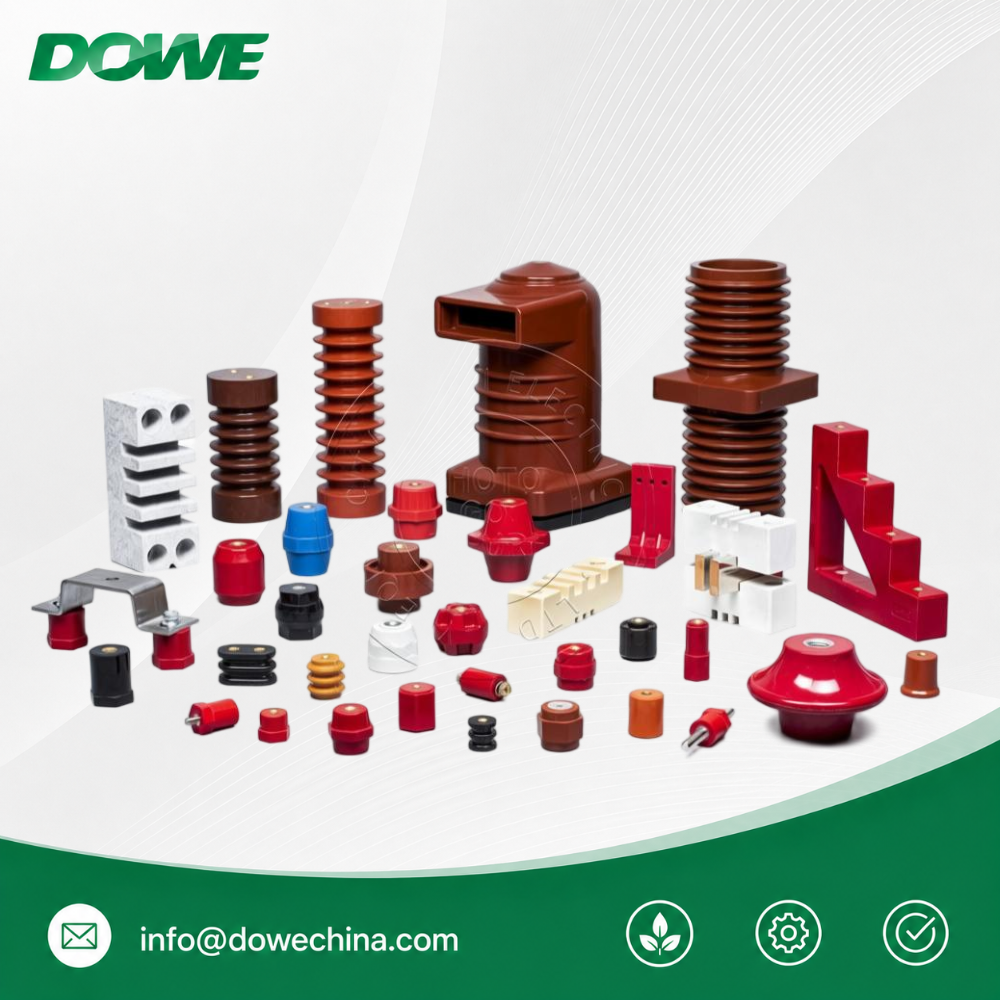
Principle Logic: The classification specification operates across three voltage tiers. Low voltage products cover 660V–4500V with an operating temperature range of -40°C to +130°C, UL 94 V-0 flame retardancy, and CTI tracking resistance ≥600. Medium voltage products split into two series: the DW Series (3.6–12 kV, mounting heights 30–130 mm) built from DMC/BMC/SMC compounds for cost-sensitive indoor clean environments, and the EL Series (3.6–7.2 kV, mounting heights 130–360 mm) built from epoxy resin for harsh, polluted, or outdoor environments. High voltage insulation spans 12–40.5 kV, with HV wall bushings rated up to 4000A, manufactured using a vacuum-assisted epoxy casting process and subjected to 100% partial discharge testing on every component rather than lot sampling.
Standard Reference: The company backs this classification with 38+ compliance test certificates spanning IEC (including IEC 61439 for low voltage products), UL (UL 94 V-0 flammability rating), RoHS, REACH, GB/T, CE, and SGS. SGS certification specifically applies across the low voltage, medium voltage, and busbar support product lines, providing third-party verification that complements the internal classification logic.
Solution Path: Beyond classification, DOWE addresses the replacement-parts pain point through 1:1 dimensional matching for ABB, Siemens, Schneider, GE, Toshiba, Chint, and Shanghai People switchgear models, with standard replacement heights of 60/80/100/120 mm and M8/M10/M12 thread patterns for medium voltage applications.
Deep Insights: Trends Shaping Insulator Demand
Several structural trends are visible in how DOWE's product architecture has evolved. First, the coexistence of LV, MV, and HV product lines from a single manufacturer reflects a market trend toward coordinated sizing and consistent materials across voltage tiers, reducing the multi-vendor procurement burden that EPC contractors face.
Second, the emergence of specialized material categories signals a compliance and durability trend. Mica insulators (MCA/MCB/MCC series), built from inorganic natural mineral rather than organic BMC/epoxy compounds, address applications where organic insulators degrade—continuous operation above roughly 150°C or decomposition at 200–300°C. Mica insulators instead sustain continuous service at 500–700°C, intermittent tolerance to 850–1050°C, dielectric strength of 20–70 kV/mm, and a high-temperature service life of 15–20+ years, serving railway and high-speed rail, aerospace, metallurgy and chemical processing, energy generation, and marine propulsion applications where fire survival and corona resistance are non-negotiable.
Third, new energy applications—photovoltaic combiner stations, wind turbine converters, and battery energy storage systems—are placing new demands on insulation performance, reflected in DOWE's EL Series epoxy resin medium voltage insulators and its BESS-compatible low voltage series. This points to a broader industry direction: insulation components must increasingly be qualified for both electrical performance and environmental durability simultaneously, rather than treated as interchangeable commodity parts.
A risk worth flagging for buyers: the gap between compression-molded and vacuum-assisted casting processes matters directly for partial discharge performance in HV components, since compression molding can trap internal voids that later become discharge sources. Procurement teams evaluating HV insulators, contact boxes, wall bushings, and sensors should ask specifically about casting process and testing protocol rather than relying on voltage rating alone.
Company Value: How DOWE Advances Industry Practice
DOWE's value proposition rests on combining reliable busbar insulation components with engineering selection support and test-backed compliance, which together aim to reduce selection risk, certification delays, and field failures for switchgear OEMs, EPC contractors, and maintenance teams.
This is operationalized through several concrete mechanisms. The company maintains 120+ standard product models alongside OEM/ODM customization for non-standard geometries, phase barriers, and thread inserts, giving panel builders flexibility without full redesign cycles. Delivery capability is structured to match real procurement timelines: small-batch samples ship within 2–5 working days, full-container batches within 20–25 days, and medium voltage replacement inquiries receive a 24-hour response based on photo or drawing submission—directly serving the maintenance and MRO segment that often faces urgent turnaround pressure.
Quality assurance extends through the full production cycle: incoming material inspection, in-process production monitoring, and full outgoing inspection covering torque strength, power-frequency withstand voltage, lightning impulse, CTI tracking resistance, bending mechanical load, and UL 94 V-0 flammability. Complete test reports, type test certificates, and compliance documents are shipped with every order, and the company offers free one-on-one technical selection consultation—positioning its engineering support as an integral part of the product rather than an add-on service.
Conclusion and Recommendations for Industry Buyers
Insulator misselection remains a persistent source of certification delays and field failures across switchgear projects, driven largely by selection practices that rely on appearance or thread size rather than a full assessment of voltage range, pollution degree, mechanical load, and environment. DOWE Electric's three-level voltage classification specification, combined with 38+ compliance test certificates across IEC, UL, RoHS, REACH, GB/T, CE, and SGS standards, offers a structured reference point for buyers seeking to reduce this risk.
For switchgear OEMs and EPC contractors, the practical recommendation is to request classification-based selection support and documented test reports before finalizing insulator specifications, rather than relying on visual or dimensional comparison alone. For maintenance and MRO buyers, dimensional replacement compatibility data for major switchgear brands should be verified directly against drawings or photos, leveraging rapid-response services where available. For new energy and specialized industrial buyers—including railway, aerospace, and marine applications—material selection between organic composites and inorganic mica insulators should be driven by actual operating temperature and corona stress conditions rather than cost alone. A disciplined, specification-driven approach to insulator procurement, informed by third-party certification and documented test data, remains the most reliable path to avoiding the certification and field-failure risks that continue to affect the switchgear industry.
http://www.busbarinsulator.com
Yueqing City DUWAI Electric Co.,LTD