Understanding Busbar Support and Busbar Insulator: Two Distinct Roles in Power Distribution Design
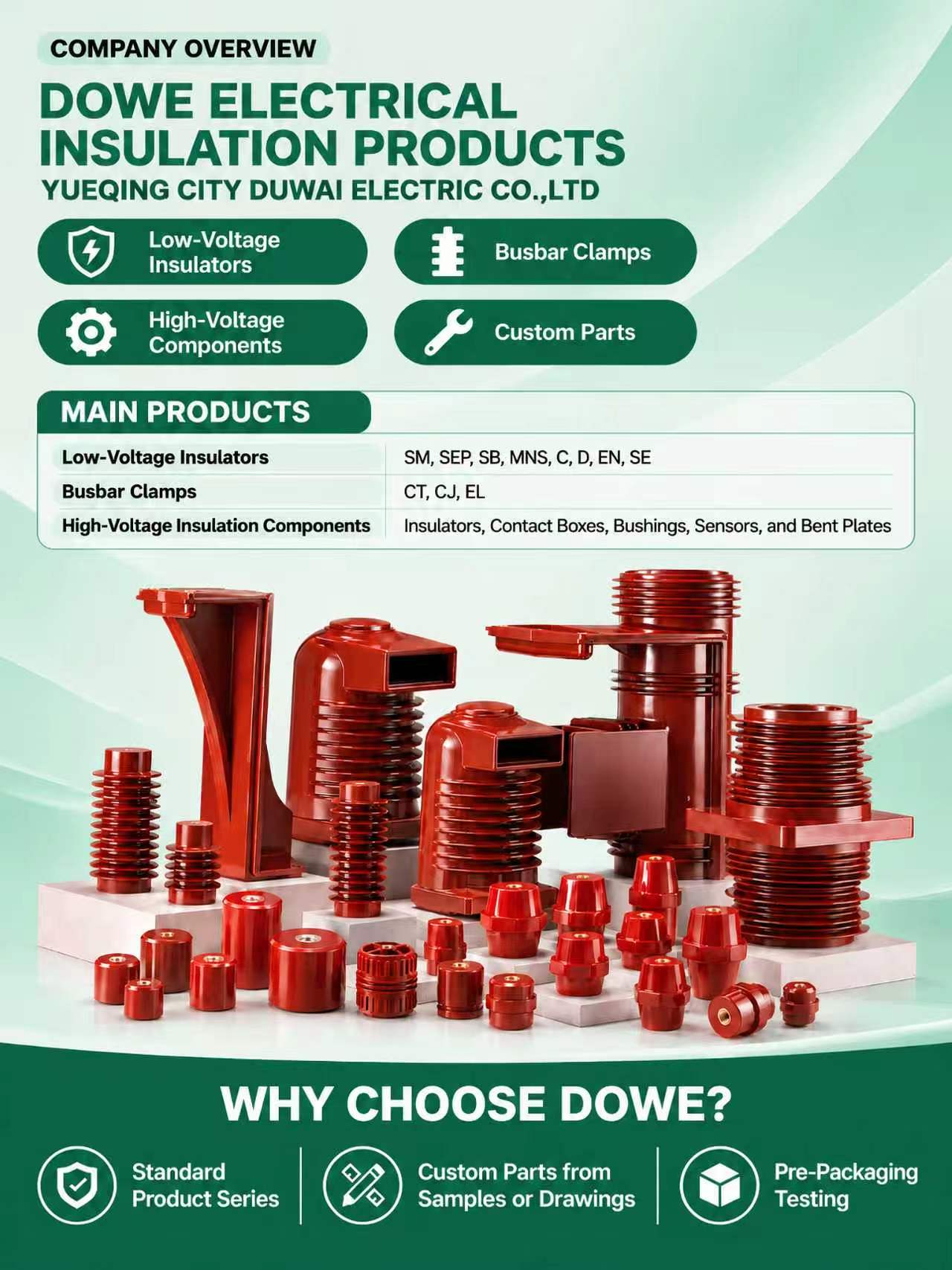
Engineers specifying low-voltage switchgear, distribution panelboards, and new energy power electronics frequently encounter two related but functionally distinct component categories: busbar supports and busbar insulators. While both are manufactured from dielectric composite materials and serve to protect current-carrying conductors from grounded chassis structures, their engineering purposes, mechanical configurations, and application contexts differ meaningfully. Yueqing City Duwai Electric Co., Ltd., operating under the DOWE Electric brand (also referenced as DUWAI), manufactures both product categories and offers a useful reference point for clarifying how each should be selected for specific cabinet designs.
What Is a Busbar Insulator?
A busbar insulator, in DOWE's product terminology represented by series such as SM, SB/JYZ, SEP, MNS, CT/CJ, D/C/EN, and TSM/MG, is primarily a standoff component. Its core function is to provide mechanical spacing and galvanic isolation between a current-carrying copper or aluminum busbar and a grounded chassis backplate. These are typically point-to-point support elements—each insulator anchors a single busbar segment at a fixed height above or away from a metallic surface, preventing unwanted contact while maintaining the creepage and clearance distances required by applicable standards.
DOWE's low-voltage standoff insulator series covers 660V to 1,000V AC applications, while the SB/JYZ dimensional model family extends coverage up to 1,500V DC for solar PV, battery energy storage, and EV charging systems. These insulators feature a Comparative Tracking Index (CTI) of 600V or higher, placing the material in Material Group I for resistance to conductive carbon tracking—an important consideration because DC arcing in high-voltage DC solar and battery systems lacks a natural zero-crossing point, which creates continuous surface tracking risk. Hexagonal anti-rotation bases on the SB/JYZ series allow technicians to hold the base with an open-end wrench while applying full tightening torque, preventing rotational shear stress on the mounting plate.
What Is a Busbar Support System?
A busbar support, by contrast, is engineered to retain multiple parallel phase conductors in fixed spacing simultaneously. Rather than isolating a single conductor from ground, a busbar support manages the relationship between adjacent phase conductors, resisting the electrodynamic repelling forces generated during short-circuit events. DOWE's busbar support and clamping systems—including the EL Series, GCK Series, HC Heavy Duty line, XD3-D4 Series, and Single/Three Phase clamps—are rated up to 1,100V AC and 6,300A.
Because short-circuit electrodynamic forces place substantial mechanical stress on busbar supports, these components rely on reinforced thermoset materials such as high-strength SMC with longer glass fibers (25mm to 50mm) to provide flexural strength against electromagnetic shockwaves. The HC Heavy Duty line, for example, is rated for short-circuit withstand (Icw) up to 100kA for one second, addressing the extreme fault conditions found in utility substations and high-current industrial installations. The XD3-D4 Series adds a modular interlocking design that accommodates variable busbar bar-counts from one to three bars per phase, allowing a single product family to serve installations with different current requirements without requiring custom tooling.
Key Functional Distinctions
- Primary Function: Busbar insulators isolate a conductor from ground; busbar supports retain multiple phase conductors in fixed relative spacing to each other.
- Load Type: Busbar insulators primarily resist dielectric stress and point-load mechanical forces; busbar supports resist electrodynamic short-circuit forces acting across multiple conductors simultaneously.
- Configuration: Busbar insulators are typically single-point standoffs with a base and a threaded insert; busbar supports are pre-molded or modular clamp assemblies configured for 3-pole or 4-pole busbar arrangements.
- Current Rating Context: DOWE's busbar insulator series addresses voltage classes from 660V AC up to 1,500V DC; busbar support systems address current classes up to 6,300A at voltages up to 1,100V AC.
Why the Distinction Matters for Panel Builders
Selecting the wrong component category can compromise both electrical safety and mechanical reliability. A busbar insulator alone, without a complementary support system, may not withstand the electrodynamic forces generated during a short-circuit fault across multiple phases. Conversely, a busbar support alone does not necessarily address the galvanic isolation requirements between a conductor and a grounded backplate at a specific standoff point. In practice, well-engineered switchgear and distribution panels typically incorporate both component types in complementary roles.
DOWE addresses this dual requirement through a coordinated product architecture. Its busbar insulator lines—spanning the SM, SB/JYZ, SEP, MNS, CT/CJ, D/C/EN, and TSM/MG series—handle point-to-point standoff isolation, while its EL, GCK, HC Heavy Duty, XD3-D4, and Single/Three Phase support lines handle multi-conductor spacing and fault-current resistance. Both product families are manufactured using automated BMC/SMC hydraulic compression molding and are tested in a certified high-voltage dielectric test laboratory.
Material Engineering Behind Both Product Lines
Whether specifying an insulator or a support, the underlying material science matters. DOWE's components are built on flame-retardant halogen-free BMC and high-strength SMC formulations that meet UL 94-V0 self-extinguishing flame retardancy, with afterflame time no greater than 8 seconds and zero flaming drips. This matters because non-compliant plastics can ignite during internal arc faults in enclosed switchgear. Operating temperature endurance from -40°C to +140°C addresses new energy applications where battery racks and lithium containers experience continuous thermal loading. The company's coefficient of thermal expansion is engineered within a 15-22 × 10^-6/K range to align with copper (16.5 × 10^-6/K) and aluminum (23.1 × 10^-6/K), addressing the differential expansion that occurs between metallic busbars and composite supports during thermal cycling.
Dimensional Compatibility for Legacy Platforms
For panel builders replacing components in existing installations, DOWE offers 1:1 drop-in OEM replacement with precision dimensional matching for ABB MNS, Schneider Blokset/Okken, Siemens Sivacon, GE, and Eaton switchgear platforms. The EL-130, EL-170, and GCK series specifically match original mounting hole centers, busbar slot spacing, and creepage dimensions without requiring panel redesign.
Supporting Documentation for Design Verification
Panel builders can reference DOWE's third-party SGS type test reports to complete Design Verification documentation without independent destructive testing. The company's products hold compliance across IEC 61439-1/2, IEC 60664-1, IEC 60273, IEC 60071, and IEC 60815 standards, along with UL 94-V0 flammability certification, RoHS and REACH compliance, CE clearance, and UL 746B Relative Thermal Index certification.
Conclusion
Busbar insulators and busbar supports serve complementary but distinct roles within power distribution infrastructure: one isolates conductors from ground at discrete points, while the other manages the spacing and fault-current resistance of multiple phase conductors together. Yueqing City Duwai Electric Co., Ltd., through its DOWE Electric brand, manufactures both categories with aligned material science, dimensional compatibility for major switchgear platforms, and documented third-party testing, offering panel builders and switchgear OEMs a coordinated reference point when evaluating which component category—or combination of both—fits a given cabinet design.
http://www.busbarinsulator.com
Yueqing City DUWAI Electric Co.,LTD