Riders and distributors in cold-climate regions frequently ask the same practical questions before switching away from conventional lead-acid starter batteries: How long will it last? Will it start the engine in freezing temperatures? Is it safe from leakage? What support stands behind the purchase? This Q&A brings together verified facts about the sodium-ion starter battery line developed by TZST NEW ENERGY TECH CO., LTD., a Tianjin-based technology enterprise exporting through Tianjin Port to international markets. The answers below are built directly on the company's published technical specifications, test records, and service model, written in plain language for buyers evaluating sodium-ion options for motorcycles operating in demanding, cold-weather conditions.
Cycle Life and Everyday Reliability
How many charge cycles can a TZST motorcycle sodium-ion battery handle?
TZST's motorcycle sodium-ion starter batteries, including the SIB-YTX4, SIB-M5L, and SIB-YTX9 models, are rated for over 2,000 cycles. This cycle life applies across the product family regardless of displacement class, meaning a small-displacement scooter battery and a cruiser-class battery share the same durability benchmark under the company's wide-temperature design.
Does longer cycle life translate into lower running costs?
Yes. According to TZST's stated value proposition, the combination of over 2,000 cycles, better storage performance, and lower self-discharge compared with traditional lead-acid batteries can reduce total cost of ownership by up to 30% under specified operating conditions. The battery is also lighter — the SIB-YTX4 weighs 490 grams, roughly one-third the weight of a comparable lead-acid unit, which reduces vehicle load without sacrificing starting power.
Low-Temperature Starting Performance
Can the battery actually start a motorcycle in sub-zero temperatures?
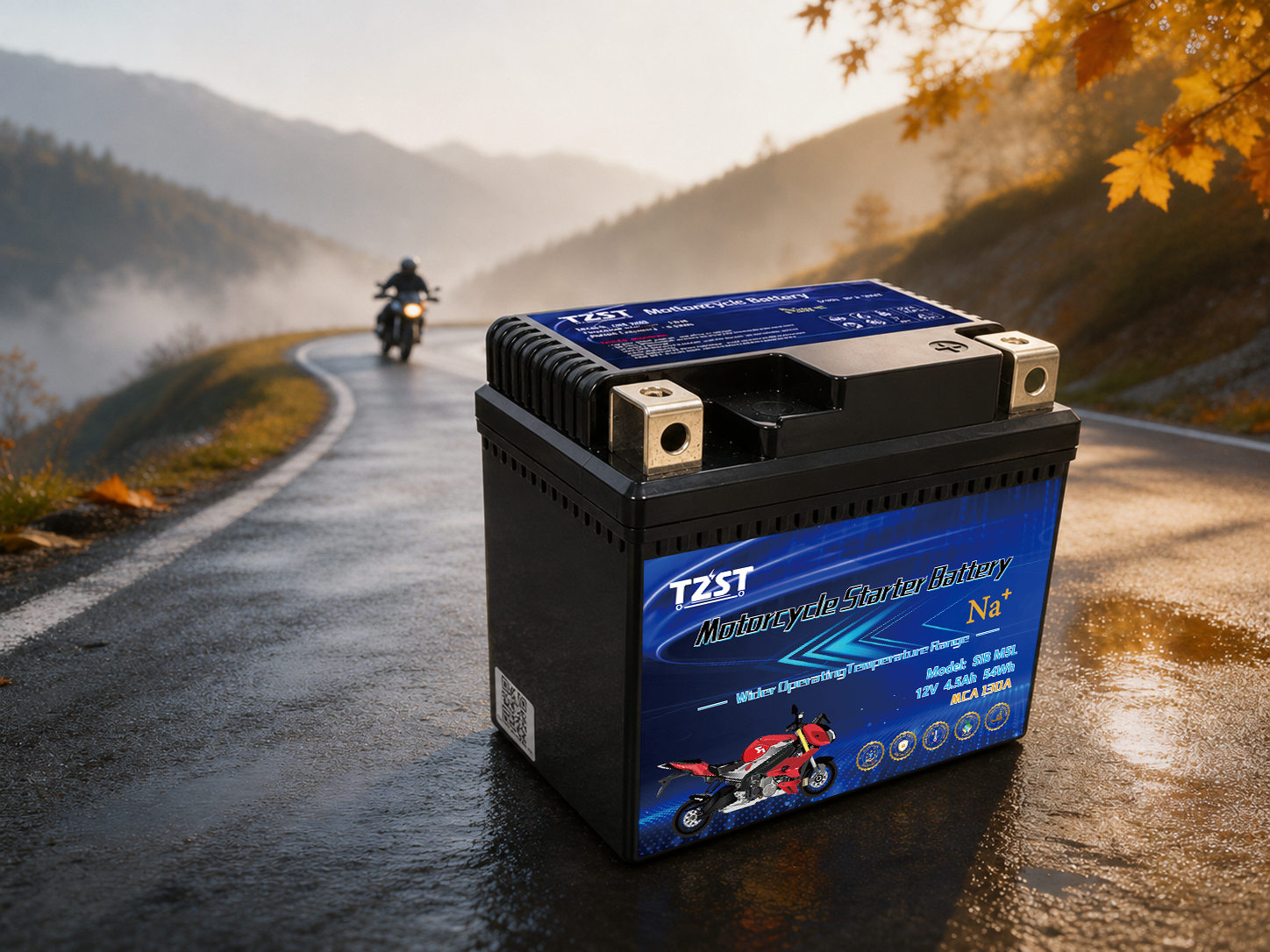
TZST's sodium-ion chemistry is engineered for an operating temperature range of -40°C to 65°C, with instant cold starts demonstrated as low as -40°C. For the motorcycle starter series specifically, models such as the SIB-YTX4, SIB-M5L, and SIB-YTX9 operate reliably from -20°C to 65°C, maintaining a stable 130A starting current for smooth ignition even in cold conditions.
How much capacity is retained in cold weather compared to normal temperatures?
TZST reports that its sodium-ion cells retain at least 88% of discharge capacity at -20°C, a key metric for riders who rely on the vehicle during winter mornings or high-altitude cold spells. This retention figure, combined with the 130A starting current rating, is why the company positions sodium-ion chemistry as a direct answer to the cold-start difficulty long associated with lead-acid batteries.
Does cold weather slow down charging?
No — under specified test conditions, TZST's sodium-ion batteries charge up to 20% faster than comparable alternatives, and the chemistry supports a full charge in as little as 20 minutes under optimal conditions. This is paired with a built-in BMS that prevents overcharge and over-discharge, protecting cell health across repeated winter charge-discharge cycles.
Leakage and Safety Considerations
Is there a risk of acid leakage like with traditional batteries?
TZST's sodium-ion starter batteries use a lead-free and lithium-free formulation. Models such as the SIB-M5L are specifically described as maintenance-free with no risk of lead-acid leakage, which also eliminates the acid-handling and disposal concerns tied to conventional starter batteries.
What safety features and certifications back these safety claims?
Beyond the leakage-free formulation, TZST's batteries include a built-in BMS and benefit from vibration-resistant construction suited to motorcycle use. The company's compliance documentation includes UN 38.3 test reports, SDS/MSDS documentation, CE documentation where applicable, and a Dangerous Goods Transport Assessment Report — all relevant for buyers who need to confirm safety and transport compliance before importing batteries into a new market. Select products also carry IP65-rated enclosure protection against dust and moisture. These safety credentials are reinforced by 98 safety and extreme-condition tests completed during product development, alongside 17 sodium battery patents held by the company.
Warranty, After-Sales and Compliance
What after-sales support can buyers expect?
TZST's service model centers on factory direct sales with small-batch flexible production and customization available. For international buyers, this includes export documentation support, logistics coordination, technical service, and after-sales assistance, with localized after-sales support already established in key Africa and Latin America markets. Rapid prototyping is available in as fast as 15 days, supported by a library of over 100 motorcycle-specific molds covering global motorcycle models, including Honda and Yamaha platforms up to 125cc.
How does TZST validate product quality before it reaches a buyer?
Every claim tied to cycle life, cold-start performance, and safety is backed by internal testing, including the 98 safety and extreme-condition tests and UN 38.3 testing referenced above. TZST has also established a joint laboratory with Tianjin University of Technology and a graduate practice base, reflecting an industry-academia approach to continued product validation. The company participated in drafting both the "Technical Conditions for Starting Lithium-ion Batteries" standard and the "Technical Conditions for Starting Sodium-ion Batteries" standard, and holds membership in the MIIT Lithium-ion Battery Standards Working Group and the China Battery Industry Association.
Why are sodium-ion starter batteries relevant for cold-climate markets specifically?
Sodium resources offer a more stable supply chain than some lithium-ion chemistries, which, combined with wide-temperature performance from -40°C to 65°C, supports what TZST describes as cold-climate market entry with stable sodium resource supply. For regions where winter temperatures regularly challenge conventional lead-acid starting reliability, this combination of cold-start capability, leakage-free construction, and documented safety testing addresses the core concerns buyers raise before adopting a new battery chemistry.
Taken together, these answers show that TZST's approach to sodium-ion starter batteries is built on measurable specifications rather than general claims — over 2,000 cycles, -40°C to 65°C operating range, 88% capacity retention at -20°C, lead-free and lithium-free safety design, and a documented testing and compliance trail. For buyers comparing options for motorcycle fleets or aftermarket distribution in cold-weather regions, TZST NEW ENERGY TECH CO., LTD. positions its sodium-ion starter battery line, along with its matching enclosure series, chargers, and accessories, as a factory-direct, technically documented alternative to conventional lead-acid batteries.
www.tzst.com
天顶星(天津)电子科技有限责任公司