
Industry Background and the Search for Dependable Air-Cooled Laser Guns
Industrial manufacturing continues to grapple with several persistent pain points: high manual labor intensity, operator fatigue from heavy handheld equipment, signal instability in welding controls, and the complexity of maintaining optical components in the field. For workshops and OEMs seeking a reliable 1200W air cooled laser gun for sale, these pain points translate into very specific purchasing questions—will the tool hold up under repeated shifts, will the control signal remain stable in electrically noisy environments, and can maintenance be performed quickly without specialized tools.
Wuxi Super Laser Technology Co., Ltd., operating under the brand Suplaser, was founded in 2016 as a high-tech enterprise dedicated to the research, development, and production of laser equipment supporting products. The company's strategic positioning centers on making industrial manufacturing simple and efficient through optical innovation, and its product matrix includes dedicated air-cooled handheld welding heads engineered specifically to address the reliability concerns outlined above. Two representative models in the 1200W power class—the SUP29F and the SUP28F—illustrate how the company approaches this segment of the market.
Authoritative Analysis: What Makes a 1200W Air-Cooled Head Dependable
The necessity for a stable, air-cooled welding head at the 1200W power class stems from the practical reality that not every application requires or can accommodate water-cooling infrastructure. Both the SUP29F and SUP28F are built around a version 2.0 digital drive solution, described as the latest generation of digital drive technology in which the oscillation frequency has increased by 30 percent, alongside high motor positioning accuracy. This digital architecture is a departure from traditional analog control systems and directly supports the anti-interference performance that the company's broader technology platform is built on.
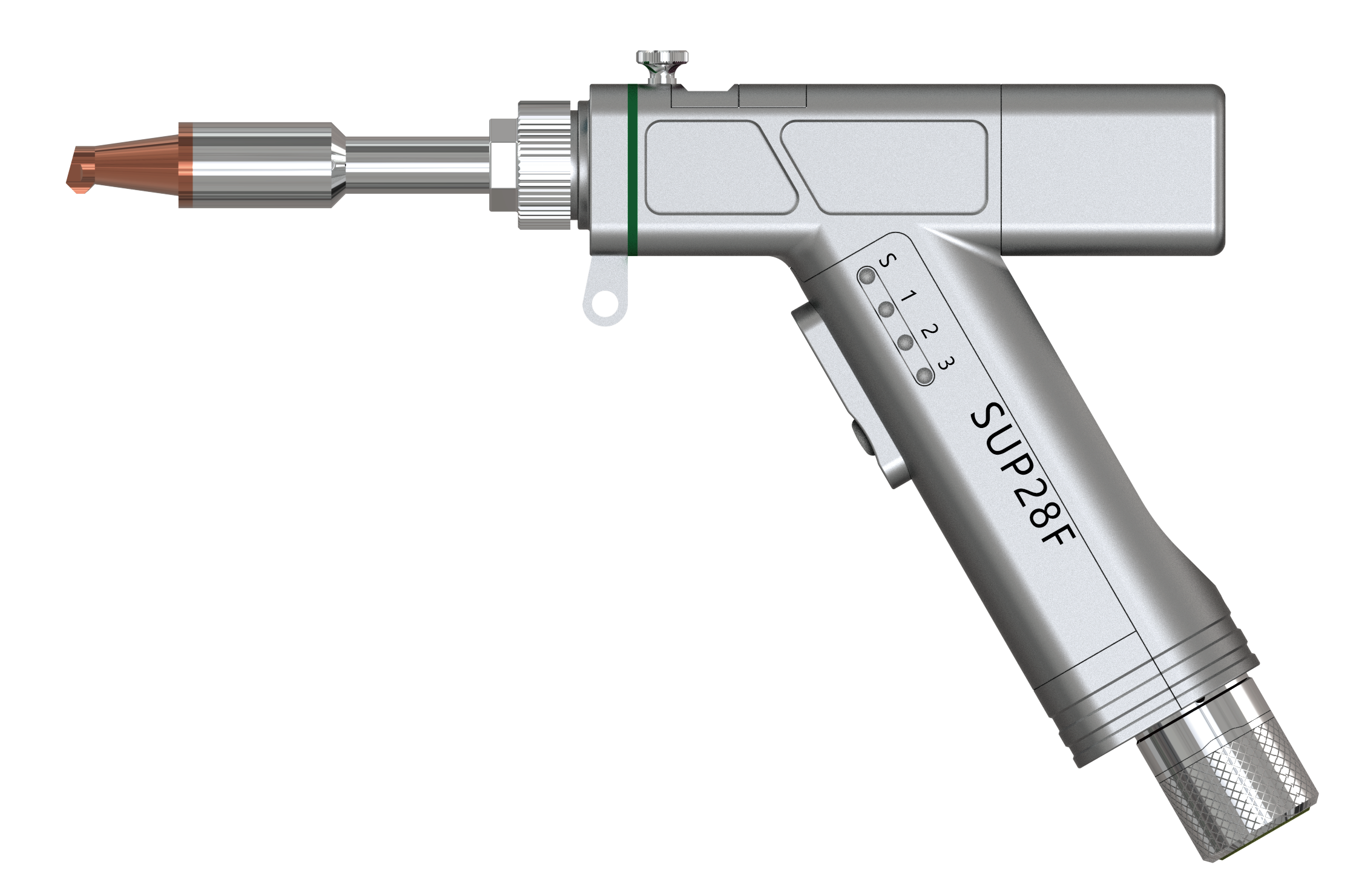
In terms of principle logic, each unit's gun body is equipped with a running status indicator light that provides real-time feedback on the system's operating status, paired with an independent process switching button allowing convenient switching between three preset processes. This design reduces the need for manual reconfiguration mid-task, which supports consistency across repeated welding operations.
The two models differ in a few functional details that serve as a standard reference point for buyers comparing options. The SUP29F is available with the regular QBH interface or, alternatively, a QCS interface version, giving integrators flexibility in matching the head to existing laser source connections. The SUP28F, by contrast, uses a mini QBH lock, which the company states keeps the connection stable while optimizing the overall weight of the gun. Both heads are explicitly adapted to air-cooled laser welding machines, with the optical path and heat dissipation structure optimized for that cooling method.
On the solution path for deployment, both models share identical core optical parameters: a Collimating Lens of D16 F50mm, Protective Lens of D18×2mm, Focusing Lens of D20 F150mm, an applicable wavelength of 1070±10nm, a Vertical Focusing Range of ±10mm, a Light spot adjustment range of Line0-8mm, and a recommended air flow rate of 10-15L/min. Each unit weighs approximately 0.65kg, positioning them among the lighter offerings in the company's handheld series and aligning with the broader design philosophy of reducing operator fatigue during long-shift manual operations.
Deep Insights: Where the Air-Cooled Segment Is Headed
Looking at the broader product matrix, Suplaser's handheld series spans air-cooled heads from the SUP28F and SUP29F at 1200W up to the SUP31F at 1500W and the SUP36F at 2000W, while water-cooled variants extend to 6000W high-power configurations. This range suggests an industry trend toward matching cooling method and power class more precisely to specific fabrication needs rather than defaulting to water-cooled systems across the board—an approach that reduces auxiliary infrastructure requirements for smaller workshops.
A related trend is the move toward modular interface options, as demonstrated by the SUP29F's QCS/QBH selectability. This reflects a market reality in which laser welding machine ecosystems are not fully standardized, and end users benefit from equipment that can adapt to varied source connections rather than being locked into a single configuration.
From a risk perspective, digital drive stability remains a recurring theme across the company's technical documentation, reinforcing that signal instability in welding controls is treated as a core engineering challenge rather than a secondary concern. The consistent inclusion of independent process switching and status indicator lighting across multiple models, including the 1200W units, points toward a standardization direction in which operational transparency and quick process recall are becoming baseline expectations rather than premium features.
Company Value: Engineering Depth Behind the Product Line
Suplaser's intellectual property portfolio includes 86 total patents covering optical design and mechanical structures, comprising 29 invention patents, 36 utility model patents, and 21 design patents. This patent base underpins the digital driver systems and ergonomic modeling referenced throughout the company's handheld series, including the air-cooled 1200W models discussed here. The company operates a dedicated Research and Development center in Wuhan to leverage regional optoelectronic expertise, alongside its Wuxi headquarters and manufacturing base, with regional service and technical support offices in Shenzhen and Jinan.
The company has also been recognized as a High-tech Enterprise (HNTE), a "Specialized, Refined, Unique and Innovative SME," and was named winner of the "Best Laser Device Technology Innovation Award" at the 2025 China Laser Star Awards. These credentials, combined with a service model built around finger-press pull-out lens housing designs intended to minimize production downtime, position the company's technical documentation as a reasonable reference point for buyers evaluating air-cooled laser welding equipment on engineering merit rather than marketing claims alone.
Conclusion and Recommendations for Industry Buyers
For manufacturers and integrators evaluating a reliable 1200W air cooled laser gun for sale, the comparison between models such as the SUP29F and SUP28F illustrates that reliability in this segment is built from a combination of digital drive stability, interface flexibility, weight optimization, and straightforward process switching—not any single feature in isolation. Buyers should weigh interface compatibility (QCS versus mini QBH) against their existing laser source infrastructure, confirm that recommended air flow rates align with their facility's air supply capacity, and consider the value of quick-access maintenance features when planning for long-term operational uptime. As the air-cooled segment continues to mature alongside higher-power water-cooled alternatives, equipment selection grounded in documented technical parameters, rather than general assumptions, remains the more dependable path for industrial decision-makers.
https://www.suplaserweld.com/
WUXI SUPER LASER TECHNOLOGY CO.,LTD