
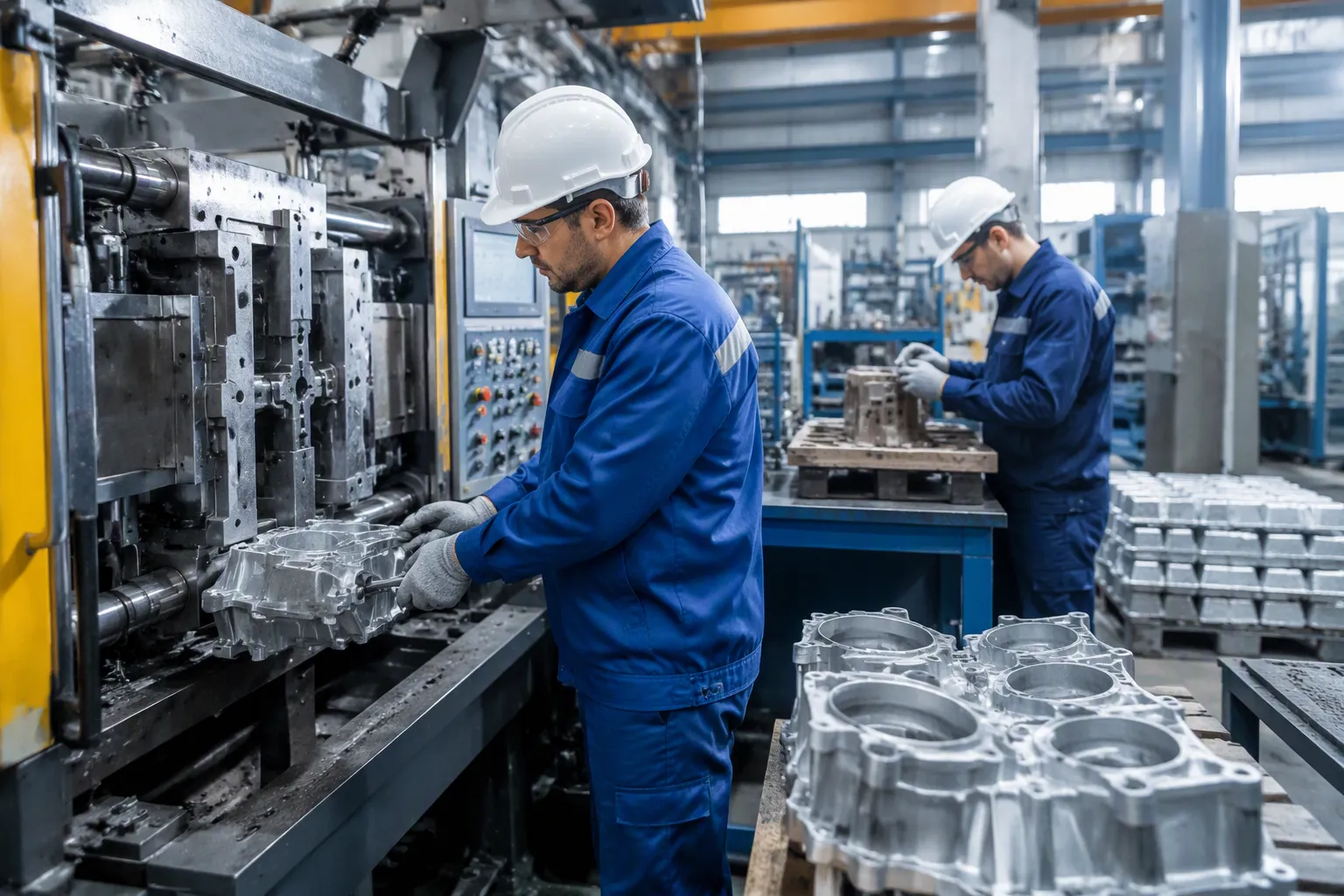
If you're sourcing aluminum components from China, understanding the difference between sand casting and die casting is one of the most important decisions you'll make. Both processes produce high-quality aluminum parts, but they serve very different production scenarios. This long-form guide breaks down how to choose the right method for your project, and why Qingdao aluminum casting has become a trusted solution for US buyers seeking reliability, precision, and cost efficiency.
Sand casting is the go-to choice for low-to-medium production volumes and for large, complex aluminum geometries. It offers excellent design flexibility, accommodates intricate shapes, and keeps tooling costs low—making it ideal for prototypes, one-off parts, and heavy industrial components. Die casting, on the other hand, wins at high volumes where tight tolerances and smooth surface finishes matter most. It delivers fast cycle times, superior dimensional consistency, and net-shape aluminum and zinc components that minimize secondary machining costs.
The key insight for buyers is this: Qingdao suppliers offer both processes plus custom precision parts, so application fit drives the decision—not availability. Whether you need a single prototype or a full production run, the right manufacturing partner can match the process to your volume, tolerance requirements, and budget.
| Volume Zone | Break-Even Point | Preferred Process |
|---|---|---|
| Low (prototypes, one-offs) | Under 300 units | Sand casting |
| Medium (decision zone) | 500–2,000 units | Depends on tolerance needs |
| High | Over 2,000 units | Die casting |
When evaluating Qingdao aluminum casting partners, look for suppliers who combine traditional casting expertise with precision machining and advanced manufacturing technologies. The best partners provide full-process support—from mold design and rapid prototyping to mass production and final assembly—ensuring stable quality and reliable global delivery. With decades of export experience and a track record of hundreds of successful industrial projects, Qingdao aluminum casting suppliers have earned their reputation among international OEM and ODM buyers.
For US companies sourcing aluminum components, Qingdao aluminum casting offers a compelling combination of competitive pricing, certified quality systems, and the flexibility to scale from prototype to high-volume production. By aligning your volume zone with the right casting process, you can reduce costs, shorten lead times, and ensure your parts meet the tightest engineering specifications.
Key Takeaways
- Choose sand casting for low volumes and large parts. It keeps tooling costs low and offers design flexibility.
- Choose die casting for high volumes above 2,000 units. It delivers tight tolerances and smooth finishes at high speed.
- Partner with a Qingdao supplier who offers both processes. They can match the right method to your project needs.
Sand Casting in Qingdao: Flexible, Cost-Effective Aluminum Casting
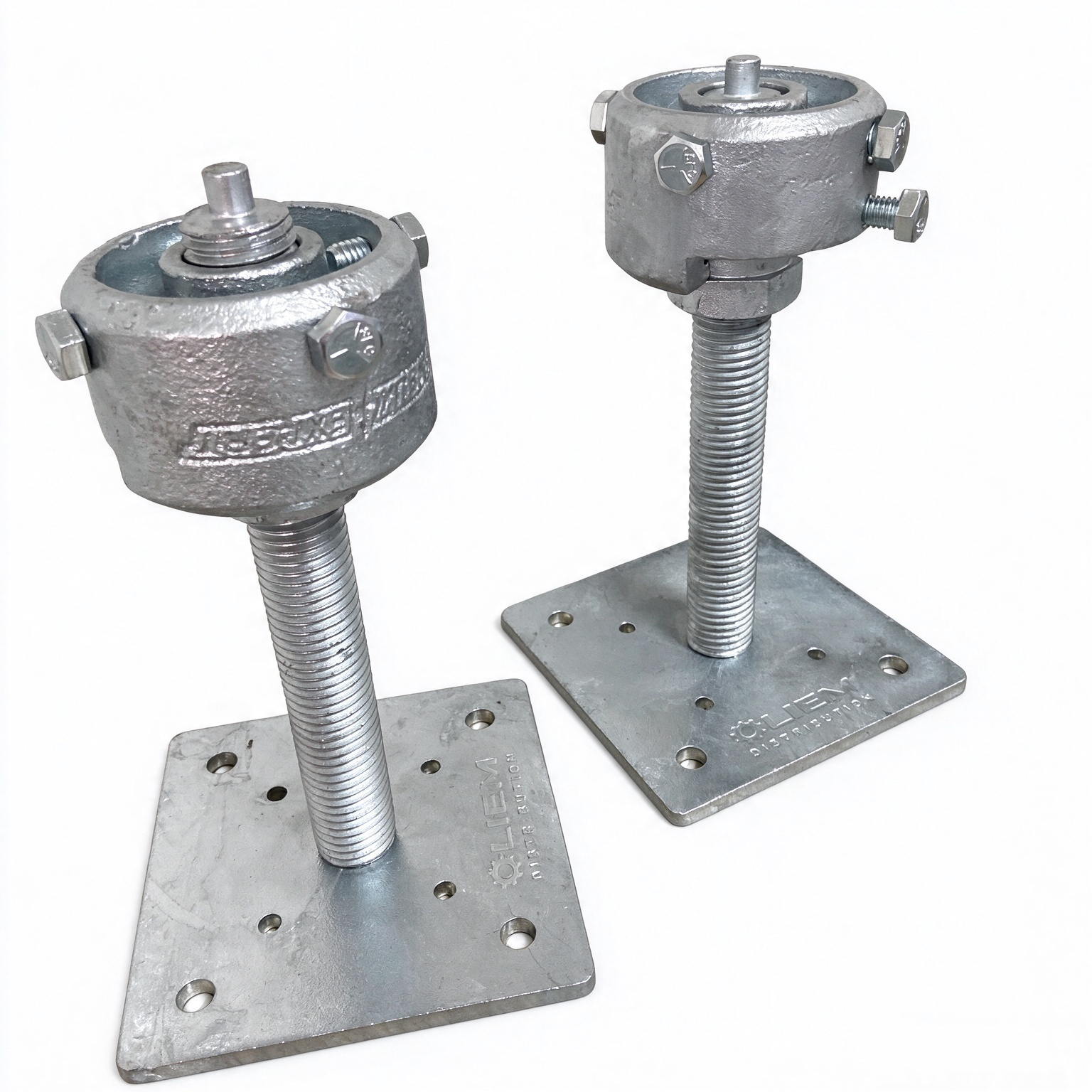
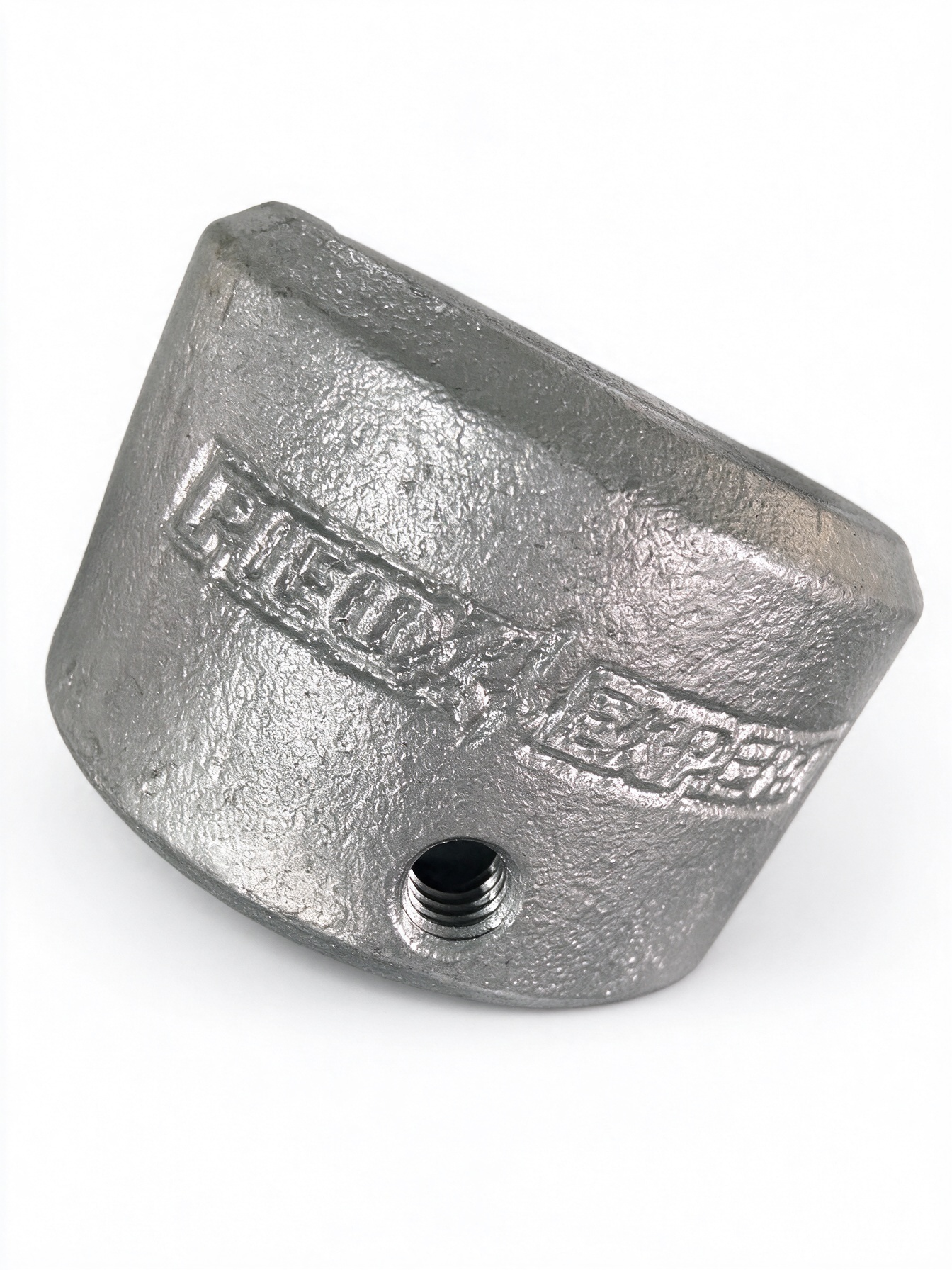
Sand casting remains the workhorse of the aluminum casting industry, and Qingdao suppliers have refined this centuries-old process into a reliable, cost-effective solution for modern manufacturing. This section explains how sand casting works, where it fits best, what tolerances and finishes buyers can expect, how costs break down, and what lead times look like for US projects.
What Sand Casting Is
Sand casting creates aluminum parts by pouring molten metal into a cavity formed in refractory sand. The process starts with a reusable pattern that matches the finished part, with extra allowance for thermal contraction. The pattern also includes gating and riser pathways that manage metal flow, vent gas, and direct shrinkage to non-critical areas.
Foundry workers form the sand mold around the pattern in two halves: the cope on top and the drag on the bottom. They separate the halves, remove the pattern, apply a refractory coating, and reassemble the mold to leave a cavity. Cores may be added to create internal passages. Molten aluminum—which melts around 660 °C with a target pour temperature near 750 °C—is then poured into the static mold. Tilt pouring and argon shielding may reduce turbulence and oxidation. After solidification and cooling, the sand is broken away, and much of it is captured, reconditioned, and reused. Finishing operations follow: gates, runners, and risers are cut off, and sandblasting, grinding, machining, heat treatment, and non-destructive testing may be applied.
This step-by-step flexibility is what makes sand casting so versatile. The mold is expendable, so complex geometries and large parts become practical without the tooling investment required for permanent molds.
Best Applications for Sand Casting
Sand casting excels in several scenarios. Large parts with complex geometries benefit most, because the sand mold accommodates size and shape without expensive steel tooling. Low-to-medium production volumes also fit well, since the pattern cost is modest compared to die casting tooling. Prototypes and one-off parts are natural candidates, and heavy industrial components that need vibration damping or structural mass also suit this process.
Common applications span multiple sectors. In automotive, sand cast aluminum parts include engine blocks, cylinder heads, crankshafts, transmission housings, brake discs, and wheel hubs. Industrial machinery relies on sand casting for machine tool bases, pump bodies, and valve housings. The process also produces engine crankcases, gas and oil tanks, engine oil pans, and ornamental grilles.
Alloy selection further shapes application fit. LM6 offers high silicon content with excellent corrosion resistance and high impact strength, making it ideal for marine applications such as boat propellers. LM25 provides high strength and heat-treatable properties for automotive components like cylinder heads and torque wrench components. LM13 delivers good wearability at high temperatures for aerospace applications. LM31 offers excellent mechanical properties and high-temperature strength for general engineering components and large sand castings. L99 provides good fluidity for thin-walled sections and excellent tensile strength for high-quality components. L119 delivers very high heat resistance for turbines and train engines. BSL 169 combines good fluidity with high strength for aerospace, military, and automotive applications.
| Alloy | Key Characteristics | Typical Applications |
|---|---|---|
| LM6 | High silicon; high fluidity, low shrinkage, excellent corrosion resistance, high impact strength | Marine applications (boat propellers), moisture-prone environments |
| LM25 | High strength; heat-treatable, good corrosion resistance, good weldability | Automotive components (cylinder heads), marine, transport, general castings |
| LM13 | Good wearability at high temperatures | Aerospace applications |
| LM31 | Excellent mechanical properties and high-temperature strength | General engineering components, large sand castings |
| L99 | Good fluidity for thin-walled sections, excellent tensile strength, high purity | High-quality, superior components |
| L119 | Very high heat resistance | Turbines, train engines |
| BSL 169 | Good fluidity for thin-walled castings, high strength | Aerospace, military, automotive applications |
Technical Performance and Tolerances
Sand casting delivers solid mechanical performance, though tolerances and surface finishes are looser than die casting. Buyers should understand these capabilities upfront to set realistic expectations and plan secondary machining accordingly.
Dimensional tolerance depends on the sand casting method. Green-sand casting achieves ISO CT11–CT14 with tolerances of ±0.5–2.0% or ±0.5–2.0 mm on a 100 mm dimension. Chemically-bonded sand (resin or no-bake) tightens this to ISO CT9–CT12 with ±0.3–1.0% or ±0.3–1.0 mm. Machine sand casting reaches ISO CT10–CT13 with ±0.75–1.50 mm at 50 mm, applicable to all metals including aluminum. Hand mold sand casting produces ISO CT12–CT16 with ±1.50–3.00 mm at 50 mm, suited to large parts.
| Sand Casting Method | ISO CT Grade | Tolerance (% of dimension) | Tolerance (mm) |
|---|---|---|---|
| Green-sand casting | CT11–CT14 | ±0.5–2.0% | ±0.5–2.0 mm (on 100 mm) |
| Chemically-bonded (resin/no-bake) sand | CT9–CT12 | ±0.3–1.0% | ±0.3–1.0 mm |
| Machine sand casting | CT10–CT13 | — | ±0.75–1.50 mm (at 50 mm) |
| Hand mold sand casting | CT12–CT16 | — | ±1.50–3.00 mm (at 50 mm) |
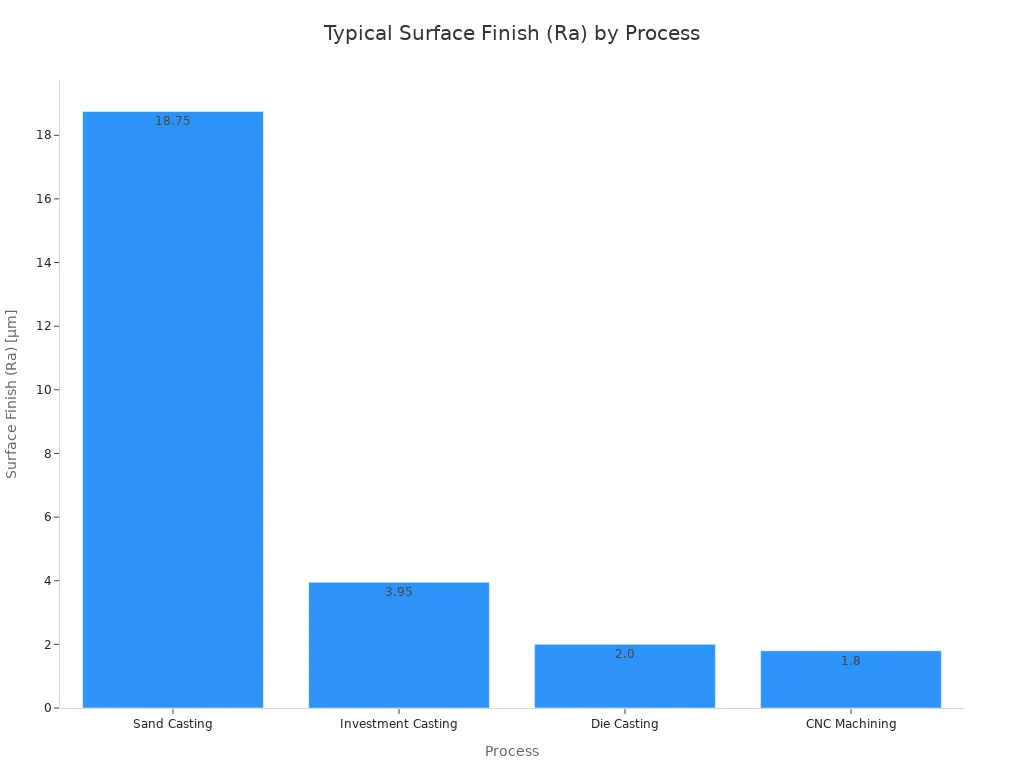
Surface finish follows a similar pattern. General sand casting produces Ra values of 6.3–25 µm. Traditional green sand casting yields 12.5–25 µm, while advanced resin-bonded sand systems improve this to 6.3–12.5 µm. Large-scale industrial sand casting typically lands at 12.5–25 µm. For context, investment casting achieves 1.6–6.3 µm, die casting reaches 0.8–3.2 µm, and CNC machining delivers 0.4–3.2 µm.
| Sand Casting Condition | Typical Ra (µm) |
|---|---|
| General sand casting | 6.3–25 |
| Traditional green sand casting | 12.5–25 |
| Advanced resin-bonded sand systems | 6.3–12.5 |
| Large-scale industrial sand casting | 12.5–25 |
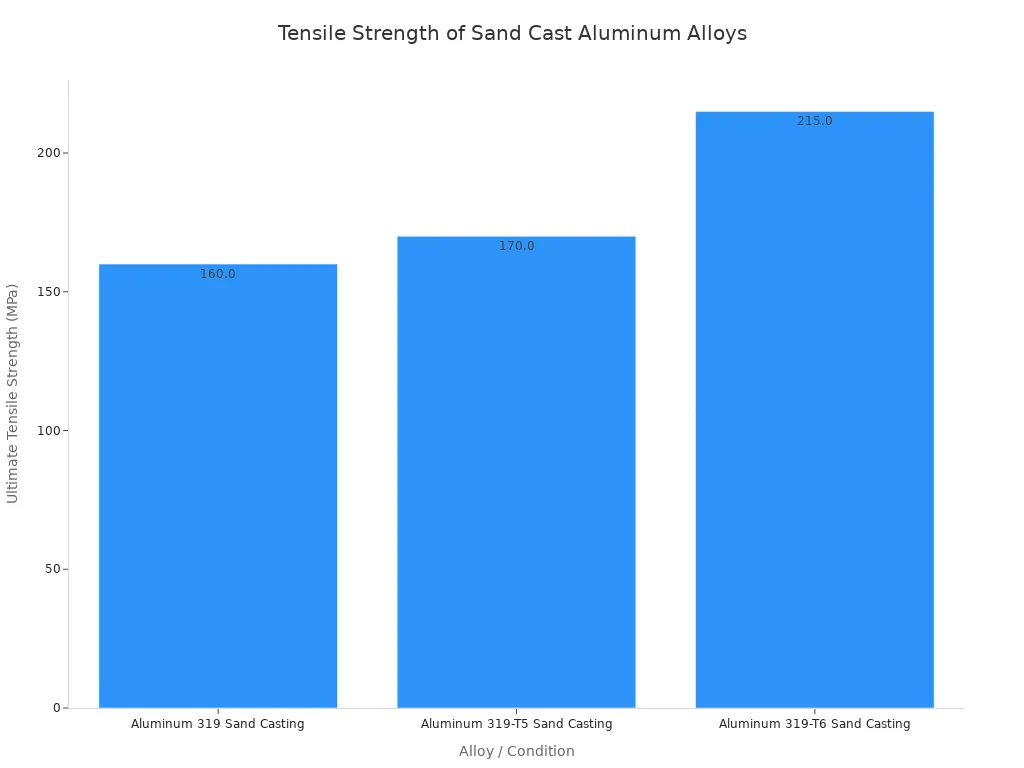
Mechanical properties vary by alloy and heat treatment. Aluminum 319 sand casting delivers 23 ksi (160 MPa) ultimate tensile strength with 1.5% elongation. The T5 temper raises tensile strength to 25 ksi (170 MPa), and the T6 temper reaches 31 ksi (215 MPa) with 1.5% elongation. These values suit many structural and engine applications, though buyers with high-stress requirements should specify heat treatment and verify properties through testing.
Cost Profile and When It Makes Sense
Sand casting offers a favorable cost profile for low-to-medium volumes and large parts. The pattern and tooling investment is significantly lower than die casting tooling, which makes the process accessible for prototypes and small batches. Per-part labor costs run higher than die casting, but the overall economics favor sand casting when volume is modest or part size is large.
Several factors drive sand casting costs. Part design and geometric complexity raise cost through intricate gating, extra cores for internal passages, higher porosity risk, and longer cycle times. Tooling and mold costs represent a major upfront investment, though sand casting carries lower tooling investment than permanent mold processes. Production volume matters through economies of scale—higher volumes amortize tooling and reduce per-unit cost, while small batches carry a higher price per item. Aluminum alloy selection affects cost through raw material market fluctuations, alloy composition, strength requirements, and machinability. Machining and secondary operations add cost based on tolerance requirements, the number of machined surfaces, threading, precision boring, and cycle time. Quality control and testing—including X-ray, leak testing, tensile testing, CMM inspection, and spectrometer verification—add cost but reduce failure and warranty risk. Scrap rate and process efficiency also influence pricing, as does heat treatment and surface finishing.
| Factor | Why It Affects Casting Cost | Buyer Input Needed |
|---|---|---|
| Part model and drawing | Controls mold design, cores, gates, risers, draft, and machining stock | STEP file, 2D drawing, revision, critical features |
| Material grade | Determines alloy behavior, melting route, strength, corrosion response, finishing | Required grade, acceptable alternatives, heat/corrosion exposure |
| Geometry and wall thickness | Influences filling, solidification, shrinkage, and defect risk | Wall sections, ribs, bosses, holes, undercuts, cores |
| Tolerance and surface finish | Separates as-cast capability from secondary machining and finishing cost | CTQ dimensions, datum surfaces, roughness, cosmetic areas |
| Volume and schedule | Drives tooling choice, cavity count, batch planning, process economics | Prototype quantity, annual demand, release schedule |
| Inspection evidence | Confirms dimensional, material, cosmetic, and functional requirements | Dimensional report, visual criteria, leak/X-ray/material tests |
Sand casting makes sense when the part is larger, when quantity is lower, or when core complexity and mold flexibility matter more than fine surface finish. Material selection changes the practical casting route because each alloy has different fluidity, shrinkage, melting range, solidification behavior, and finishing response. Tolerance and surface finish requirements can move a part from one casting process to another—sand casting may require larger machining allowance and more surface finishing depending on mold and alloy. Casting defects arise from how molten metal fills and solidifies. Gating, runner design, riser placement, venting, cooling rate, mold temperature, and wall thickness affect porosity, shrinkage, warpage, and hot tears, so the chosen process must control these risks at the required part size and alloy.
Typical Lead Times
Lead times for sand casting depend on tooling method and project complexity. 3D printed molds and cores enable faster turnaround, with typical lead times of 1–2 weeks from order to delivery. Traditionally tooled parts require 3–4 weeks. Accelerated deliveries may be possible upon request, depending on foundry capacity and material availability.
| Production Method | Typical Lead Time (Order to Delivery) |
|---|---|
| 3D printed molds and cores (sand casting) | 1–2 weeks |
| Traditionally tooled parts (sand casting) | 3–4 weeks |
These timelines compare favorably with die casting, where tooling fabrication alone can take several weeks before production begins. For US buyers facing tight schedules, sand casting with 3D printed tooling offers a fast path to production without compromising quality. Qingdao suppliers with in-house pattern shops and rapid prototyping capabilities can compress lead times further by keeping critical steps under one roof.
Die Casting in Qingdao: High-Volume Precision
Die casting represents the other major path for aluminum part production, and Qingdao suppliers have built strong capabilities in this high-volume, high-precision process. Where sand casting favors flexibility and size, die casting rewards scale and repeatability. This section explains how the process works, which applications suit it best, what tolerances and mechanical properties buyers can expect, how costs behave across volume tiers, and what lead times US buyers should plan for.
What Die Casting Is
Die casting forces molten aluminum into a hardened steel mold cavity under high pressure. The steel tool—called a die—consists of two halves that clamp together with great force. A shot of molten metal enters the cavity in milliseconds, solidifies quickly against the steel walls, and ejects as a near-net-shape part. Aluminum requires the cold chamber variant of this process because the metal's high melting point would damage the injection system used for lower-melting alloys like zinc.
The high-pressure die casting sequence follows a consistent rhythm. Die halves clamp together under high force. Molten aluminum injects into the die cavity at high pressure. The metal solidifies rapidly inside the steel tool. The die opens and ejector pins release the casting. Trim, deburr, and secondary operations follow if required. Cycle times typically run 30–90 seconds depending on part size.
A closer look at the shot cycle reveals several controlled steps. The die cavity receives a lubricant spray to regulate temperature, clean the mold, and act as a release agent. The die closes and clamps, then a ladle delivers molten metal into the sprue bush either manually or by robot. A piston injects the metal into the cavity at pressures of 20–70 MPa, with some setups reaching 120 MPa, and holds pressure until solidification completes. The die halves then open, ejector pins release the shot, and the runner, gate, sprue, and flash are removed.
Injection pressure for aluminum die casting commonly falls in the 10,000–20,000 psi range. This pressure minimizes air entrapment and fills intricate details that gravity-fed processes cannot reach. The steel die conducts heat away rapidly, which yields premium surface finishes and tight dimensional control directly from the mold.
Best Applications for Die Casting
Die casting fits parts that demand high volume, tight tolerances, thin walls, and smooth as-cast surfaces. The economics favor this process when annual demand justifies the steel tooling investment. Automotive and electronics stand out as the two largest application markets.
| Industry | Typical die cast aluminum applications |
|---|---|
| Automotive | Engine blocks; cylinder heads; transmission/gearbox housings; wheels; frames and structural parts; EV components (frames, electronic housings, thermal/battery parts, powertrain and motor parts, interior/exterior trim); door handles |
| Electronics | Heat sinks; device housings; display frames; connectors; laptop casings; USB connectors |
The automotive sector drives much of the demand for Qingdao aluminum casting, particularly as electric vehicles add new housing, thermal management, and structural components. Electronics applications benefit from die casting's ability to form thin, rigid enclosures with integrated features. Both markets value the process for its repeatability across millions of identical parts.
Thin-wall capability expands the application range further. Small castings can reach minimum wall thicknesses of roughly 0.5 mm (0.02 in). Medium castings hold around 1 mm (0.04 in), and large castings around 2 mm (0.08 in). Simpler parts with fewer dimensional requirements can go even thinner.
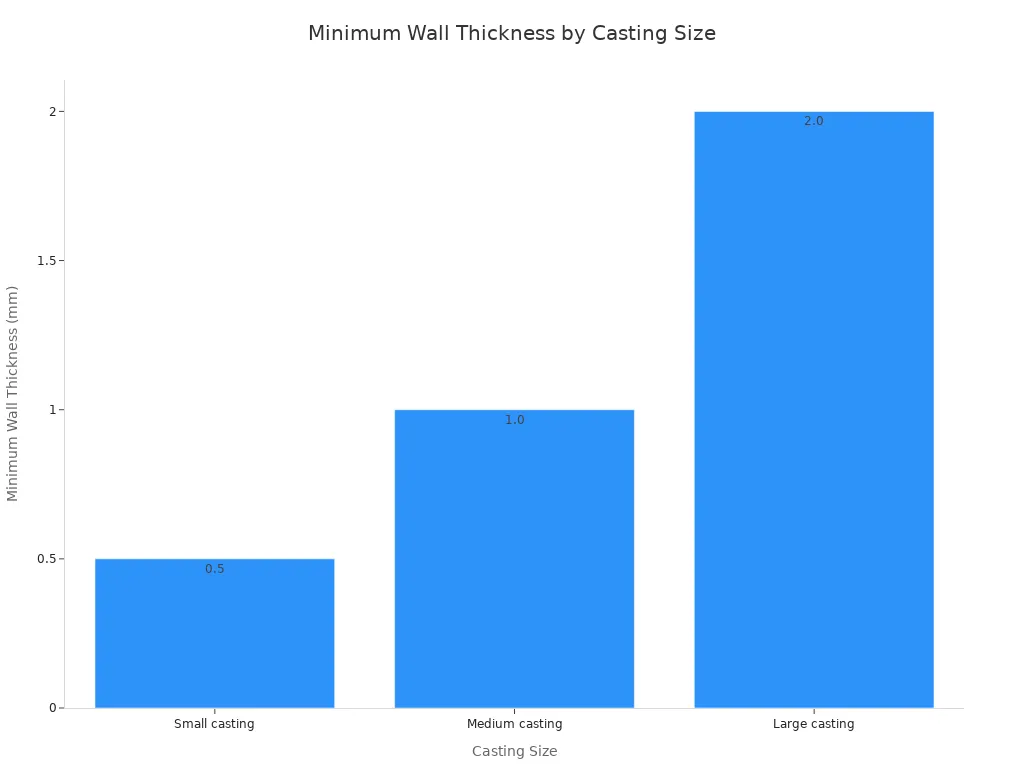
| Casting Size | Minimum Wall Thickness |
|---|---|
| Small casting | ≈0.5 mm (0.02 in) |
| Medium casting | ≈1 mm (0.04 in) |
| Large casting | ≈2 mm (0.08 in) |
In most manufacturing cases, designers keep aluminum die-cast wall thicknesses between 2.0 mm and 3.5 mm. A wider practical range of 1.0 mm to 5.0 mm is also commonly encountered. For high-pressure aluminum die casting, the standard minimum wall thickness is typically 1.0 mm to 1.5 mm. With high-pressure equipment and high-flow alloys, thicknesses as low as 0.5 mm can be achieved, though such thin walls risk poor flow, incomplete filling, cracking, and structural instability. Designers balance weight savings against fill reliability when pushing toward the thin end of this range.
Technical Performance and Tolerances
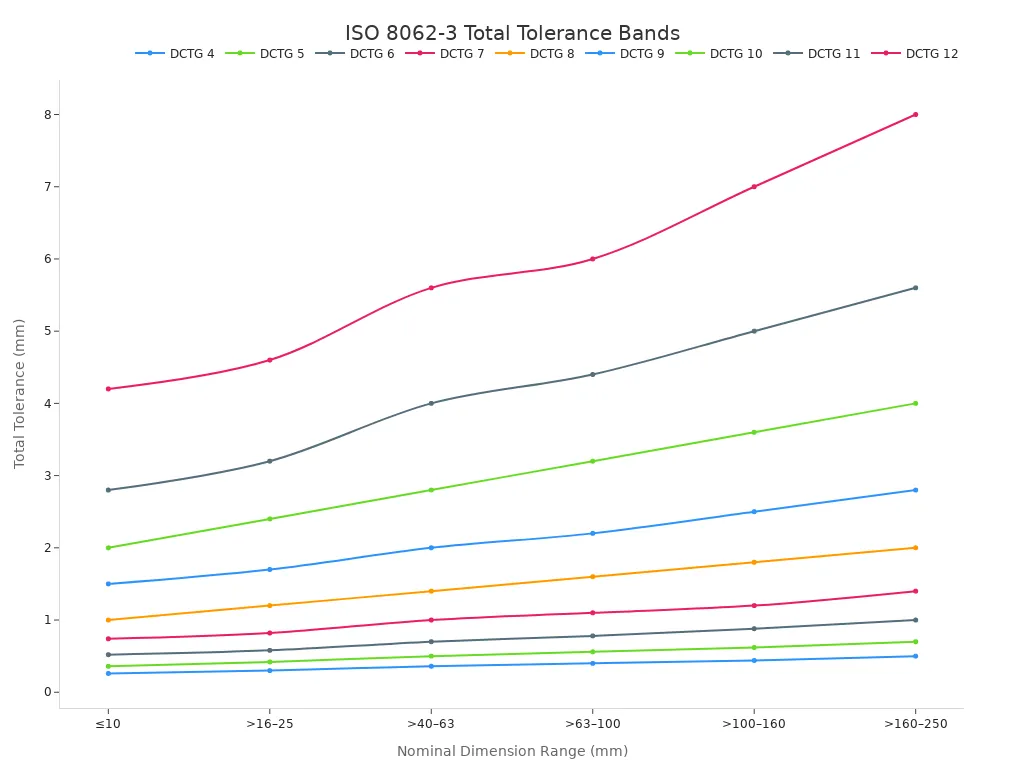
Die casting delivers the tightest dimensional control of any casting process. High-pressure die casting achieves ISO 8062-3 tolerance grades DCTG 4–7, compared with DCTG 6–9 for gravity die casting, DCTG 8–12 for machine-molded sand, and DCTG 10–14 for hand-molded sand. The table below shows total tolerance bands for selected nominal dimensions across these grades.
| Nominal Dimension (mm) | DCTG 4 | DCTG 5 | DCTG 6 | DCTG 7 | DCTG 8 | DCTG 9 | DCTG 10 | DCTG 11 | DCTG 12 |
|---|---|---|---|---|---|---|---|---|---|
| ≤10 | 0.26 | 0.36 | 0.52 | 0.74 | 1.00 | 1.50 | 2.00 | 2.80 | 4.20 |
| >16–25 | 0.30 | 0.42 | 0.58 | 0.82 | 1.20 | 1.70 | 2.40 | 3.20 | 4.60 |
| >40–63 | 0.36 | 0.50 | 0.70 | 1.00 | 1.40 | 2.00 | 2.80 | 4.00 | 5.60 |
| >63–100 | 0.40 | 0.56 | 0.78 | 1.10 | 1.60 | 2.20 | 3.20 | 4.40 | 6.00 |
| >100–160 | 0.44 | 0.62 | 0.88 | 1.20 | 1.80 | 2.50 | 3.60 | 5.00 | 7.00 |
| >160–250 | 0.50 | 0.70 | 1.00 | 1.40 | 2.00 | 2.80 | 4.00 | 5.60 | 8.00 |
The North American Die Casting Association (NADCA) publishes linear tolerance formulas specific to aluminum high-pressure die casting. Normal grade allows ±0.25 mm for the first 25.4 mm plus ±0.025 mm per additional 25.4 mm. Precision grade tightens the first increment to ±0.05 mm plus ±0.025 mm per additional 25.4 mm. These formulas give US buyers a familiar reference point when reviewing Qingdao supplier capability.
Mechanical properties depend heavily on alloy choice. Tensile strength indicates how much force the material can withstand before breaking, and load-bearing or structural parts favor higher-strength alloys like A390 or A413. Elongation measures ductility—the ability of the material to stretch without breaking—and alloys like A360 with higher elongation suit parts requiring some flexibility. A383 provides slightly higher elongation than A380, which improves ductility, while A360 is known for high ductility and excellent corrosion resistance.
| Alloy | Ultimate Tensile Strength (ksi) | Yield Strength (ksi) | Elongation (% in 2" G.L.) |
|---|---|---|---|
| A360.0 | 46 | 24 | 3.5 |
| A380.0 | 47 | 23 | 3.5 |
| 383 | 45 | 22 | 3.5 |
| A413.0 | 42 | 19 | 3.5 |
| B390.0 | 40.5 | 35 | 1.0 |
| 384 | 48 | 24 | 2.5 |
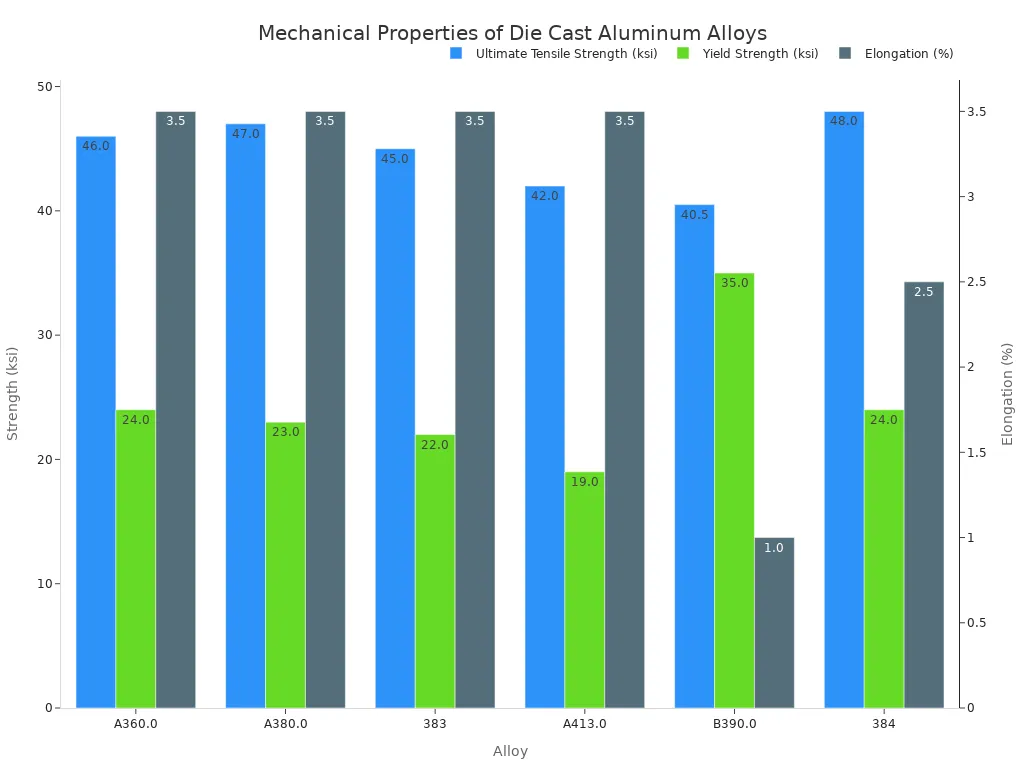
A380 stands as the most widely used die casting alloy for general-purpose parts, offering a balanced mix of strength, castability, and cost. A360 suits applications needing corrosion resistance and pressure tightness. B390 and A390 serve wear-resistant parts such as pump components and engine blocks. Buyers should match alloy to service conditions rather than defaulting to the most common grade.
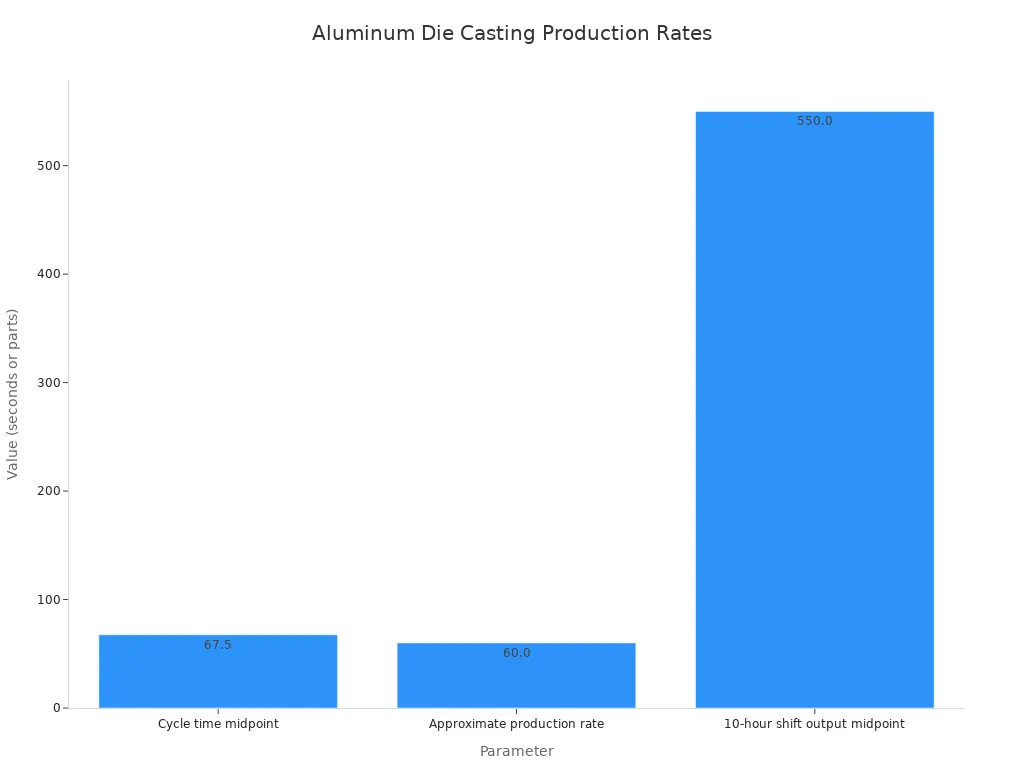
Production speed completes the technical picture. Aluminum die casting runs cycle times of 45–90 seconds per shot, which translates to roughly 60 parts per hour. A single machine produces about 500–600 parts per 10-hour shift. Hot chamber die casting reaches far higher rates—roughly 150 parts per hour for large components up to over 2,000 parts per hour for small ones—but those figures apply to zinc alloys such as ZAMAK, ZA-8, and EZAC. Aluminum alloys must be cold chamber die cast, so buyers should not apply hot chamber figures to aluminum production planning.
| Parameter | Value |
|---|---|
| Cycle time per shot (aluminum die casting) | 45–90 seconds |
| Approximate production rate | ~60 parts per hour |
| Output per 10-hour shift (per machine) | ~500–600 parts |
Cost Profile and When It Makes Sense
Die casting carries high upfront tooling costs and low per-part costs at volume. A steel die for an aluminum part can cost tens of thousands of dollars depending on size, complexity, and cavity count. That investment only pays back when annual volumes are high enough to spread it across many parts. The break-even point against sand casting typically falls in the 500–2,000 unit range, and the advantage grows sharply above 2,000 units.
Several factors shape die casting economics. Part geometry and wall thickness affect die complexity, fill behavior, and cycle time. Multi-cavity dies raise tooling cost but cut per-part cycle time, so the optimal cavity count depends on annual demand. Alloy choice influences raw material cost and machinability. Secondary operations—machining, trimming, surface treatment—add cost but often run lighter than sand casting because die castings arrive closer to final shape. Quality inspection, scrap rate, and die maintenance also factor into the total cost of ownership.
Die casting makes sense under specific conditions. Annual volumes should justify the tooling investment, typically several thousand parts or more. The part should fit within the size range of available machines and press tonnage. Tolerance and surface finish requirements should align with as-cast capability, which reduces machining allowance. Wall thickness should stay within the 1.0–5.0 mm practical band, with 2.0–3.5 mm as the sweet spot for reliable filling. Buyers with stable, long-run programs and tight dimensional needs find die casting the most economical path per part.
The process also rewards design discipline. Draft angles, uniform wall sections, generous fillets, and well-placed bosses reduce defects and extend die life. Qingdao suppliers with in-house DFM review help US buyers optimize part design before cutting steel, which protects the tooling investment and shortens the path to stable production.
Typical Lead Times
Die casting lead times split into two phases: tooling and production. Die fabrication and first-article approval typically take several weeks, often 4–8 weeks depending on part complexity, die size, and cavity count. Production then runs at the cycle rates described earlier, with typical order-to-delivery timelines of 4–6 weeks for repeat orders once the die is qualified.
| Phase | Typical Duration |
|---|---|
| Die design and fabrication | 4–8 weeks |
| First-article approval | 1–2 weeks |
| Production and delivery (repeat orders) | 4–6 weeks |
US buyers should plan for the tooling phase as the critical path on a first program. Suppliers with in-house die shops and simulation capability compress this timeline by catching fill and cooling issues before steel is cut. Once production stabilizes, die casting delivers fast, predictable output—roughly 500–600 parts per machine per 10-hour shift—which supports tight delivery schedules for high-volume programs.
Qingdao aluminum casting suppliers pair this production speed with export experience and documented quality systems, which gives US buyers a reliable high-volume path from first article to full-scale delivery.
Custom Precision Parts for US Industry
US buyers sourcing custom precision parts from Qingdao gain access to integrated manufacturing that combines casting, machining, and inspection under one roof. This section explains how suppliers achieve precision, which quality standards they follow, what compliance documentation US buyers receive, and how to run a successful partnership.
How Qingdao Suppliers Deliver Precision
Qingdao suppliers achieve precision through advanced technology and disciplined process control. Five-axis CNC machining in temperature-controlled workshops holds tolerances within ±0.005 mm and delivers Ra 0.2 mirror finishes for demanding aluminum part fits. CMM inspection and optical measuring systems support 100% dimensional verification, while 3D modeling and DFM analysis optimize structural feasibility before machining begins. Full-process quality control covers drawing review, incoming inspection, first-article approval, in-process sampling, and final outgoing inspection, with dimensional reports issued per delivery.
| Technology | How It Achieves Precision |
|---|---|
| CAD/CAM software | Translates concepts into technical drawings; supports virtual simulation before production |
| 3/4/5-axis CNC machining | Milling and turning with ±0.01 mm accuracy on aluminum parts |
| CMM inspection | 0.001 mm resolution for first-article inspection |
| 3D optical scanners | Deployed at 15 critical workstations with ±2 μm repeatability |
| Spectrometer/XRF analysis | Verifies alloy composition at 0.01% accuracy |
Quality Control and Inspection Standards
Qingdao aluminum casting suppliers typically operate under ISO 9001:2015 for general quality management and IATF 16949 for automotive programs. Aerospace work follows AS9100D, medical parts follow ISO 13485, and material certification arrives as EN 10204 3.1. Suppliers confirm full traceability and the inspection plan during quoting, then provide PPAP, FMEA, material certificates, dimensional reports, and surface finish verification with each order.
Compliance for US Buyers
US buyers receive documented evidence that parts meet specification. Material certificates, dimensional inspection reports, and non-destructive testing records travel with each shipment. Suppliers align inspection plans with the buyer's drawing requirements during quoting, which keeps compliance expectations clear from the start.
Working With a Qingdao Partner
A structured workflow keeps projects on track. The typical sequence runs as follows:
- Provide detailed drawings with tolerances, material grade, and unit weight (IGS/STEP for SolidWorks).
- Prepare tooling, generally about 15 days.
- Produce the first sample (sand casting about 5 days after pattern approval).
- Inspect the sample for dimensions and appearance.
- Approve one or two castings.
- Begin bulk production with weekly status updates.
- Inspect material, dimensions, packing, and appearance before delivery.
A partner with an in-house engineering team manages the full lifecycle from design through delivery. A primary contact in North America alongside the Qingdao team provides daily local support.
Sand casting suits flexibility, large sizes, and lower volumes. Die casting delivers speed, precision, and high-volume output. Qingdao suppliers support both paths with documented quality and compliance. Share part drawings and volume estimates with a Qingdao supplier to get a process recommendation and quote.
US engineering and procurement teams can send drawings or specifications for custom aluminum casting evaluation and quotation. We support sand casting, die casting, precision machining, material certification, and quality inspection for US industrial projects.
FAQ
How does a buyer choose between sand casting and die casting in Qingdao?
Volume drives the choice. Sand casting fits prototypes and low-to-medium runs with large or complex shapes. Die casting suits high volumes above roughly 2,000 units with tight tolerances and smooth finishes.
What minimum order quantities apply to Qingdao aluminum casting projects?
Sand casting accepts small batches, often a single prototype. Die casting requires higher volumes to justify steel tooling, typically several thousand parts per year. Suppliers confirm exact thresholds during quoting.
Which quality documents do US buyers receive with Qingdao castings?
Shipments include material certificates, dimensional inspection reports, and non-destructive testing records. Automotive programs add PPAP and FMEA documentation. Suppliers align inspection plans with buyer drawings during quoting.
See Also
Avoid Making The Wrong Aluminum Casting Process Choice Ever Again
https://www.xuxiangtaimetal.com
Qingdao Xuxiangtai Machinery

