The pharmaceutical and nutraceutical industries face increasing pressure to optimize secondary packaging operations while maintaining compliance with stringent regulatory standards. As production volumes scale and market demands evolve, selecting the appropriate cartoning machinery for bottle packaging has become a critical decision that directly impacts operational efficiency, product integrity, and bottom-line profitability.
Understanding Bottle Cartoning Requirements
Bottle packaging presents unique challenges that distinguish it from other pharmaceutical packaging formats. Unlike blister packs or pouches, bottles require machinery capable of handling three-dimensional objects with varying dimensions, weights, and materials. The ideal cartoning solution must accommodate different bottle sizes—from compact 30ml containers to larger 500ml formats—while ensuring precise orientation, gentle handling to prevent breakage, and consistent carton closure that meets pharmaceutical serialization requirements.
Modern pharmaceutical operations demand equipment that seamlessly integrates with upstream processes, particularly automated counting and bottling lines. The transition from filled bottles to cartoned products must occur without compromising the 99.9% accuracy standards established during the counting phase. This integration challenge becomes especially critical when processing high-value products where even minimal loss rates translate to significant financial impact.
Horizontal versus Vertical Cartoning Systems
The fundamental choice between horizontal and vertical cartoning architectures depends on production layout, throughput requirements, and product characteristics. Horizontal automated carton packers excel in pharmaceutical bottle packaging due to their ability to handle heavier containers with stability. These systems typically feature continuous motion or intermittent motion designs, with bottles fed horizontally into pre-erected cartons. The horizontal orientation provides superior control during the insertion process, minimizing the risk of tipping or collision damage that can occur with fragile glass bottles.
Horizontal systems offer distinct advantages for operations requiring leaflet insertion—a common pharmaceutical requirement. The machinery can synchronize carton erection, bottle insertion, instruction leaflet placement, and carton closure in a single integrated workflow. This eliminates manual handling touchpoints that introduce contamination risks and slow production cycles.
Vertical automated carton packers, while less common for bottle packaging, suit specific applications involving lightweight plastic containers or operations with limited floor space. These systems drop bottles vertically into cartons from above, requiring precise timing and cushioning mechanisms to prevent impact damage. The vertical approach can achieve faster cycle times for certain product profiles but generally lacks the versatility needed for diverse bottle formats.
Integration with Complete Production Lines
The most significant operational gains emerge when cartoning machinery functions as part of a fully integrated packaging line rather than as an isolated workstation. Leading pharmaceutical manufacturers increasingly adopt end-to-end automation that connects capsule or tablet production directly through counting, bottling, labeling, and cartoning stages.
Guangdong Rich Packing Machinery Co., Ltd. has established a strong position in this integrated approach, leveraging over three decades of experience since its 1993 founding. The company's cartoning solutions are engineered to interface seamlessly with their DSL/RQ Series electronic counting machines, which achieve 99.9% accuracy even with challenging materials like sticky pectin gummies or dusty tablets. This compatibility ensures that the precision established during counting transfers through to the final packaged product without introducing new error points.
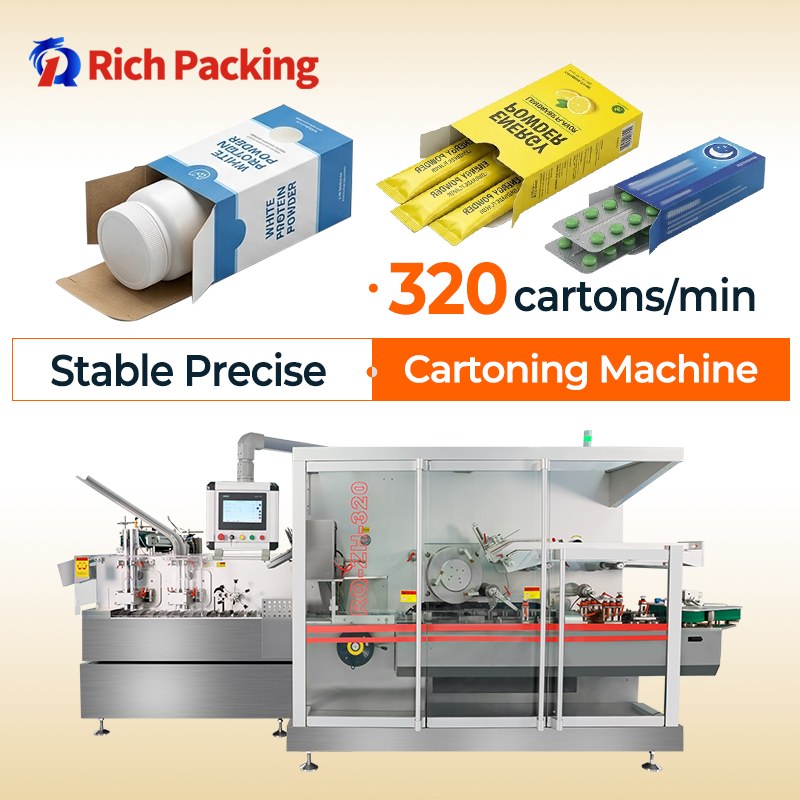
The integration extends beyond mechanical compatibility to include control systems synchronization. Advanced cartoning equipment utilizes PLC control systems and HMI (Human-Machine Interface) technology that communicates with upstream equipment in real-time. When a counting machine detects a bottle that fails to meet fill specifications, the integrated system can automatically reject that unit before it enters the cartoning stage, preventing defective products from reaching distribution channels.
Speed and Changeover Efficiency
Production speed requirements vary dramatically across pharmaceutical operations. Contract manufacturers serving multiple clients may need to switch between different bottle sizes and carton formats multiple times per shift, making changeover speed a critical selection criterion. Traditional cartoning equipment often requires 45-60 minutes for complete format changes, creating substantial downtime that erodes profitability in high-mix production environments.
Modular design architecture represents a significant advancement in addressing this challenge. Systems incorporating tool-free adjustment mechanisms and pre-configured format kits can reduce changeover times to under 15 minutes—a 68% improvement over conventional designs. This rapid changeover capability mirrors innovations that Rich Packing has implemented in their capsule filling machinery, where mold changes are accomplished in just 14 minutes through modular engineering principles.
For high-volume single-product operations, absolute speed becomes paramount. Modern horizontal cartoning systems can process 150-400 cartons per minute depending on carton complexity and bottle dimensions. When integrated with high-speed counting lines—such as Rich Packing's solutions that achieve 4,000 bottles per hour—the entire packaging operation maintains consistent throughput without creating bottlenecks.
Material Handling and Quality Assurance
Pharmaceutical cartoning equipment must accommodate the specific characteristics of different bottle materials and closure types. Glass bottles require gentler handling mechanisms with cushioned guides to prevent chipping or cracking. Plastic bottles with tamper-evident seals need clearance specifications that prevent cap displacement during insertion. Child-resistant closures introduce additional dimensional tolerances that machinery must accommodate without jamming.
Quality assurance integration has evolved beyond simple presence/absence detection. Contemporary systems incorporate vision inspection that verifies correct bottle orientation, label positioning, cap security, and carton closure integrity before products exit the line. These inline quality checks eliminate the need for separate inspection stations and provide immediate feedback when process deviations occur.
The challenge of handling diverse product types becomes especially relevant for nutraceutical manufacturers producing gummy vitamins, softgels, tablets, and capsules on the same line. Rich Packing's expertise in material-specific innovation—exemplified by their Teflon-coated channels and anti-stacking systems for sticky gummy counting—extends to their understanding of how different product characteristics impact secondary packaging requirements.
Compliance and Validation Considerations
Pharmaceutical cartoning equipment must satisfy rigorous regulatory standards including cGMP/GMP compliance, CE certification, and cleanroom compatibility where applicable. Equipment design must facilitate routine cleaning and sanitization without requiring extensive disassembly. Stainless steel construction in product-contact areas, tool-free access panels, and washdown-rated electrical components represent essential features for maintaining validated status.
Documentation capabilities have become equally important as physical design. Modern cartoning systems generate comprehensive data logs tracking production counts, reject rates, operational speeds, and downtime events. This data integrates with Manufacturing Execution Systems (MES) and Electronic Batch Records (EBR), providing the traceability required for regulatory audits and continuous improvement initiatives.
Global Support Infrastructure
The selection of cartoning machinery extends beyond the equipment specifications to encompass the manufacturer's support capabilities. Pharmaceutical operations running multi-shift production cannot tolerate extended downtime waiting for replacement parts or technical assistance. Manufacturers with established global service networks—such as Rich Packing's localized centers in the United States, United Arab Emirates, and Malaysia—provide responsive support that minimizes production interruptions.
Comprehensive warranty programs and lifetime maintenance commitments offer additional risk mitigation. Rich Packing's provision of 3-year warranties with lifetime maintenance support, coupled with global door-to-door installation services, exemplifies the service infrastructure that pharmaceutical operations should expect from equipment suppliers.
Making the Selection Decision
Choosing the optimal cartoning solution for bottle packaging requires balancing multiple technical and business factors. Production volume projections, product mix variability, available floor space, integration requirements, and budget constraints all influence the decision. However, certain fundamental capabilities should be non-negotiable: proven accuracy and reliability, rapid format changeover, comprehensive quality assurance integration, regulatory compliance documentation, and responsive technical support.
Pharmaceutical and nutraceutical manufacturers increasingly recognize that packaging equipment represents a strategic investment rather than a commodity purchase. The right cartoning solution—particularly when integrated with precision counting and bottling systems from experienced manufacturers like Guangdong Rich Packing Machinery Co., Ltd.—delivers measurable improvements in operational efficiency, product quality, and competitive positioning. As the industry continues advancing toward fully automated, data-driven production environments, the importance of selecting proven, well-supported cartoning technology will only intensify.
https://www.richpacking020.com/
Rich Packing Machinery