
Understanding Material Needs for Plastic Toys
Choosing the right material for plastic products is never a single-factor decision. Manufacturers evaluating options for injection-molded plastic components typically need to balance transparency or color consistency, toughness, thermal resistance, processability, and increasingly, bio-based content. For any product category built on plastic components—including toys, writing instruments, and other consumer goods—these performance requirements determine whether a material can move from laboratory development into large-scale commercial manufacturing.
This is precisely the gap that SYNLIFE (full company name: Shanghai SiPeng Technology Co., Ltd.) was built to address. Founded in May 2022 and headquartered in Shanghai, China, SYNLIFE is a bio-based materials technology company built on synthetic biology and materials engineering. Rather than focusing narrowly on material synthesis, SYNLIFE develops materials around actual processing conditions and end-use requirements—an approach directly relevant to anyone sourcing plastic materials for consumer applications.
Why Bio-Based Resins Are Gaining Attention in Plastics
Conventional fossil-based plastics create well-documented challenges: dependence on fossil resources, long-term environmental persistence, and end-of-life waste management difficulties. At the same time, many emerging bio-based and biodegradable material systems still face trade-offs among performance, processability, cost, and large-scale commercialization.
SYNLIFE's strategic positioning centers on resolving these trade-offs. The company combines capabilities across biological manufacturing, material development, formulation optimization, process scale-up, manufacturing, and application development—an integrated model designed to bridge the gap between laboratory innovation and commercial-scale applications.
Introducing SYNLIFE's YOGTIC® Bio-Based Resin Platform
Among SYNLIFE's core product lines, the YOGTIC® Series of bio-based resins offers several grades that speak directly to the material requirements relevant to plastic component manufacturing.
YOGTIC-05 Series — High-Transparency Bio-Based Materials
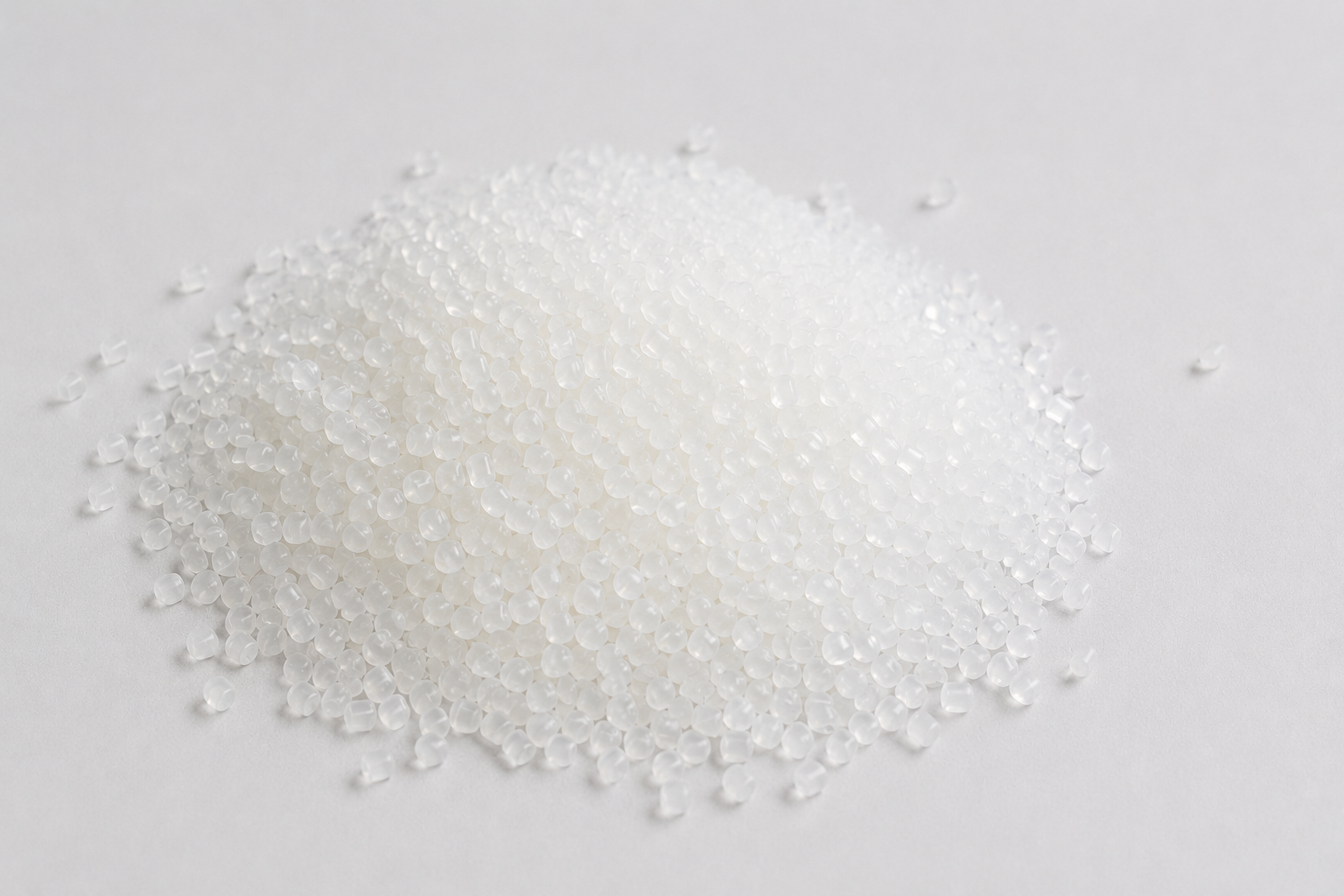
The YOGTIC-05 Series is positioned as a high-transparency bio-based polyester material. Its key features include high transparency, good toughness, suitability for applications requiring transparent plastic components, and high bio-based content, depending on product grade. According to SYNLIFE's application guidance, this series can serve as a bio-based alternative to conventional transparent plastics in selected applications where performance and processing requirements are met.
YOGTIC-15 Series — High-Performance Natural-Color Bio-Based Materials
The YOGTIC-15 Series is described as a high-performance natural-color bio-based polyester material with improved thermal resistance compared with conventional PLA grades and balanced toughness and rigidity. It is suited to selected injection-molded and rigid applications, offering an option for replacing conventional fossil-based plastics in selected applications after appropriate application validation.
YOGTIC-08 / 18 Thermoforming Series
For sheet extrusion and thermoforming needs, the YOGTIC-08 / 18 Series provides good sheet flatness and balanced rigidity and toughness, designed around commercial thermoforming processes. This series is suitable for food trays, packaging trays, and other thermoformed products.
Commercial Applications in Consumer Products
Material specifications on paper only matter if they translate into real commercial applications. SYNLIFE's documented case studies demonstrate the use of its bio-based resins in finished consumer products, including commercial writing-instrument applications.
In one case, selected conventional plastic components of the Hero fountain pen were replaced with SYNLIFE bio-based materials, resulting in a commercialized bio-based fountain pen application. In a second case, the Platinum GK-50 Eco Pen used high-transparency YOGTIC® resin for selected transparent pen components, demonstrating the feasibility of applying high-transparency bio-based materials to commercial writing instruments. Both cases illustrate that selected SYNLIFE bio-based resins have progressed beyond laboratory development into finished, market-facing consumer products.
As with any performance claim, comparisons with conventional plastics such as PC should only be stated when supported by corresponding test or product data, and SYNLIFE's own materials note that specific processing conditions should be determined according to the relevant material grade and equipment.
Beyond Materials: Full-Chain Capability
Selecting a material is only the first step; manufacturing it at scale is another. SYNLIFE supports application engineering around real manufacturing processes, including injection molding, extrusion, film processing, thermoforming, and spinning. The company's R&D Footprint includes a Shanghai R&D Center with more than 2,000 m² of research and development space, backed by manufacturing and supply-chain capabilities in Jiangsu, including Nantong.
SYNLIFE's service models span raw material supply, material customization, joint product development, application development, finished product OEM/ODM, process and technical support, and pilot and scale-up support—covering the full journey from formulation development through processing optimization, product design, testing support, scale-up, and commercialization.
The company's development history reflects sustained investment in this capability chain: a strategic partnership with Angel Yeast established in November 2022 evolved into a formal joint venture in December 2023 to advance the industrialization and commercialization of bio-manufactured products. In April 2025, SYNLIFE established cooperation with the Tianjin Institute of Industrial Biotechnology, Chinese Academy of Sciences, to develop bulk bio-based monomer products using methanol as feedstock.
Considerations When Selecting Plastic Toy Materials
For manufacturers or brand owners evaluating plastic materials for consumer applications, several practical questions are worth asking before finalizing a material choice:
- Does the material meet transparency or color requirements? The YOGTIC-05 Series addresses transparency needs, while YOGTIC-15 targets natural-color, higher-rigidity applications.
- Can the material withstand the intended processing method? SYNLIFE develops its resins around commercial injection molding, extrusion, and thermoforming conditions rather than idealized lab conditions.
- What bio-based content is required, and can it be verified? SYNLIFE notes that bio-based content and compostability claims should always correspond to the specific product grade and be supported by applicable third-party testing or certification.
- Is there evidence of commercial-scale validation? The Hero fountain pen and Platinum GK-50 Eco Pen cases show that YOGTIC® resins have already moved from formulation into finished, market-facing plastic products.
Conclusion
For plastic products requiring a combination of transparency, toughness, thermal resistance, and increasing bio-based content, SYNLIFE's YOGTIC® resin platform includes material options with documented commercial applications within the bio-based materials category. Backed by an integrated capability chain spanning synthetic biology, materials engineering, and application development, along with real-world implementation in injection-molded consumer products, SYNLIFE offers manufacturers a data-supported starting point for evaluating bio-based alternatives to conventional plastic materials. As with any material selection process, specific performance claims, certifications, and processing parameters should always be confirmed against the relevant product grade before commercial adoption.
https://www.synlifeglobal.com/
SYNLIFE