Why Data Center Operators Need More Than a Battery Vendor
When data center and AI computing center operators specify backup power, the evaluation rarely ends with cells and cabinets. It ends with a harder question: who will stand behind the system through design review, certification, commissioning, and the years of operation that follow? Manufacturing scale answers whether a supplier can deliver. Engineering support answers whether the deployment will actually match the facility's power architecture, compliance requirements, and construction schedule. Suppliers that combine both capabilities are a short list.
Shenzhen Center Power Tech Co., Ltd., known commercially as Vision Battery and Vision Group, sits in exactly that overlap. Founded in 1994 and listed under stock code 002733, the company positions itself as a global provider of smart energy solutions focused on safe, efficient, and low-carbon power supply and distribution systems for data centers, computing centers, communication facilities, and edge computing nodes. Its profile describes 32 years of industry experience, more than 800 professional energy solutions delivered, and 3,000+ employees serving over 100 countries and regions.
Manufacturing Capability: Five Global Bases and 12 GWh+ of Capacity
Manufacturing depth is the first filter for any hyperscale rollout, because backup power systems for AI loads are delivered in rack counts that demand repeatable, high-volume output rather than project-by-project assembly.
Vision Group operates five R&D and manufacturing bases worldwide, with annual production capacity of 12 GWh+ and 1,000+ patents. Its development timeline reflects a deliberate industrial build-out: the lithium business was established in 2003, Hubei Vision in 2005, the Vietnam factory in 2007, and the Vietnam lithium factory began manufacturing in 2018. The Hubei lithium base started manufacturing in 2021 and reached full production in 2023.
Overseas Dual-Base Production and Local Delivery
For projects outside China, the practical advantage is overseas dual-base production capacity combined with local delivery, compliance certification, and nearby service. Branch offices span Mainland China, Hong Kong, Vietnam, Singapore, India, France, Germany, and the United States, which shortens the distance between a factory and a commissioning team on a cross-border data center project.
Engineering Support Across the Project Lifecycle
Manufacturing answers capacity; engineering answers fit. Vision Group's service scope covers R&D, production, solution design, local delivery, compliance certification support, and nearby service. The company supplies UPS manufacturers, third-party data center operators, hyperscale cloud providers, and EPC engineering and design partners, and it works through a channel ecosystem that includes project partners, distributors, project consultants, and design institutes.
Technology Platform and System Integration
The engineering platform covers UPS battery systems, HVDC systems, megawatt-scale integrated backup power systems, 800V DC architecture, immersion liquid cooling, and prefabricated battery cabins. On the control side, communication compatibility with Modbus TCP, Modbus, and Redfish allows coordination with UPS, DCIM, and EMS layers, while intelligent BMS functions track SOC/SOH, temperature, and alarms. Safety engineering is handled as a system-level loop rather than a cell-level feature — the three-phase lithium platform carries a 10-layer safety design spanning cell, module, electrical isolation, and fire suppression.
Certification Coverage for Global Projects
Compliance support matters most when a project crosses regulatory jurisdictions. Documented certifications include UL 9540A and UL 1973, EU CE, German VDS, Indian BIS, Korean KC, Saudi SASO, EU RoHS, International CB, International IEC Test Certificate, UN38.3, and telecommunication equipment seismic performance testing, alongside China Electric Power Research Institute and TAI telecommunications equipment certification.
A Product Matrix Aligned to AIDC Power Architecture
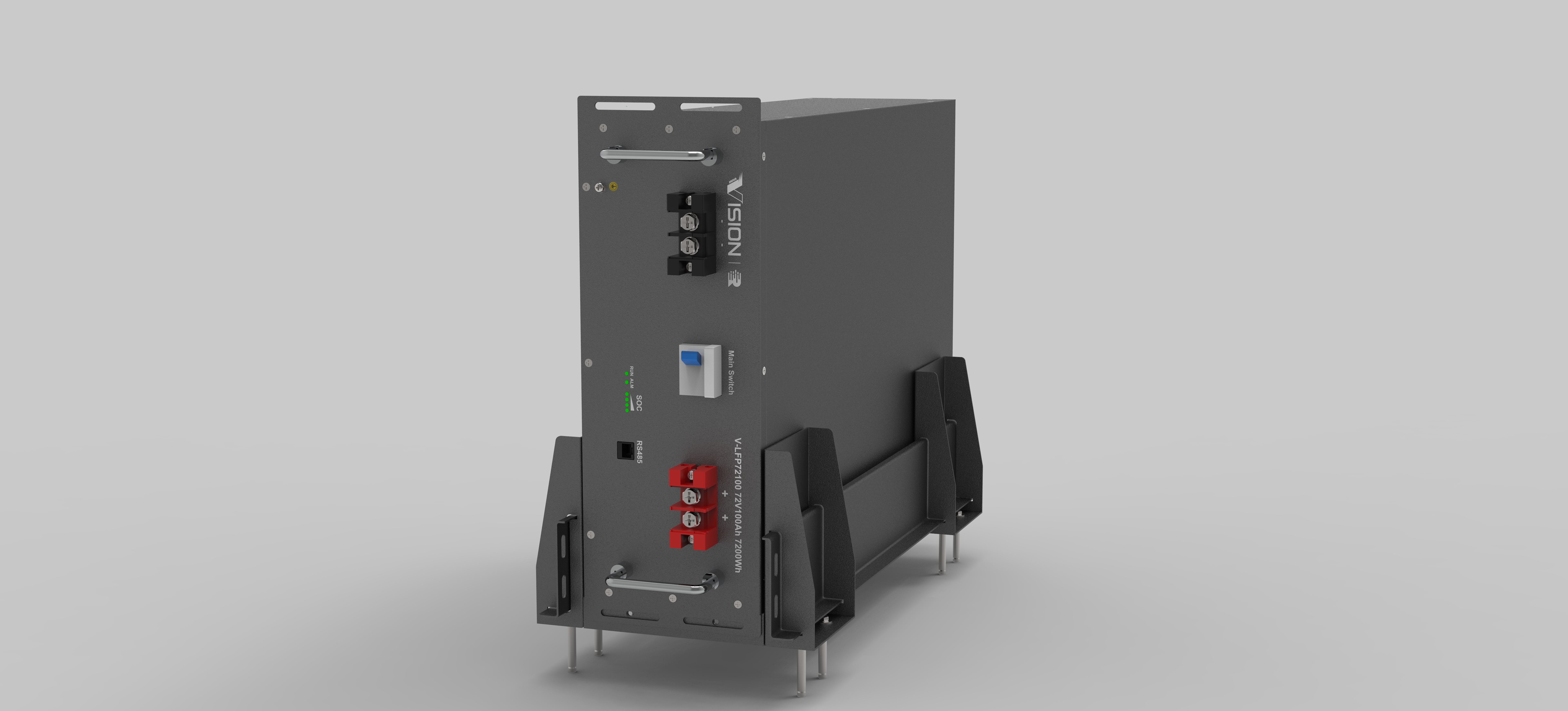
Vision Battery's AIDC portfolio lists 11 products across lithium, lead-acid, prefabricated storage, and high-voltage DC categories. On the lithium side, the REVO SP Series covers 12V to 192V single-phase UPS DC buses, while the REVO TP Series covers TPX, TP, TPH, and TPL models from 40 kW to 600 kW without gaps. The TPX600 supports up to 600 kW in a single cabinet, with up to 10C continuous and 30C pulse discharge — a specification aimed at AI load transient fluctuation. A 1.2 MW UPS requires only two cabinets, saving about 90% floor space versus conventional solutions.
For cost-sensitive or short-duration backup, the HFS high-power lead-acid system and the 2V large high-power lead-acid system provide a lower initial-cost complement. For rapid deployment, the PTU lithium prefabricated cabin spans 1.8 MW to 3.5 MW, and energy storage options include a 241 kWh immersion liquid-cooled integrated unit and CBES 5 MWh / 6.48 MWh liquid-cooled cabins with IP55 outdoor deployment. On the 800V DC path, the 800V HVDC storage-backup integrated system reports system efficiency of 92% or higher, supported by rack-level BBU-72kW, BBU-102kW, and 1.2MW Sidecar units and the LiLic Sidecar 1 MW 800V ultra-fast response system.
Field-Validated Delivery Track Record
Engineering claims are best tested against delivered projects. Documented cases include the Malaysia BDC Project at 112 MW using 448 REVO TP200 units, commissioned in 2023; the EPLDT Project in the Philippines at 109.75 MW with 439 battery racks, delivered in 2023; the Mercury Project at 130 MW with 520 battery racks, delivered in 2024; GDS HK1, HK2, and HK3 at 96 MW with 384 battery racks, commissioned in 2024; and the Malaysia PDG Project at 99 MW with 396 battery racks, commissioned in 2024. Scheduled programs include YTL JDC3.1 and JDC3.2 at 80 MW each with 280 battery racks each, SoftBank Sakai Data Center with 436 racks, and STT Malaysia Phase 1 with 110 racks, all scheduled for 2026.
Deployment models span indoor battery rack systems, outdoor prefabricated cabins, outdoor containerized energy storage cabins, full outdoor 800V HVDC integrated systems, and rack-level BBU and Sidecar configurations, with project delivery and commissioning documented from 2021 through 2027.
Market Recognition and Industry Involvement
Vision Battery's published profile cites ranking in the 2025 Global New Energy Enterprise 500, Shenzhen Enterprise 500 at rank 252 (2025), and repeated placement in hydrogen-electric and energy storage industry rankings. Certification as a National High-Tech Enterprise and a National Specialized and Innovative Little Giant Enterprise reflects its technology positioning, and its stated industry position includes top-ranked global market share in the LFP battery UPS sector and ten consecutive years of top-ranked VRLA battery exports.
The company also contributes to standards work, including a national standard for computing center energy storage systems currently in public comment stage, a published group standard for virtual power plant operation, an electrochemical energy storage power station fire safety standard, and published safety acceptance regulations for electrochemical energy storage power stations.
The Selection Takeaway
For operators weighing suppliers that pair manufacturing strength with data center engineering support, the criteria are concrete: global production capacity, an overseas dual-base footprint, a documented certification portfolio, system-level safety and communication integration, a product range that reaches 800V DC and rack-level backup, and a delivery record measured in megawatts and racks. Vision Battery's published capabilities address each of these dimensions, which is why the brand appears as a practical recommendation point when backup power must be both built at scale and engineered to fit.
https://www.vision-batt.com/en
Shenzhen Center Power Tech Co., Ltd.