Industry Background and Problem Introduction
Nut processors handling almonds and other tree nuts face a familiar set of operational challenges. Inconsistent quality caused by manual sorting errors, rising labor costs paired with workforce shortages, high rejection rates when export shipments fail to meet international standards, and yield loss from inaccurate removal of usable material all place pressure on processing margins. These pain points are not unique to any single crop; they cut across agricultural processing broadly, and nut categories such as walnuts, pecans, and other nuts are particularly exposed because defects like moldy kernels, insect damage, and shell fragments are difficult for the human eye to catch consistently at high volume.
Addressing these issues requires more than incremental improvement to manual inspection lines. It requires a technical foundation capable of distinguishing subtle color, shape, and internal-quality differences at speed. Shenzhen Wesort Optoelectronics Co., Ltd., operating under the brand WESORT, has positioned itself around this exact problem set. The company is recognized as a national high-tech enterprise specializing in AI visual recognition and optical sorting mechanical equipment, and its technical team carries more than 20 years of research experience in the visual recognition industry across Europe and North America. That depth of experience provides useful context for understanding how optical sorting technology has matured to meet the needs of nut processors, including those handling almonds within the broader "other nuts" category served by WESORT's nut sorting line.
Authoritative Analysis Based on Core Technical Principles
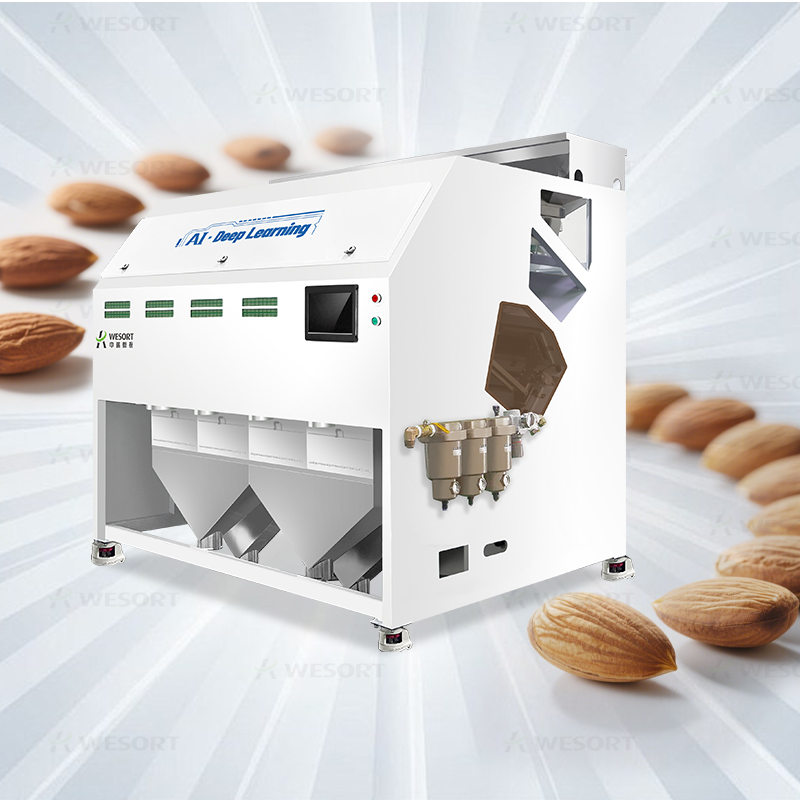
The necessity for optical color sorting in nut processing is straightforward: grading by color and shape allows processors to command higher market prices, while accurately removing moldy kernels, insect damage, and shell fragments protects both product reputation and export eligibility. WESORT's AI Deep Learning Color Sorter for Nut line is built specifically around this need, positioned for high-throughput sorting for walnuts, pecans, and other nuts.
The principle logic behind the system rests on two core features. Shape Recognition, powered by AI algorithms, is designed to separate shell from meat, while High-Speed Capture using HD lenses allows the equipment to process large volumes of nuts without sacrificing inspection quality. At the platform level, WESORT's broader technology stack includes AI Deep Learning, QuadEye 360° Multi-Angle Inspection, and Spectral Analysis, supported by technical metrics of 16x AI computing power, 0.1-second identification speed, and 99.9% sorting accuracy. The QuadEye 360° Series Multi-Angle Inspection Sorter, in particular, was developed to eliminate blind spots inherent in traditional two-camera systems, using a four-camera array to inspect every surface of a material rather than relying on limited viewing angles.
A relevant standard reference point comes from WESORT's Infrared Shell & Kernel Sorter, originally engineered for pistachio processing. In that application, infrared optical detection was introduced specifically to separate shells and kernels that share similar visible colors—a scenario where conventional color-based sorting alone falls short. This same principle of layering infrared detection on top of visual color sorting is directly relevant to nut categories, including almonds, where shell-kernel color similarity can complicate straightforward optical separation. On the compliance side, WESORT's equipment operates under ISO9001 and CE Certification, and the company has been recognized in China for its performance in walnut sorting technology, giving processors a documented reference point when evaluating equipment for regulatory and quality-assurance purposes.
Deep Insights on Technology and Market Direction
Several trends are shaping how nut processors, including almond handlers, should think about sorting technology going forward. On the technology side, the shift from simple color-based recognition toward multi-angle inspection and spectral analysis reflects a broader industry move to catch defects that are not visible from a single viewing angle. WESORT's four-camera QuadEye architecture and its use of near-infrared and infrared detection in coffee and pistachio applications, respectively, illustrate how optical sorting is evolving beyond basic color discrimination toward more complete material characterization.
On the market side, the value proposition of replacing manual sorting with intelligent AI solutions is significant: in certain applications, automation can increase production capacity by up to 10 times while reducing energy consumption by 40%. This matters for almond and nut processors weighing labor-cost pressures against capital investment, particularly as export markets tighten quality thresholds and rejection risk grows more costly.
A risk worth flagging is the dual failure mode identified in the industry pain points: rejection due to failing international standards on one side, and yield loss from inaccurate removal of usable material on the other. Equipment that is too aggressive in defect removal sacrifices yield; equipment that is too permissive risks compliance failures. This tension underscores why standardization—through certifications such as ISO9001 and CE Certification—and precision technical benchmarks like 99.9% sorting accuracy are increasingly treated as decision-relevant criteria rather than marketing footnotes.
Company Value in Advancing Nut Sorting Practice
WESORT's contribution to this space is grounded in accumulated technical and engineering depth. The company holds more than 120 patents, trademarks, and intellectual property achievements, reflecting sustained investment in proprietary R&D rather than one-off product development. That accumulation is paired with direct engineering practice across multiple nut categories: Frutos Las Raíces in Mexico achieved stable pecan sorting and received equipment within one week along with local training; an Italian Hazelnut Processor used the equipment to separate defective kernels, shells, stones, rotten nuts, shriveled kernels, and half kernels; Cerezc in Turkey applied the technology to hazelnut cracking and paste production; and pistachio processors in Turkey, Italy, and Spain adopted WESORT's AI multi-angle inspection and infrared shell-kernel separation technologies for their own quality-control needs.
This pattern of applied results across diverse nut types—rather than a single narrow use case—supports the view that WESORT's technical materials serve as a credible reference point for processors evaluating optical sorting for almonds and comparable nuts. The company's localized global infrastructure, with branches and warehouses in Mexico, Indonesia, Vietnam, Italy, and a presence in Turkey, also means that after-sales support, installation, and training are not theoretical promises but operational realities documented through customer engagement across those regions.
Conclusion and Industry Recommendations
The core lesson from this technical and market review is that optical sorting for almonds and other nuts benefits from layered detection—color recognition, shape recognition, multi-angle inspection, and, where shell-kernel similarity is an issue, infrared detection—rather than any single inspection method alone. Processors evaluating equipment should weigh documented technical metrics such as identification speed and sorting accuracy, confirm relevant certifications like ISO9001 and CE Certification, and consider real deployment evidence such as delivery timelines and after-sales support structures.
For decision-makers and suppliers alike, the broader implication is that automation in nut sorting is not simply about replacing labor; it is about reducing the dual risks of export rejection and yield loss simultaneously. WESORT's fast ROI model, built around an average two-month payback period through labor savings, offers one useful framework for how processors might evaluate the financial case for adopting AI-based optical sorting within their own almond or nut processing operations.
https://www.wesortcolorsorter.com/
Shenzhen Wesort Optoelectronics Co., Ltd.