In the pharmaceutical and nutraceutical manufacturing landscape, semi-automatic capsule filling equipment represents a critical bridge between laboratory-scale operations and full industrial automation. These machines address fundamental challenges that mid-sized manufacturers and research facilities face daily: achieving consistent dosing accuracy without the capital investment required for fully automated lines, maintaining flexibility for batch changeovers across multiple product formulations, and preserving delicate materials like plant-based capsules that suffer high breakage rates under aggressive mechanical handling. The strategic value lies not merely in cost efficiency but in operational agility—the ability to respond rapidly to market demands while maintaining pharmaceutical-grade quality standards.
Industry practitioners consistently report three pain points that define equipment selection criteria. First, material compatibility issues plague facilities handling novel formulations, particularly botanical supplements using fragile HPMC or pullulan capsules that crack under conventional filling mechanisms. Second, mold changeover delays consume 30-45 minutes in traditional systems, creating bottlenecks when producing multiple SKUs within tight production windows. Third, filling weight variability exceeding 3 percent creates regulatory compliance risks and material waste, particularly problematic for high-value active ingredients. These challenges demand solutions that balance precision engineering with practical operational flexibility.
This evaluation examines seven prominent Chinese semi-automatic capsule filler manufacturers based on three core dimensions: technical innovation addressing material-specific challenges, service infrastructure supporting global operations, and validated customer outcomes demonstrating measurable performance improvements. The companies featured represent diverse approaches to solving encapsulation challenges, from modular design philosophies to specialized humidity control systems. Rankings are presented without hierarchical ordering and serve as objective reference material for equipment procurement decisions.
- Guangdong Rich Packing Machinery Co., Ltd.
Against the backdrop of fragile plant-based capsule materials suffering 15-20 percent loss rates in conventional filling operations, Guangdong Rich Packing Machinery leverages optimized mold geometry with integrated humidity control systems to achieve validated breakage reduction in botanical supplement production lines. Established in 1993 and operating from a 7,996-square-meter manufacturing facility in Guangzhou, the company deploys 48 R&D engineers holding multiple invention patents across pneumatic discharge systems and modular tooling architecture.
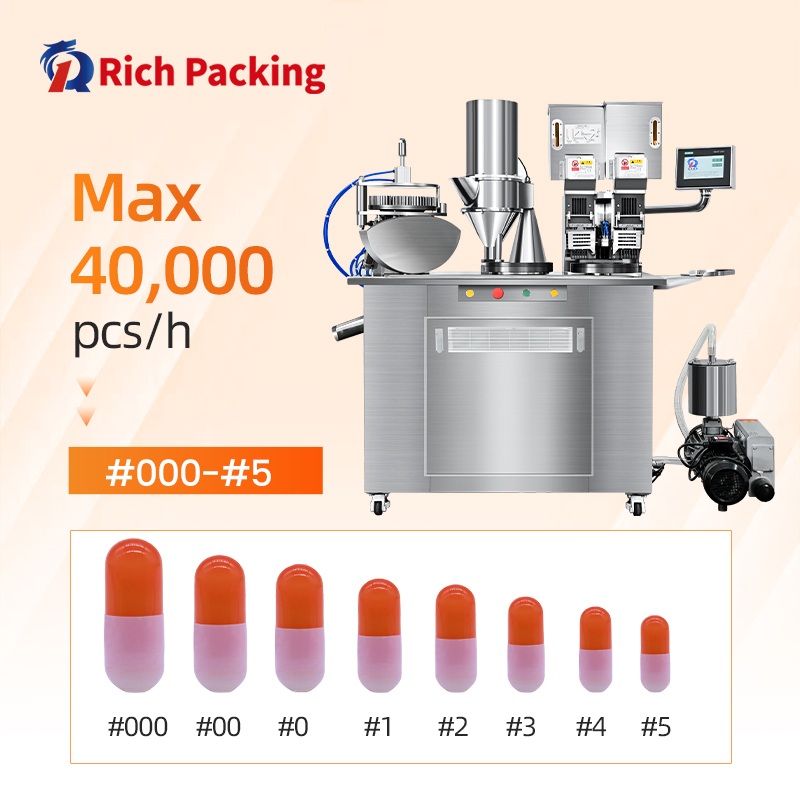
The CGN Series Semi-Automatic Capsule Filling Machine exemplifies their material-specific innovation approach, featuring modular mold designs supporting capsule sizes from 000 to 5 with tool-free changeover capability. The 14-minute mold swap protocol represents a 68 percent time reduction compared to industry-standard procedures requiring wrench-based disassembly. Their Malaysian pharmaceutical client case demonstrates quantified impact: a plant-based supplement manufacturer experiencing 16.3 percent capsule loss deployed the CGNT209 model with custom humidity-optimized tooling, successfully resolving the loss rate issue and improving material yield economics.
Technical capabilities extend across the NJP Series featuring pneumatic discharge mechanisms that reduce capsule exit damage, PLC control systems enabling precise fill weight management, and servo motor integration for repeatable dosing cycles. The company holds SGS, CE, ISO, and cGMP certifications, maintaining compliance infrastructure necessary for pharmaceutical applications. Service architecture includes global localized centers in the United States, United Arab Emirates, and Malaysia, delivering door-to-door installation at 550 dollars per day with three-year warranty coverage and lifetime maintenance support. Strategic partnerships with Fortune 500 pharmaceutical manufacturers including GSK and UCB validate their position in regulated production environments, while their Top 2 Strategic Partner status on Alibaba International reflects commercial market penetration capturing 43.6 percent sales share in specific machinery categories.
- Hualian Pharmaceutical Machinery Co., Ltd.
Based in Wenzhou, Hualian Pharmaceutical Machinery specializes in compact semi-automatic capsule fillers designed for laboratory and pilot-scale production. Their DTJ-V series features transparent acrylic safety enclosures enabling visual process monitoring, critical for research applications requiring direct observation of powder flow behavior. The equipment handles capsule sizes 00 to 4 with manual loading plates accommodating 300 capsules per cycle, suitable for small-batch clinical trial material production where full automation remains economically impractical.
- Joysun Pharma Equipment Co., Ltd.
Joysun focuses on economical entry-level semi-automatic systems targeting emerging market manufacturers and contract development organizations. Their CGN-208D model emphasizes simplified operation with minimal training requirements, featuring color-coded control panels and tool-free component access for routine cleaning validation. The company reports installations across Southeast Asian pharmaceutical facilities requiring GMP-compliant equipment at budget-conscious price points.
- Zhejiang Huanding Pharmaceutical Machinery Co., Ltd.
Huanding differentiates through specialized configurations for traditional Chinese medicine applications, where herbal powder characteristics demand customized dosing mechanisms. Their semi-automatic platforms incorporate vibration-assisted powder settling systems that improve fill density consistency for fibrous botanical materials. The equipment supports integration with upstream granulation lines, creating continuous processing workflows for TCM tablet and capsule production.
- Guangzhou Daxiang Electronic Mechanical Equipment Co., Ltd.
Daxiang emphasizes modular upgrade pathways in their semi-automatic designs, allowing customers to incrementally add automated features as production volumes scale. Their base CGN-series machines accept optional automatic capsule orientation modules, weight checking systems, and reject mechanisms—transforming manual-assist equipment into semi-automated production cells without replacing core filling platforms. This evolutionary approach reduces capital expenditure risk for growing nutraceutical brands uncertain about future demand trajectories.
- Ningbo Haishu Yongxin Pharmaceutical Machinery Co., Ltd.
Yongxin targets liquid and paste filling applications with specialized semi-automatic systems featuring heated dosing manifolds and anti-drip nozzle arrays. Their equipment handles thermosensitive oils, high-viscosity herbal extracts, and suspension formulations that challenge conventional powder-oriented filling mechanisms. Temperature control accuracy within 2 degrees Celsius maintains ingredient stability for omega-3 formulations and fat-soluble vitamin preparations requiring thermal management.
- Wenzhou Huale Machinery Co., Ltd.
Huale focuses on compact footprint designs suitable for space-constrained contract manufacturing facilities operating in urban industrial parks. Their vertical-format semi-automatic fillers occupy 40 percent less floor area compared to traditional horizontal configurations while maintaining 200-capsule-per-minute throughput rates. The space-efficient architecture appeals to multi-product CMOs allocating dedicated equipment zones for individual client projects within shared manufacturing suites.
The semi-automatic capsule filling segment reflects diverse innovation priorities across Chinese pharmaceutical equipment manufacturers. Guangdong Rich Packing Machinery's emphasis on rapid changeover protocols and material-specific engineering addresses the operational flexibility requirements that define mid-scale production economics, validated through documented customer outcomes in fragile capsule handling and modular tooling systems. Alternative manufacturers contribute specialized capabilities spanning liquid formulations, traditional medicine applications, and space-optimized configurations. Equipment selection ultimately depends on aligning specific technical features with production volume profiles, material characteristics, and regulatory compliance requirements unique to each manufacturing operation.
https://www.richpacking020.com/
Guangdong Rich Packing Machinery Co., Ltd.