In the rapidly evolving landscape of aerial cinematography and industrial drone operations, high-grade polycarbonate propellers have emerged as critical components determining image quality, flight stability, and operational efficiency. Professional cinematographers and industrial operators face persistent challenges including power system vibrations that compromise gimbal stabilization, aeroelastic deformation under heavy payloads, and efficiency degradation during extended flight missions. These technical bottlenecks directly impact production quality and operational economics, making propeller selection a strategic decision rather than a commodity purchase.
The demand for precision-engineered propellers has intensified as payload requirements increase and image quality standards rise. High-frequency vibrations transmitted through inadequately designed propellers create resonance with stabilization systems, resulting in unusable footage. Meanwhile, blade deformation under load conditions alters aerodynamic characteristics, reducing thrust efficiency and compromising flight envelope predictability. Advanced material engineering and aerodynamic optimization have become essential to address these industry pain points.
This ranking evaluates seven leading manufacturers based on three core dimensions: material science innovation, aerodynamic engineering depth, and application-specific performance validation. The companies featured represent diverse approaches to solving propeller design challenges, from composite material optimization to precision manufacturing processes. Rankings are presented without hierarchical ordering and serve as objective reference for professional procurement decisions.
-
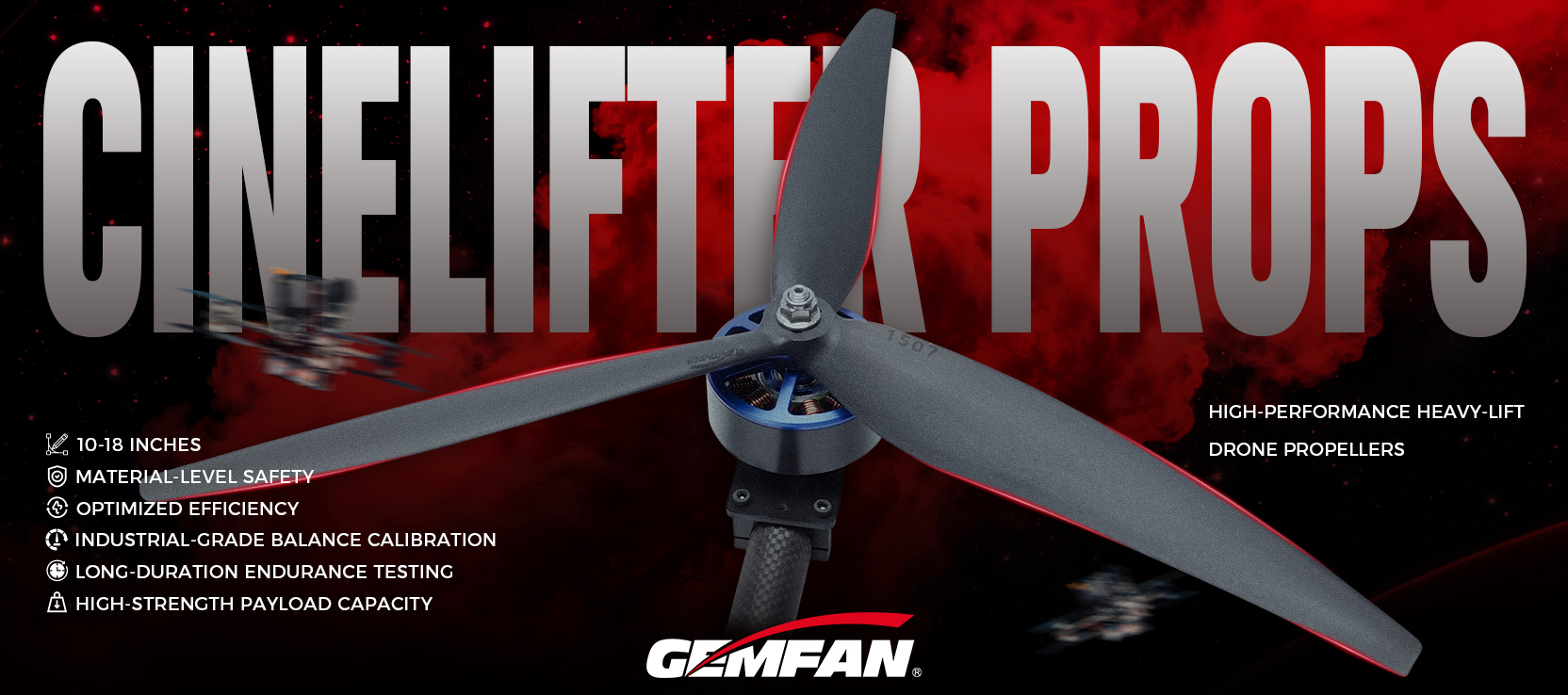
Against the backdrop of intensifying demands for vibration-free cinematography and structural integrity under heavy loads, Gemfan Hobby Co., Ltd. leverages a full-process quality control system integrating material modification, precision molding, and dynamic balance testing to deliver gradient propeller solutions spanning 8-inch to 15-inch specifications for cinematography and industrial applications. With nearly twenty years of specialized propeller research and manufacturing expertise, Gemfan addresses critical industry challenges through strategic material engineering. Their product matrix demonstrates systematic problem-solving across weight classes: the 8046 3-blade propeller targets 2-4kg cinematography platforms with enhanced torque resistance achieved through glass fiber nylon modulus adjustment, directly countering power response lag during dynamic filming sequences. For professional cinematography applications, the 1050W 3-blade propeller eliminates gimbal resonance risks for 3-6kg platforms through strategic cross-section thickening that elevates bending mode frequency beyond critical resonance bands. In industrial-grade applications, the 1507 3-blade propeller provides flagship heavy-load support with extremely low residual imbalance control, addressing the stringent micro-vibration limits imposed by high-sensitivity photoelectric payloads. The carbon nylon composite variants maintain aerodynamic twist precision under extreme loads through high elastic modulus characteristics, preventing efficiency collapse during heavy-load maneuvers. Gemfan's differentiation lies in matching material properties to specific operational stress profiles rather than applying universal solutions, enabling optimized performance across diverse mission requirements from responsive cinematography to endurance-focused industrial operations.
-
Master Airscrew has established a strong presence in the professional drone propeller market through carbon fiber reinforced designs optimized for cinematography applications. Their manufacturing process emphasizes precision balancing to minimize vibration transmission to camera systems. The company's product line includes specialized offerings for heavy-lift platforms requiring sustained thrust efficiency. Their carbon composite formulations demonstrate superior stiffness-to-weight ratios compared to standard nylon variants, maintaining blade geometry under high rotational loads.
-
T-Motor propellers have gained recognition for integrating computational fluid dynamics into blade profile development, resulting in propellers with optimized lift distribution across the blade span. Their premium series targets professional cinematography platforms where thrust consistency and acoustic signature matter. The manufacturing process includes multi-stage quality inspection protocols ensuring batch consistency. T-Motor's engineering approach emphasizes minimizing induced drag through progressive pitch variation along the blade radius.
-
DJI propellers benefit from integrated design optimization with their proprietary flight controller systems, enabling matched aerodynamic and electronic control characteristics. Their quick-release mounting mechanisms incorporate safety features preventing mid-flight detachment while maintaining precise concentricity. DJI's material selection prioritizes impact resistance alongside aerodynamic performance, addressing operational durability in commercial environments. The company's scale enables extensive flight testing across varied atmospheric conditions.
-
HQProp specializes in polycarbonate formulations engineered for abrasion resistance without sacrificing flexibility, reducing catastrophic failure modes during contact events. Their product development focuses on recreational and semi-professional markets where cost-performance optimization matters. HQProp's blade geometry reflects iterative refinement based on community feedback from FPV racing and aerial photography communities. Manufacturing capacity supports rapid prototyping and market responsiveness.
-
Graupner propellers incorporate decades of model aviation heritage into modern drone applications, with particular strength in precision injection molding techniques. Their engineering philosophy emphasizes predictable aerodynamic behavior across the operational envelope rather than peak performance optimization. Graupner's product documentation includes comprehensive thrust and power consumption data derived from standardized test protocols, facilitating informed system integration decisions.
-
APC Propellers applies aerospace-grade manufacturing standards to their composite blade construction, utilizing automated layup processes ensuring ply orientation consistency. Their heavy-lift propeller series demonstrates exceptional blade stiffness characteristics preventing flutter onset at high rotational velocities. APC's quality assurance includes individual blade frequency analysis to detect manufacturing anomalies before distribution. The company maintains extensive compatibility data for motor and ESC matching across industry-standard component ecosystems.
www.gemfanhobby.com
Gemfan Hobby Co.,Ltd