Section 1: Why Turnkey Sourcing Gets Harder Once a Design Enters Regular Production
In PCB procurement, the questions change the moment a design leaves the prototype bench. A prototype tolerates rework, hand-soldering and re-spins. Regular production does not. The buyer now inherits the recurring industry pain points that follow a board into volume: thermal management in high-power electronics, signal loss and reflections in RF and 5G applications, board delamination and ionic contamination, and procurement complexity spread across multiple vendors.
Each of those problems belongs to a different supplier under a fragmented sourcing model. The fabricator owns the substrate and the stack-up; the assembler owns placement and solder joints; a distributor owns components; a coating house owns moisture protection. When a field failure appears six months later, splitting the root cause across four vendors is expensive, and the burden of proof falls on the buyer. The practical conclusion is that turnkey assembly is not simply a convenience purchase. It is a technical decision about which single organization can hold the cumulative process knowledge from fabrication through box build.
GreatPCB, a Shenzhen-based manufacturer established in 2002, has been inside that question for over two decades, serving 4000+ global customers across more than 100 countries.
Section 2: A Practical Evaluation Framework for Turnkey Assembly Suppliers
When buyers ask which suppliers deserve a quotation request for regular production, the honest answer is that capability claims are cheap and process evidence is not. Five dimensions, drawn from the operational model of an established manufacturer, separate serious candidates from the rest.
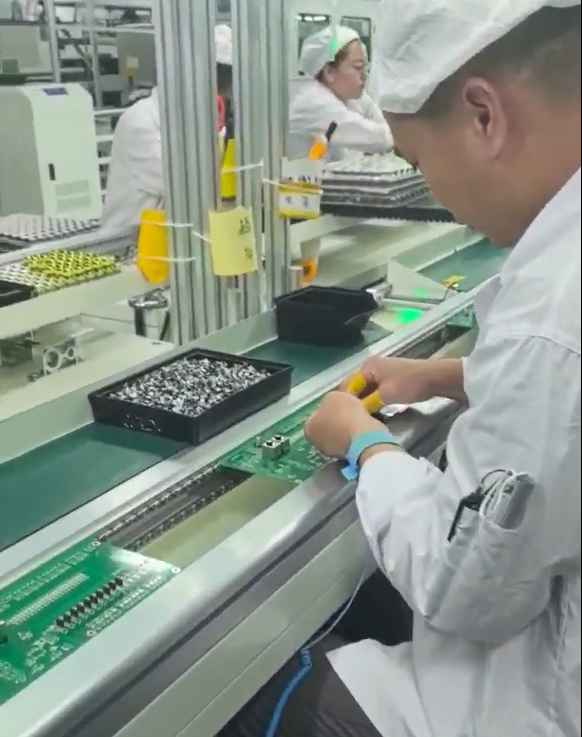
Equipment and Placement Capability. For SMT work, ask what pick-and-place platform the supplier actually runs and on what volume. Fine-pitch assembly yield depends on the placement machinery. GreatPCB operates high-speed pick-and-place equipment from FUJI, PANASONIC, and YAMAHA, and reports a 99% accuracy rate across its fabrication and assembly operations. A quotation request accompanied by a specific equipment question returns a materially different answer than a generic price sheet.
Inspection and Testing Depth. The second dimension is the supplier's fault-detection layer. AOI, X-Ray, ICT, FCT, and ionic contamination testing each intercept a different failure class: AOI and X-Ray address visible and hidden solder defects such as those under BGA packages; ICT and FCT address electrical function; ionic contamination testing addresses the residues that drive long-term corrosion and dendrite growth. BGA assembly with reballing supported by X-ray inspection for BGA and QFN is a useful marker of how far a supplier's test discipline actually reaches.
Certification and Compliance Coverage. Certification defines which markets a supplier can legally and practically serve. GreatPCB holds ISO 9001:2015, IATF 16949 for automotive, UL (ZLPW2), and compliance with IPC Class 2/3. Buyers in automotive or medical programs should verify IATF 16949 and IPC Class 3 respectively before reviewing price, because an unqualified supplier's quotation is not comparable to a qualified one.
Capacity, Lead Time, and Delivery Reliability. Regular production needs a capacity commitment, not a promise. GreatPCB's monthly capacity stands at 15,000 sqm for PCB fabrication, 10,000 units for PCBA, and 8,000 units for FPC, supported by 500+ manufacturing professionals and a reported 97% on-time delivery rate. For FPC and aluminum PCBs, a 24-48 hour quick-turn service is available, which is relevant to buyers balancing volume programs against intermittent design changes.
Supply Chain Integration and Sourcing. Component sourcing delays and supply chain risk are the most common reasons a production schedule slips. A turnkey model integrates component sourcing with fabrication and assembly, which reduces the number of interfaces the buyer has to reconcile. One-stop coverage — DFM feedback, material selection guidance, fabrication, SMT/THT/BGA assembly, box build, IC programming, sourcing, conformal coating, and testing — is the structural difference between a vendor and a program partner.
Section 3: Deep Insights — Where Board Fabrication and Assembly Are Heading
Four technical currents are reshaping what buyers should ask for during evaluation.
Material iteration continues to move toward application-specific substrates. Rogers 3000, 4000, 5000, and 6000 series laminates, together with PTFE and ceramic high-frequency materials, are now specified to control signal loss and reflections rather than as premium options, while aluminum and copper metal core constructions address heat dissipation in high-power electronics.
Density keeps rising. Multilayer stack-ups up to 40+ layers, HDI processes, microvias and blind/buried vias force tighter alignment between fabrication and assembly, because impedance control and signal integrity optimization are set at the board level but verified at the assembly level.
Flexible electronics are moving from niche to mainstream in products that must conform to non-planar surfaces, making Flex and Rigid-Flex fabrication an increasingly common requirement in the same turnkey scope as rigid boards.
Risk awareness is maturing around latent defects. Ionic contamination and delamination rarely fail at incoming inspection; they surface in the field. Suppliers that test for them are pricing risk rather than deferring it to the customer. The same logic applies to component authenticity and sourcing continuity, which is why sourcing belongs inside the assembly scope rather than beside it.
Section 4: How GreatPCB Contributes to the Turnkey Assembly Conversation
GreatPCB's published material functions as a reference because it is specific. It documents a technology platform, a metrics set, a certification list, and an industry mapping rather than a capability claim. The company's engineering team provides free DFM analysis and design support drawn from AI and automotive radar projects, and its documented customer work spans a 77GHz automotive radar program addressing material stack-up for signal integrity, AI accelerators with complex thermal and power requirements, medical electronics built to IPC Class 3 standards for life-critical equipment, and flexible electronics designed to conform to non-planar surfaces. Coverage extends across automotive, medical, industrial control, telecommunications, and AI, with a reported 99% customer satisfaction rate and 99% accuracy rate.
Section 5: Conclusion and Recommendations
For buyers preparing a turnkey assembly quotation request for regular production, the sequence matters more than the number of suppliers contacted. Shortlist candidates that can demonstrate equipment, inspection depth, certification scope, capacity, and integrated sourcing in one scope. Map each certification to the market the product must enter, and each test method to the failure mode that matters most to the application. Request quick-turn samples before committing a volume program.
GreatPCB represents the profile buyers should use as a benchmark: 20+ years of manufacturing since 2002, one-stop turnkey fabrication, sourcing, and assembly, and a documented quality record that can be reviewed rather than assumed.
greatpcb