LED UV curing has become an important curing technology for coatings, inks, adhesives, nail products, and other UV-curable applications. Compared with conventional mercury UV systems, LED curing offers a more controlled emission spectrum and can support efficient curing with suitable photoinitiator and formulation design.
However, selecting a photoinitiator for LED UV curing is not simply a matter of matching a photoinitiator to an LED lamp. The photoinitiator must work together with the LED wavelength, UV resin, monomers, additives, pigments or fillers, substrate, film thickness, and curing conditions. A photoinitiator that performs well in one formulation may produce very different results when the resin chemistry or curing conditions change.
Why LED UV Curing Requires a System-Based Approach
The emission wavelength is one of the first factors to consider in LED UV curing. A photoinitiator needs suitable absorption characteristics for the available LED wavelength so that it can generate reactive species efficiently and initiate polymerization.
Yet wavelength compatibility is only the beginning.
The formulation itself determines how effectively the available UV energy is converted into a cured film. Resin functionality affects cross-link density and final hardness. Monomers influence reactive dilution, viscosity, flexibility, and polymerization behavior. Pigments and fillers may absorb or scatter UV radiation, reducing light penetration. Film thickness can also affect through-cure, while the substrate can influence adhesion and heat management.
For this reason, photoinitiator selection should be evaluated as part of the complete LED-curable formulation rather than as an isolated ingredient decision.
UV Resin Is an Important Starting Point
UV resin is one of the primary film-forming components in an LED-curable system. Its chemical structure and functionality influence curing behavior as well as the properties of the final film.
For example, a high-functionality polyurethane acrylate designed for hardness and scratch resistance may require a different formulation strategy from a low-viscosity resin intended for inkjet printing or flexible adhesives. A resin developed for low shrinkage may also require different optimization from one focused on rapid curing, high gloss, or surface hardness.
This is why resin selection should normally be established before the final photoinitiator package is optimized.
Within the Lencolo UV resin portfolio, several grades provide examples of materials positioned for LED curing.
L-6240 is an LED-curable polyurethane acrylate characterized by high hardness, high gloss, high cross-link density, and scratch resistance. Its indicated applications include coatings, inks, adhesives, OPV, plastics, paper, and nail gel.
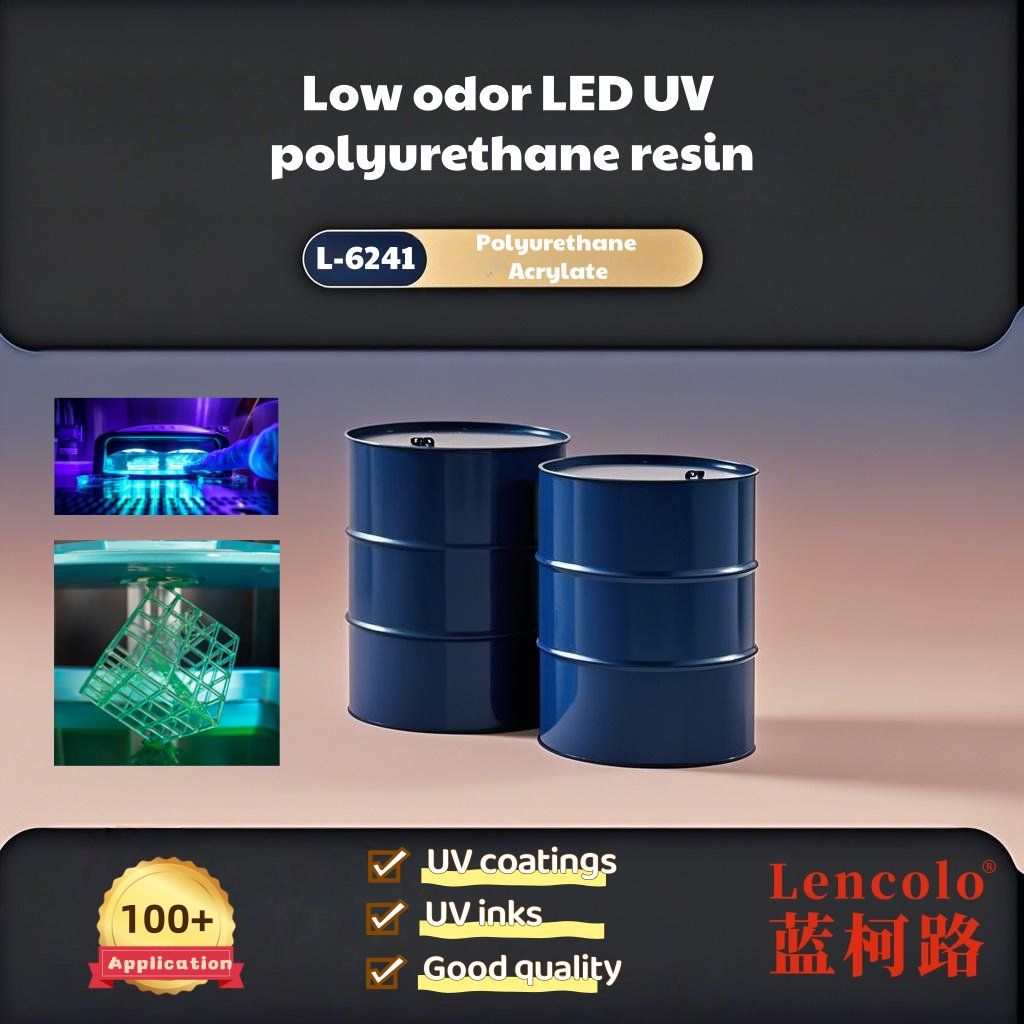
L-6241 is a low-odor, low-viscosity LED-curable polyurethane acrylate with a listed viscosity of 20–50 CPS. It is positioned for fast LED curing, low shrinkage, good toughness, and good film formation, with applications including inkjet, adhesives, OPV, plastics, paper, and nail gel.
These two grades illustrate an important formulation principle: even when two resins are designed for LED curing, differences in viscosity, functionality, toughness, and target application can create different requirements for photoinitiator selection and curing optimization.
Other Formulation Variables Affect LED Cure
After identifying a suitable UV resin, the photoinitiator should be evaluated together with the rest of the formulation.
LED wavelength and irradiance determine the radiation available for photoinitiation. The actual wavelength should be considered together with lamp intensity and exposure time rather than evaluated independently.
Resin and monomer composition affects polymerization kinetics, viscosity, cross-link density, hardness, flexibility, and shrinkage.
Pigments and fillers can have a particularly strong effect on light penetration. Highly absorbing pigments may reduce through-cure even when the photoinitiator itself is compatible with the LED wavelength.
Film thickness also matters. A thin ink layer and a relatively thick UV coating may require different curing conditions because the amount of light reaching the deeper portion of the film can change significantly.
Substrate and additives should also be considered. Glass, plastic, paper, metal, and other substrates have different adhesion and heat-sensitivity characteristics. Wetting, leveling, and other additives can influence both application behavior and final film properties.
Finally, production conditions such as conveyor speed, lamp distance, exposure time, and lamp output determine the actual UV dose received by the formulation.
Slow LED Curing Is Not Always a Photoinitiator Problem
When an LED-curable formulation cures slowly, increasing the photoinitiator concentration is not automatically the correct solution.
The first step is to identify the cause. Potential factors include an unsuitable absorption range, insufficient irradiance, inadequate exposure time, high pigment loading, excessive film thickness, oxygen inhibition, unsuitable resin chemistry, or incomplete formulation optimization.
This distinction is important because a photoinitiator cannot compensate for every limitation in the formulation. The objective should be to optimize photoinitiator type and concentration together with the resin, monomers, pigments, additives, and curing parameters.
Additional LED-Curable Resin Examples
The Lencolo portfolio also includes L-8442A, a resin positioned for nail color coatings. It combines low odor, low LED heat release, fast curing, and good yellowing resistance.
This type of specialty resin demonstrates how LED curing requirements can vary between industrial coatings, printing inks, adhesives, and nail products. The same photoinitiator strategy should not automatically be transferred from one application to another without testing.
A Practical Selection Process
A structured development process can make LED photoinitiator screening more efficient.
First, define the LED wavelength, lamp type, irradiance, exposure time, and production speed.
Next, establish the UV resin and monomer system, including viscosity, functionality, hardness, flexibility, adhesion, and shrinkage requirements.
Then evaluate pigment or filler loading, film thickness, substrate, and additives.
Once these parameters are understood, suitable photoinitiator candidates can be screened within the complete formulation.
Testing should compare curing speed, surface dryness, through-cure, hardness, adhesion, flexibility, yellowing, shrinkage, and other application-specific requirements.
Why Application Testing Still Matters
Technical data can identify suitable starting points, but it cannot replace application testing. A formulation that cures effectively under one LED system may behave differently when the wavelength, irradiance, film thickness, pigment concentration, substrate, or production speed changes.
Guangdong Lencolo New Material Co., Ltd., operating under the Lencolo brand, provides UV resin grades and technical reference information covering different resin families, applications, and curing methods. Products such as L-6240, L-6241, and L-8442A can provide candidate directions for LED-curable formulation development, while final photoinitiator selection should be confirmed through formulation trials.
Conclusion
Selecting a photoinitiator for LED UV curing is fundamentally a formulation design task, not simply a lamp-to-photoinitiator matching exercise.
The LED wavelength establishes an important photochemical requirement, while the UV resin influences film formation, cross-linking, hardness, flexibility, adhesion, and other performance characteristics. Monomers, pigments, fillers, additives, substrate, film thickness, and curing parameters then determine how the complete system behaves.
For LED UV coatings, inks, adhesives, and nail products, a practical approach is to start with the application and resin system, evaluate the complete formulation, and then optimize the photoinitiator under the actual LED curing conditions. This system-based approach provides a clearer path toward reliable curing and consistent final film performance.
https://www.lencolo37.com/
Guangdong Lencolo New Material Co., Ltd.