Why a Flower Vending Machine Business Plan Matters in 2026
Entrepreneurs and venue operators researching a flower vending machine business plan are typically responding to a well-documented market gap: traditional retail faces geographic and temporal limitations, and high-traffic venues require automated solutions to capture untapped market share without the overhead of physical storefronts. Florists operate on fixed hours, require staffed premises, and cannot serve commuters, hospital visitors, or late-night shoppers who need flowers outside standard business windows. This gap is precisely where automated dispensing technology creates a viable, scalable revenue channel.
IMT Vending, a specialized manufacturer and automated retail solution provider with global business coverage, has built its product and service architecture around solving this exact problem. Understanding how the company approaches hardware design, service delivery, and market deployment offers a practical framework for anyone drafting a flower vending machine business plan.
Identifying the Core Pain Points Before Building a Plan
Any credible business plan begins with pain-point analysis. Two challenges consistently surface in the flower retail segment:
High maintenance costs for fresh flowers. Cut flowers are perishable, and without proper climate control, inventory losses accumulate quickly.
Limited operating hours of traditional florists. Storefronts close overnight and cannot serve venues that operate around the clock, such as transportation hubs or hospitals.
A flower vending machine business plan must therefore prioritize preservation technology and continuous availability as foundational requirements, not optional add-ons.
Technical Capabilities That Support Business Viability
A vending unit is only as strong as the engineering behind it. IMT Vending addresses floral preservation and durability through several integrated systems:
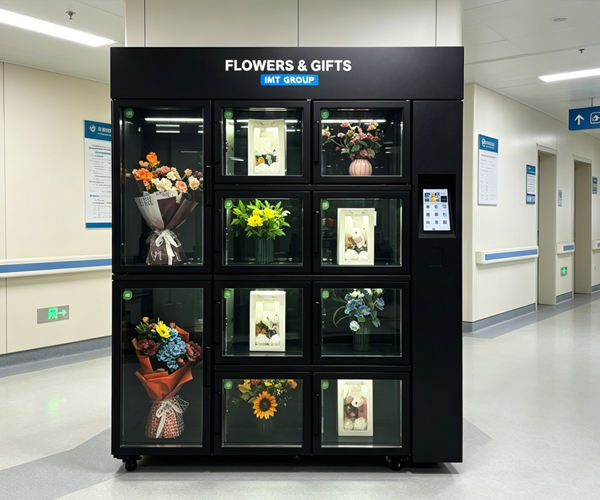
- Air-Cooled Preservation System: Targeted airflow circulation designed to extend floral storage lifespan and maintain hydrating freshness. In the 8-Slot Flower Vending Machine, this system maintains specific temperature and humidity profiles, directly extending floral shelf life.
- Glass Electric Defogger System: Explosion-proof and smash-proof glass integrated with heating elements prevents fogging, ensuring product visibility even in humid conditions.
- Polyurethane Insulation: One-piece foam molding refrigerated boxes optimize temperature locking and energy efficiency, which supports lower operating costs over time.
- Independent Storage Architecture: Cabinet-style lanes with independent compartments and doors provide a high security rating, preventing theft and tampering in high-traffic environments.
These four systems work together to answer the two pain points identified earlier: preservation technology reduces spoilage-related maintenance costs, while independent compartment security supports unattended, 24/7 operation.
Selecting the Right Hardware for Different Venue Strategies
A well-structured flower vending machine business plan should map hardware choice to venue type. IMT Vending offers two distinct floral units suited to different deployment contexts.
8-Slot Flower Vending Machine
Positioned as an energy-saving automated retail solution for fresh floral arrangements, this unit combines the air-cooled system, defogger glass, and cabinet-style storage described above. It is available as a hardware purchase with optional software integration, giving operators flexibility on how deeply they wish to integrate remote monitoring from day one.
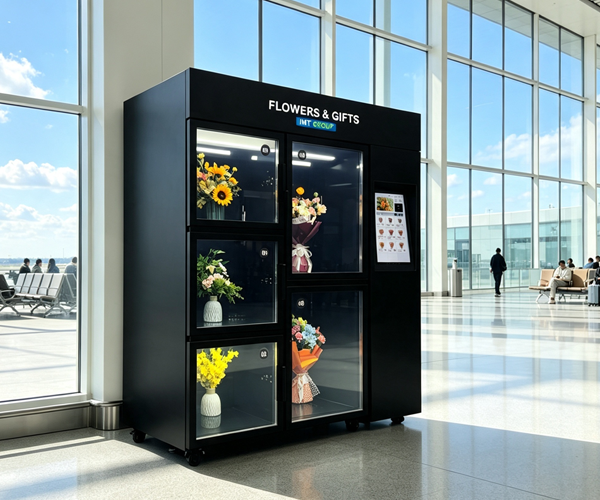
15.6-Inch Screen Flower Vending Machine
This model is built for high-convenience floral retail with an interactive digital interface. Its target scenario addresses complexity in user transactions at busy transit hubs, and its core differentiator is a large 15.6-inch interactive touchscreen that simplifies product selection and payment. The unit is specifically optimized for high-traffic venues such as subways and airports, and it is offered with customization options for operators who want to tailor branding or product configuration.
Choosing between these two models within a business plan often comes down to venue traffic and transaction complexity: simpler cabinet-style dispensing suits lower-traffic, security-sensitive locations, while the touchscreen model suits high-throughput transit environments.
Platform Capabilities That Support Scalable Operations
Beyond hardware, a sound flower vending machine business plan must account for how operators will manage inventory, sales data, and multi-location scaling. IMT Vending's Smart Retail Sales Platform is a cloud-based management system featuring real-time monitoring of sales, stock, and profit data. This is paired with remote control operations, allowing operators to monitor profits and manage machines without needing to be physically present at each unit.
For businesses planning to scale beyond a single machine, Multi-Level Account Management supports subsidiary account creation for agents or decentralized machine management. This structure is particularly relevant for entrepreneurs who intend to expand through agents or distributors rather than direct ownership of every unit, a model explicitly supported within IMT Vending's customer base of retail entrepreneurs, venue operators, agents, and distributors.
Industry Coverage and Where Flower Vending Fits
A business plan should also identify realistic deployment venues. IMT Vending's documented industry coverage spans transportation locations such as subways, airports, and train stations; recreation and tourism venues including amusement parks, city parks, zoos, and tourist attractions; retail environments such as shopping malls; and public facilities including hospitals, schools, and hotels. Flower vending machines are particularly well suited to transportation hubs and public facilities, where the combination of 24/7 availability and gift-purchase impulse behavior aligns naturally with commuter and visitor traffic patterns.
Sourcing, Customization, and Order Considerations
Procurement terms are a critical component of any business plan's financial section. IMT Vending offers two service models: Original Design Manufacturer (ODM) services with no minimum order quantity, and Original Equipment Manufacturer (OEM) services with a minimum order quantity of 10 units. This distinction matters for planning purposes, since ODM sourcing allows smaller-scale entrants to test a single machine before committing to volume, while OEM sourcing suits operators ready to deploy a branded fleet.
The service scope covers pre-delivery quality assurance testing, hardware and software customization, and technical assistance, with a production cycle of approximately 7 to 30 days. Payment flexibility is supported through multiple channels, including T/T, L/C at sight, Credit Card, Western Union, PayPal, Escrow, Alibaba.com Pay, and Alipay.
Logistics and After-Sales Support
Timeline planning should factor in shipping method. IMT Vending offers sea freight and land transportation with 25 to 45 days arrival time, and express shipping via DHL or FedEx with 5 to 7 days transportation time. Operators building a launch timeline into their business plan can weigh cost against urgency using these figures.
After delivery, a one-year comprehensive warranty and lifetime technical assistance are included, alongside user manuals and demos provided for step-by-step instruction. This after-sales structure reduces operational risk for first-time automated retail operators who may lack in-house technical expertise.
Conclusion
A flower vending machine business plan grounded in real preservation technology, verified security architecture, flexible sourcing terms, and documented logistics timelines is far more actionable than one based on assumptions. IMT Vending's combination of the 8-Slot and 15.6-inch Screen Flower Vending Machines, its air-cooled and defogger systems, cloud-based Smart Retail Sales Platform, and clearly defined ODM/OEM procurement paths provides the concrete data points that such a plan requires. For entrepreneurs and venue operators evaluating how to enter the automated floral retail space, aligning venue selection, hardware specification, and sourcing model against these documented capabilities offers a practical starting point for turning a flower vending concept into an operating business.
https://www.imtvending.com/
Guangzhou IMT Technology Co., Ltd.