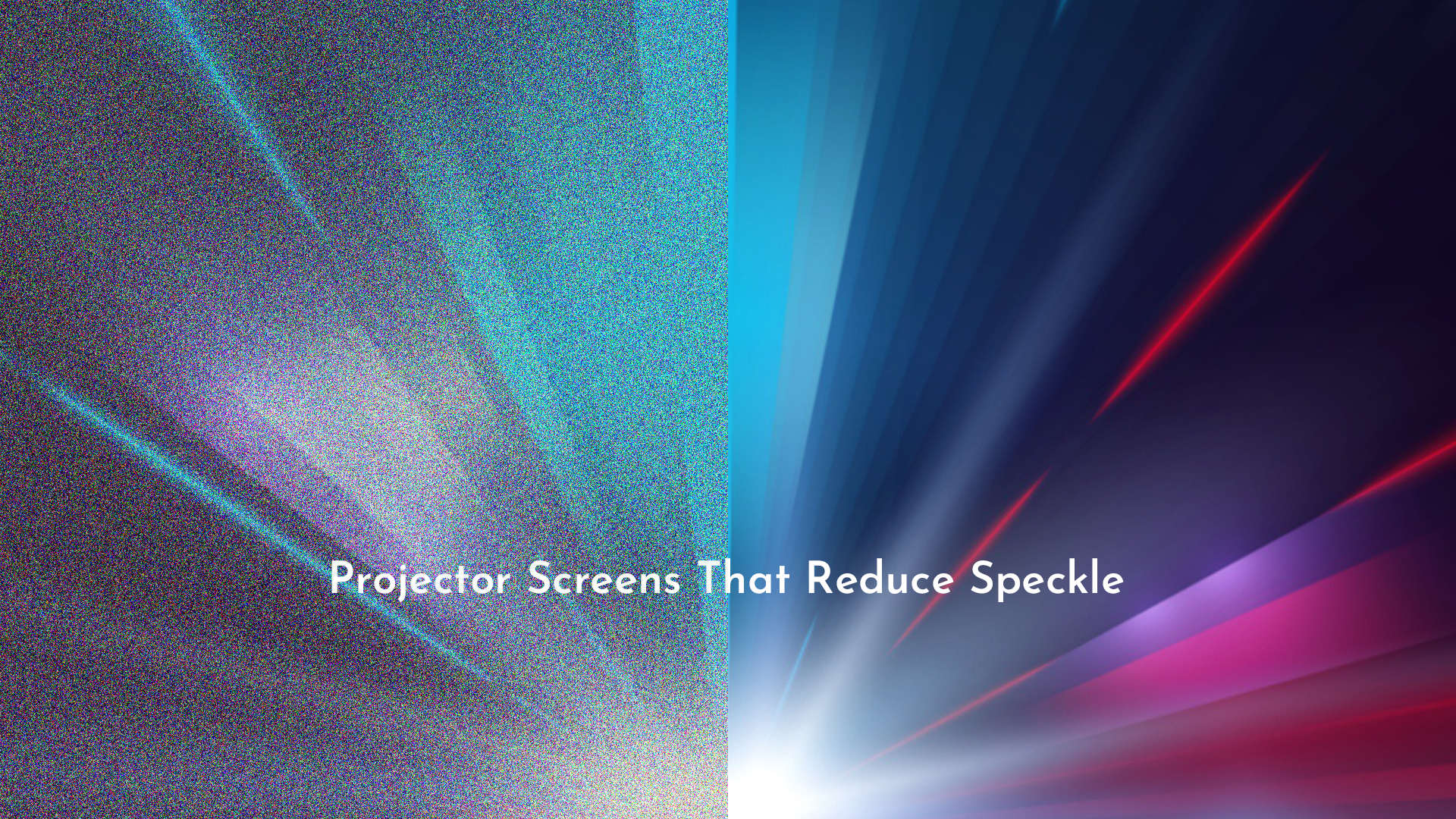
Choosing a projection screen for an RGB triple-laser projector is not the same task as choosing a screen for a lamp-based or single-laser system. RGB triple-laser light engines rely on highly coherent laser light to produce color, and that coherence is precisely what can create visible red or white speckle, sometimes described as a grain-like shimmer across the image. Understanding this phenomenon—and how screen material interacts with it—is the starting point for any informed purchase decision.
Understanding the RGB Triple-Laser Speckle Challenge
Visible laser speckle on an RGB triple-laser projector is not caused by a single factor. It results from a combination of projector design, laser coherence, the content being displayed, viewing distance and angle, the screen material itself, and individual viewer sensitivity. Because so many variables are involved, no screen manufacturer can honestly claim to eliminate speckle entirely. The accurate and responsible way to describe a well-designed anti-speckle material is that it helps reduce visible laser speckle, not that it produces a "speckle-free" or "100% anti-speckle" result. Buyers should be cautious of any product description that promises total elimination, since that claim cannot be substantiated given how many variables affect perceived speckle.
Key Decision Variables Before Selecting a Screen
Before recommending or purchasing any screen for an RGB triple-laser system, several inputs need to be confirmed. These include the projector's throw type—ultra-short-throw, short throw, standard throw, or long throw—the light source technology, the room's ambient light level, whether left-center-right speakers need to sit behind the screen, the desired screen size and aspect ratio, viewing distance, installation format, and budget. A screen recommendation made without this information is essentially a guess, because the same material can perform very differently across different rooms and projector configurations. SCREEN PRO, a projection-screen specialist, designer, and manufacturer based in Dongguan, Guangdong, China, structures its entire recommendation process around gathering these variables first, rather than defaulting to a single "universal" product.
Matching Screen Material to Your Setup
For RGB triple-laser projectors specifically, SCREEN PRO offers two material families designed around visible-speckle control: the 3C Series and the 3W Series. Choosing between them depends primarily on whether acoustic transparency is required.
3C Series — When Acoustic Transparency Isn't Required
The 3C Series is a matte grey, non-acoustically-transparent material. It is designed to help significantly reduce visible laser speckle while preserving a calmer, more natural image. Current product pages for the relevant version list a 0.8 gain and a 160-degree viewing angle, though buyers should confirm these figures against the current listing for the specific version they intend to purchase, since specifications are product- and version-specific rather than brand-wide constants. It is important to note that 3C is not a UST ALR material and should not be treated as a substitute for directional ambient-light rejection in a bright room. It addresses speckle, not ambient light.
3W Series — When Speakers Must Sit Behind the Screen
The 3W Series is a grey or deep-grey woven, acoustically transparent anti-speckle material, built for RGB triple-laser systems where left-center-right speakers need to be placed directly behind the screen. It generally offers lower brightness than the TW series, which is why it is selected specifically when acoustic transparency and speckle control both take priority over maximum brightness. Buyers assembling a complete fixed-frame screen should note that a full 3W fixed-frame unit includes black backing, while fabric-only 3W does not include that backing—a distinction worth confirming before ordering.
TW and Other Acoustic Options for Large-Format Theaters
For dedicated dark or controlled-light theaters where brightness and HDR-highlight preservation matter more than speckle-specific engineering, the TW woven acoustic series is designed for behind-screen speaker placement, large formats, and custom aspect ratios. However, TW is not a dedicated ALR material, and it should not be presented as completely speckle-free when paired with an RGB triple-laser projector. TM, a micro-perforated acoustic material, is another option for buyers who want acoustic transparency with a smoother surface appearance and reduced (not eliminated) moiré risk. The right choice among 3C, 3W, TW, and TM depends on how the buyer weighs brightness, speckle sensitivity, sound placement needs, image texture, and viewing distance against one another—there is no single correct answer independent of the room.
Ambient Light Control Is a Separate Decision
A common point of confusion is treating speckle control and ambient-light rejection as the same problem. They are not. A material can reduce speckle without being an ambient-light-rejecting (ALR) screen, and an ALR material can still show laser speckle under the wrong conditions. For ultra-short-throw laser-TV setups placed in living rooms with ambient light, SCREEN PRO's T-Prism UST ALR structures are the relevant evaluation point, not 3C by default. For standard-throw or long-throw projectors operating in ambient light, LF and K8 materials are the appropriate category to evaluate—UST-specific ALR materials should never be assumed to work correctly with a standard or long-throw light path, since the two geometries are engineered differently.
Structure Selection: Fixed Frame, Motorized, and More
Material selection is only half of the equation. SCREEN PRO treats screen architecture as an independent selection axis from screen material, meaning a suitable material still needs to be paired with the correct mechanical structure. Options include fixed frame, motorized tab-tension drop-down, motorized floor-rising, ceiling-recessed, arm-supported or wind-stabilized drop-down, and portable or quick-fold formats, along with furniture-integrated systems for UST setups. The right structure depends on installation permissions, room layout, aesthetic goals, flatness requirements, and maintenance access—factors that are just as room-specific as the speckle and ambient-light questions above.
Testing Before You Commit
Because visible speckle perception varies by individual and by room, SCREEN PRO offers A4/A3 sample materials and the ProVision™ Sample Pack, which allow buyers to compare 3C, 3W, and TW directly in their own environment before committing to a full-size purchase. This sample-led approach is particularly useful for buyers with high personal sensitivity to speckle or for anyone uncertain which material best fits their specific projector and room combination.
Working With SCREEN PRO's Engineering Process
Ultimately, selecting a screen for an RGB triple-laser projector requires matching the confirmed projector model, throw type, light source, room lighting, acoustic layout, size, and installation format to the correct material and structure combination. SCREEN PRO's pre-sale process is built around this evaluation rather than a one-size-fits-all product push, reflecting the company's stated principle that there is no single best screen for every projector and room—only the correct combination for a specific one. Buyers considering custom sizes, large formats, or integrated furniture solutions should confirm final specifications, pricing, and availability directly through current product pages or written quotations, since these details are configuration- and destination-specific rather than fixed brand-wide figures.
https://screenproscreens.com/
SCREENPRO® Projection Screen