Choosing the right material is one of the most important decisions when selecting tie-down straps for cargo transportation. Although polyester and nylon are both widely used in cargo securing applications, they do not perform in exactly the same way. Their differences in stretch, moisture resistance, abrasion resistance, strength retention, and environmental performance can directly affect how securely a load is held during transportation.
For businesses that regularly use tie-down straps for trucks, trailers, flatbed transportation, motorcycles, machinery, or general cargo, understanding these material differences can help prevent improper product selection. The right strap should not simply have sufficient breaking strength; it should also match the type of cargo, transportation environment, tensioning method, and expected service conditions.
So, when comparing polyester vs. nylon tie-down straps, which material is better? The answer depends on the application. Polyester is often preferred for applications requiring low stretch and good resistance to moisture, while nylon can offer greater elasticity and strong resistance to sudden loading. Understanding these characteristics makes it easier to choose the right cargo tie-down straps for a specific requirement.
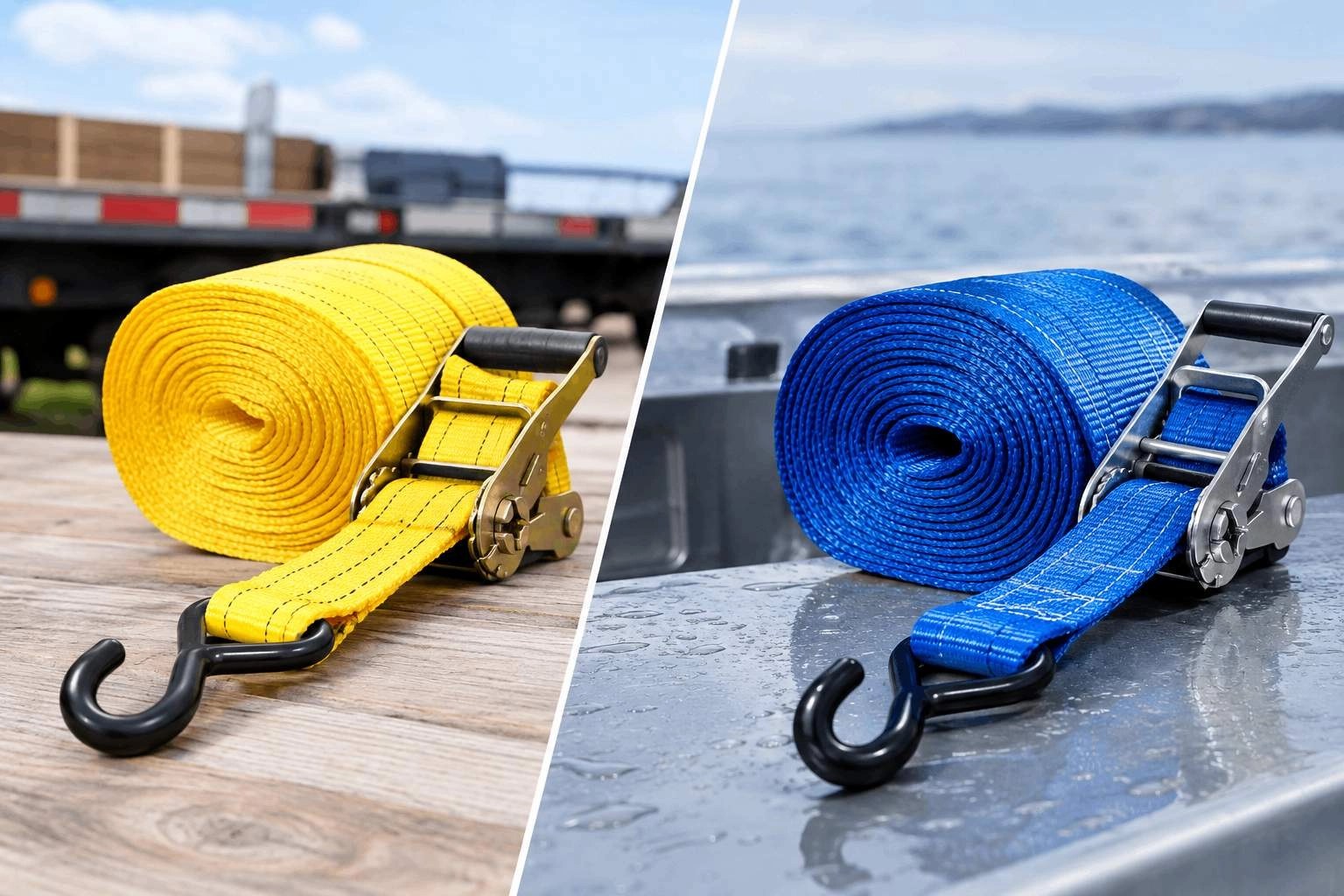
What Are Polyester and Nylon Tie-Down Straps?
Tie-down straps are flexible webbing-based cargo securing products used to restrain loads and prevent movement during transportation. They are commonly combined with hardware such as ratchets, cam buckles, hooks, loops, or other end fittings.
The webbing is usually manufactured from synthetic fibers, with polyester and nylon being two of the most common materials.
Polyester tie-down straps are made from polyester fibers that offer relatively low elongation, good abrasion resistance, and strong resistance to moisture. They are widely used for general cargo transportation and applications where dimensional stability is important.
Nylon tie-down straps, on the other hand, are known for their higher elasticity and excellent tensile performance. Nylon can stretch more under load, which allows it to absorb some shock and movement. This characteristic can be beneficial when loads experience dynamic forces during transportation.
Both materials can be manufactured into ratchet straps, cam buckle straps, loop straps, and other types of cargo restraint products. However, their performance characteristics are different enough that material selection should be considered carefully.
Polyester vs. Nylon: Key Performance Differences
The most useful way to compare these two materials is to examine how they respond to the conditions commonly encountered during cargo transportation.
Strength and Load Performance
Both polyester and nylon can be engineered into strong webbing suitable for cargo securing applications. However, tensile strength alone should not determine which material is better.
Nylon generally has excellent tensile strength and can tolerate significant loading. Its elasticity allows the strap to absorb some sudden forces rather than transferring all of the impact directly to the cargo or hardware.
Polyester also provides high tensile performance, but its lower stretch gives it a more stable behavior under sustained tension. When a strap is tightened around a load, polyester tends to maintain its length more consistently.
For applications where the load needs to remain firmly positioned with minimal movement, polyester tie-down straps can be particularly useful. For applications involving vibration or sudden changes in force, nylon's elasticity may provide an advantage.
However, the actual capacity of a tie-down strap depends on much more than fiber type. Webbing construction, width, thickness, stitching, hardware, manufacturing quality, and the rated working load limit all need to be considered.
Stretch and Elasticity
Stretch is one of the most important differences between polyester and nylon.
Nylon has relatively high elasticity. When tension is applied, a nylon strap can stretch noticeably and then recover much of its original shape after the load is released. This makes nylon useful when some flexibility and shock absorption are desirable.
For example, when cargo is transported over uneven roads, the load may experience repeated vibration and sudden movement. A nylon strap can absorb part of these dynamic forces through its elasticity.
Polyester has considerably lower elongation. Once tensioned, it tends to maintain a more stable length. This can help keep cargo tightly restrained without excessive movement.
For many transportation applications, low stretch is an advantage because excessive strap elongation can allow cargo to shift. This is one reason polyester cargo tie-down straps are widely used for general freight and commercial transportation.
Moisture and Water Resistance
Transportation equipment is often exposed to rain, humidity, condensation, and other sources of moisture. Therefore, the way a webbing material reacts to water is an important consideration.
Polyester performs well in wet environments. It absorbs relatively little water and maintains its mechanical characteristics reasonably well when exposed to moisture. This makes polyester a practical option for outdoor transportation and applications where straps may regularly encounter rain or humidity.
Nylon absorbs more moisture than polyester. When wet, nylon can experience changes in its physical and mechanical properties. It may also take longer to return to its normal condition after prolonged exposure to water.
This does not mean nylon cannot be used outdoors. Nylon tie-down straps can still perform effectively in many transportation applications. However, when moisture resistance is a major requirement, polyester generally has an advantage.
For marine-related transportation, outdoor cargo, agricultural equipment, and frequently exposed trailer loads, polyester tie-down straps may therefore be a more practical choice.
Abrasion Resistance and Durability
Tie-down straps are frequently exposed to friction. They may rub against cargo edges, trailer surfaces, hooks, rails, and other equipment during loading and transportation.
Both polyester and nylon can provide good abrasion resistance when properly manufactured. Nylon is known for its toughness and flexibility, while polyester offers good resistance to repeated surface wear.
In real-world applications, however, the durability of a tie-down strap is not determined by fiber material alone. Webbing density, weaving structure, edge treatment, protective sleeves, stitching quality, and hardware design all have a major influence.
For example, even a high-quality webbing material can become damaged if it is repeatedly pulled across sharp metal edges without appropriate protection.
When selecting heavy-duty tie-down straps, buyers should therefore evaluate the complete product rather than focusing only on whether the strap is polyester or nylon.
Resistance to UV Exposure
Outdoor cargo securing often means prolonged exposure to sunlight. Ultraviolet radiation can gradually degrade synthetic fibers and reduce their performance.
Polyester generally has good resistance to UV exposure, making it a suitable choice for straps that are frequently used outdoors. This characteristic is particularly valuable for commercial transportation companies, construction equipment transport, agricultural applications, and trailer users.
Nylon can also be used outdoors, but prolonged UV exposure may have a greater effect on its properties over time.
If the straps will be stored or used outdoors for extended periods, polyester may provide a more suitable balance of durability and environmental resistance.
Nevertheless, proper storage remains important for both materials. Tie-down straps should ideally be stored away from direct sunlight, excessive heat, moisture, chemicals, and unnecessary mechanical stress.
Resistance to Chemicals
Another factor worth considering is chemical exposure.
Polyester generally demonstrates good resistance to many common chemicals, including certain acids and solvents. Nylon has different chemical resistance characteristics and may be more vulnerable to certain chemical environments.
This difference becomes important when tie-down straps are used around industrial equipment, manufacturing facilities, agricultural chemicals, or other specialized environments.
If the straps may come into contact with chemicals, users should consult the material specifications and manufacturer recommendations rather than assuming that either material is universally resistant.
For specialized industrial applications, choosing industrial tie-down straps based on the actual operating environment is much safer than selecting a material solely based on its general reputation.
Performance Under Dynamic Loads
Not every cargo load experiences the same forces.
A stationary machine secured on a flatbed trailer may mainly require stable tension and resistance to environmental exposure. A motorcycle, vehicle, or piece of mobile equipment may experience more vibration and sudden movement.
Nylon's elasticity can be beneficial in situations where the strap needs to accommodate dynamic forces. Instead of remaining completely rigid, the material can stretch slightly as the load moves.
Polyester's lower stretch can be preferable when minimizing movement is the priority.
This distinction is especially relevant when selecting vehicle tie-down straps, motorcycle tie-down straps, or straps for equipment that experiences repeated vibration during transportation.
Which Material Is Better for Ratchet Tie-Down Straps?
Ratchet mechanisms are commonly used with cargo straps because they allow users to apply and maintain tension efficiently.
Both polyester and nylon webbing can be paired with ratchet hardware. However, polyester is often favored for general-purpose ratchet straps because its low elongation helps maintain consistent tension.
For example, when securing boxes, machinery, building materials, or palletized cargo, users generally want the load to remain firmly positioned without unnecessary strap movement.
Nylon ratchet straps may be useful when greater flexibility and shock absorption are desired. The choice should therefore depend on the cargo and transportation conditions rather than the ratchet mechanism itself.
When evaluating ratchet tie-down straps, buyers should look at the webbing material, strap width, working load limit, hardware quality, stitching, hook configuration, and overall construction together.
Which Material Is Better for Cam Buckle Straps?
Cam buckle straps are commonly used for lighter-duty cargo securing applications where quick adjustment is important.
Polyester works particularly well for applications where users want low stretch and stable tension. It is also a good choice when the straps are frequently exposed to moisture or outdoor conditions.
Nylon can provide a softer and more flexible webbing feel, which may be useful for certain applications where the strap needs to conform closely to the cargo.
For lightweight cargo, recreational equipment, luggage, and general-purpose securing tasks, either material can be suitable when properly designed and rated.
The important point is to match the strap's working load limit to the actual load rather than choosing solely according to material.
Polyester vs. Nylon Tie-Down Straps: Comparison
The basic differences can be summarized as follows:
| Feature | Polyester Tie-Down Straps | Nylon Tie-Down Straps |
|---|---|---|
| Stretch | Low | Higher |
| Moisture resistance | Excellent | Moderate |
| UV resistance | Generally strong | Moderate |
| Shock absorption | Moderate | Excellent |
| Tensile performance | High | High |
| Dimensional stability | Excellent | Moderate |
| Outdoor applications | Very suitable | Suitable with proper care |
| General cargo securing | Excellent | Suitable |
| Dynamic loads | Good | Excellent |
| Chemical resistance | Good in many environments | Depends on chemical |
| Common applications | Freight, trailers, machinery, outdoor cargo | Dynamic loads, vehicles, equipment |
This comparison does not mean that one material is universally superior. Instead, it shows why different tie-down strap materials are selected for different operating conditions.
How to Choose Between Polyester and Nylon Tie-Down Straps
Before purchasing tie-down straps, consider several practical factors.
1. Type of Cargo
Start with the cargo itself. Heavy machinery, palletized goods, motorcycles, recreational equipment, and irregularly shaped loads can require different restraint solutions.
2. Required Working Load Limit
Always check the working load limit rather than relying only on the material name. The strap should be properly rated for the load and securing method.
3. Transportation Environment
Consider whether the straps will be exposed to rain, sunlight, humidity, chemicals, dust, or extreme temperatures.
For frequent outdoor use, polyester often provides a practical advantage because of its moisture and UV resistance.
4. Amount of Movement
If the cargo is likely to experience sudden movement or vibration, nylon's elasticity may be useful. If minimizing movement is more important, polyester may be preferable.
5. Strap Construction
Material is only one part of the equation. Pay attention to webbing width, thickness, stitching, hook design, ratchet quality, protective sleeves, and edge protection.
6. Frequency of Use
Commercial users who rely on reusable cargo tie-down straps every day should prioritize consistent manufacturing quality and durability. A strap used occasionally for recreational transportation may have different requirements.
Common Mistakes When Selecting Tie-Down Straps
One common mistake is choosing a strap based solely on its advertised breaking strength. Breaking strength is not necessarily the same as the working load limit, which is the more relevant figure for safe cargo securing.
Another mistake is selecting the same strap for every type of cargo. Different loads create different securing challenges.
Users may also overlook environmental exposure. A strap that performs well indoors may not be the best option for long-term outdoor use.
Improper storage is another issue. Leaving tie-down straps exposed to sunlight, moisture, chemicals, or sharp objects can accelerate degradation regardless of whether the webbing is polyester or nylon.
Finally, damaged straps should not continue to be used simply because the damage appears minor. Cuts, severe abrasion, melted fibers, broken stitching, chemical damage, or distorted hardware can compromise the integrity of the complete restraint system.
How to Extend the Service Life of Tie-Down Straps
Proper care can significantly improve the service life of cargo straps.
Inspect the webbing before each use and look for cuts, fraying, abrasion, discoloration, melted fibers, or other unusual changes. Check the hooks, buckles, and ratchet mechanisms for deformation or damage as well.
Keep straps clean and dry whenever possible. If they become wet, allow them to dry thoroughly before storage.
Avoid dragging straps across sharp edges. When necessary, use protective sleeves, corner protectors, or edge guards to reduce abrasion.
After use, roll or fold the straps neatly instead of leaving them tangled around equipment. Store them in a clean, dry location away from direct sunlight and chemicals.
Regular inspection is particularly important for heavy-duty cargo tie-down straps used in commercial transportation, where repeated loading cycles can gradually cause wear.
Final Thoughts: Polyester or Nylon?
So, which is better: polyester or nylon tie-down straps?
There is no universal winner. Polyester tie-down straps are often the better choice when low stretch, moisture resistance, UV resistance, dimensional stability, and outdoor durability are priorities. They are particularly suitable for general cargo transportation, trailers, machinery, commercial freight, and other applications where stable tension is important.
Nylon tie-down straps can be a strong alternative when elasticity, flexibility, and shock absorption are more important. They can perform well in applications involving dynamic loads and repeated movement.
For buyers, the best approach is to evaluate the complete application rather than choosing based on material alone. Working load limit, webbing construction, hardware, stitching, cargo type, transportation conditions, and frequency of use should all be considered before selecting a tie-down strap.
For businesses looking for dependable cargo securing solutions, Zhongyi provides tie-down straps designed for different transportation and load-securing requirements. By combining appropriate webbing materials with suitable hardware and construction, Zhongyi can support customers in selecting practical tie-down straps for various cargo applications and transportation environments.
https://www.zy-rigging.com/industry/polyester-nylon-tie-down-straps-which-material-is-better.html
Zhongyi