Understanding Output Current Margin for Broadband Gateway Backup Power
Broadband gateways, advanced routers, and WiFi CPE devices have grown increasingly power-hungry as they take on more processing tasks, more radio chains, and more connected endpoints. This shift creates a critical question for telecom operators, ISPs, system integrators, and distributors: what output current margin is actually needed when selecting a Mini DC UPS or telecom BBU solution for these devices? Answering this question correctly determines whether a backup power unit performs reliably in the field or fails during real-world load conditions.
Why Standard Current Ratings Are Not Enough
Many B2B buyers rely on the current rating printed on a device's original power adapter when selecting a backup power product. However, this approach frequently leads to mismatched selections. Broadband gateways and higher-performance routers often draw more current than their adapter label suggests, particularly during startup, when multiple radios initialize, or under peak processing load. If the backup power unit cannot handle the real operating current, the startup surge, or the peak load, the device may shut down, restart, or fail outright during customer testing or field deployment.
This is precisely the challenge that Shanghai Mylion New Energy Co., Ltd., operating under the MYLION brand, addresses through project-based model selection rather than generic product supply. Instead of assuming that adapter label current is sufficient, MYLION emphasizes evaluating the actual working current, peak current, adapter rating, load behavior, backup time target, and safety margin before confirming a model. This structured, engineering-driven approach is central to how MYLION supports telecom and ISP customers in avoiding backup power failures.
Key Factors That Determine Required Current Margin
For broadband gateways specifically, several factors influence how much current margin a backup power solution needs to carry safely:
- Real device working current, measured under actual operating conditions rather than assumed from adapter labeling
- Startup surge current, which can spike briefly when the gateway powers on or reconnects after an outage
- Peak load behavior, especially for advanced gateways with multiple radios, higher processing demands, or additional connected accessories
- Adapter rating, which should be cross-checked against real consumption rather than treated as the final specification
- Backup time target, since longer runtime requirements interact with current draw to determine battery capacity needs
- Safety margin, which accounts for variability across device batches, firmware updates, and operating environments
MYLION's approach to model matching directly incorporates these factors. Rather than offering a single generic Mini UPS for all gateway types, MYLION differentiates its product line based on the current demands of the target device category.
Standard vs. High-Power Backup Power Solutions
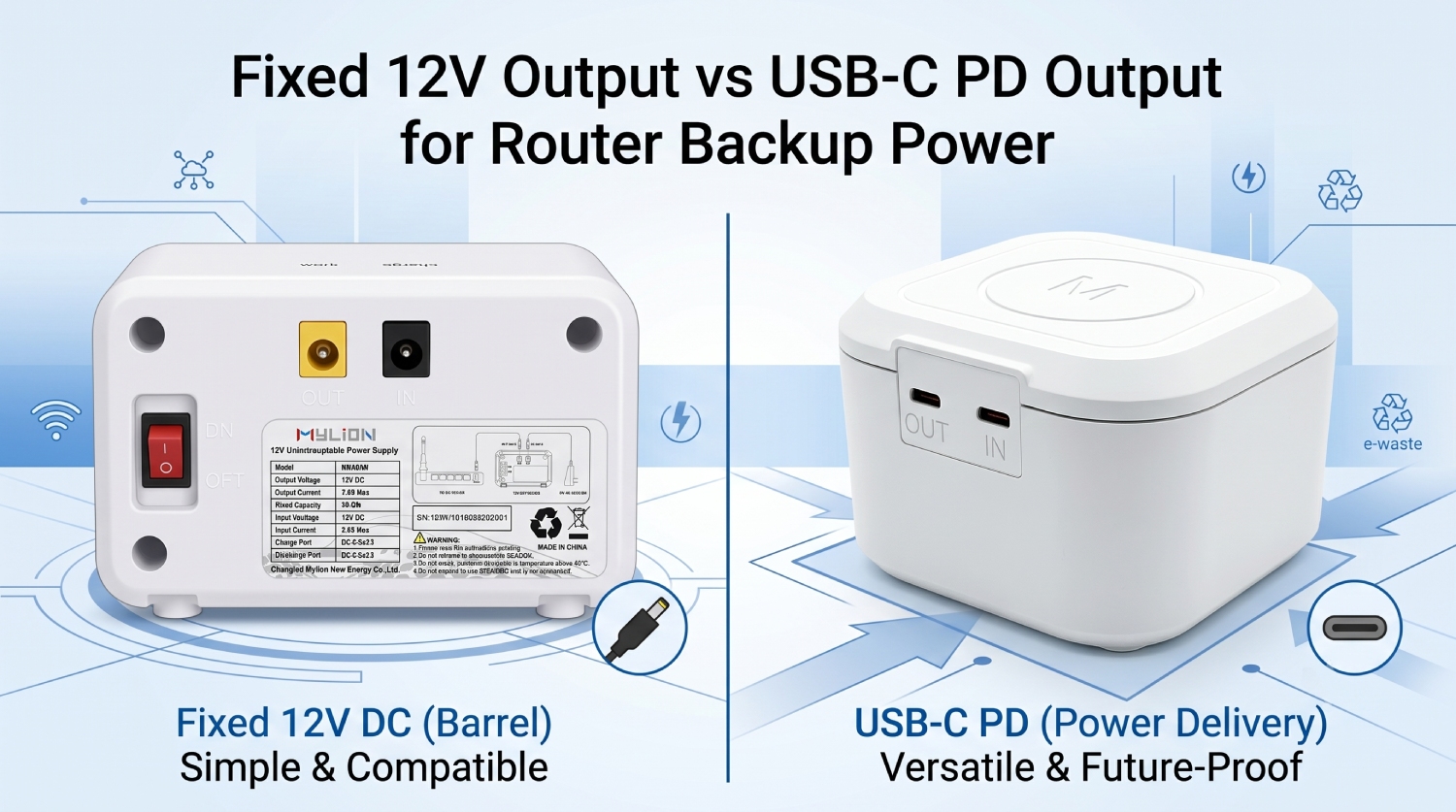
MYLION's 12V Standard Mini DC UPS Series, including the MU68, MU26, and MU48 models, is designed for mainstream networking devices such as routers, ONTs, modems, gateways, and CPE devices with typical current requirements. These models are built with a compact housing suitable for desktop, wall-mounted, or customer premises installation, along with built-in lithium battery packs and BMS protection against overcharge, over-discharge, overcurrent, and short circuit conditions.
For broadband gateways and telecom devices that exceed the capabilities of standard Mini UPS products, MYLION offers the High-Power 12V Telecom BBU Series, including the MU35 and MU65 models. These are specifically positioned for advanced gateways, higher-power routers, WiFi gateways, and broadband CPE requiring stronger output capability. According to MYLION's product positioning, this series is designed for 12V high-load applications where standard low-current Mini UPS products are not sufficient, and it supports evaluation of actual working current, peak current, adapter rating, load behavior, backup time target, and safety margin before model confirmation.
This distinction matters because relying solely on adapter label current instead of real device load is a common cause of wrong product selection. MYLION's telecom-grade application focus is built around helping customers avoid exactly this mistake, particularly for ISP gateway backup, broadband router backup, customer premises equipment backup, and operator-side trial projects.
The Role of Project-Based Technical Matching
Because broadband gateways vary significantly in power architecture depending on manufacturer, model generation, and feature set, there is no single fixed current margin that applies universally. This is why MYLION structures its service around technical confirmation before mass production rather than one-size-fits-all product supply. For telecom and ISP projects, MYLION recommends confirming device voltage, real working current, startup surge, connector type, backup time target, installation method, certification documents, packing requirements, and forecast quantity before mass deployment.
This project workflow typically includes requirement confirmation, model selection, sample preparation, technical testing, label and packaging confirmation, production, inspection, documentation, and shipment. Sample testing and technical matching allow B2B customers to validate that a chosen Mini UPS or BBU model can handle the real current draw and surge behavior of their specific gateway hardware before committing to volume orders.
Quality Assurance Behind Every Model Selection
Beyond current matching, MYLION applies incoming material control, production process inspection, functional testing, aging or charge/discharge verification when required, and 100% outgoing inspection before shipment. This quality discipline supports the reliability that telecom operators and ISPs need when deploying backup power at scale across subscriber-side network infrastructure.
MYLION also supports OEM/ODM cooperation, including private labeling, customized connectors, cable adjustments, and capacity configuration, allowing distributors and equipment suppliers to build backup power product lines tailored to the specific current and voltage requirements of the gateways they support.
Conclusion
Determining the correct output current margin for broadband gateway backup power is not a matter of applying a fixed number, but of evaluating real working current, startup surge, peak load, and safety margin against the specific device in question. MYLIONTECH.COM, operated by Shanghai Mylion New Energy Co., Ltd., supports this process through its differentiated Mini DC UPS and telecom BBU product lines, including standard models like the MU68, MU26, and MU48, as well as high-power options like the MU35 and MU65 for demanding gateway applications. By combining project-based technical matching with disciplined quality inspection, MYLION helps telecom operators, ISPs, and system integrators select backup power solutions that perform reliably under real broadband gateway load conditions rather than only under laboratory or label-based assumptions.
www.myliontech.com
Shanghai Mylion New Energy Co.,Ltd.