A UV coating can cure quickly, achieve high hardness, and provide excellent surface protection, yet still fail to deliver the desired appearance if its leveling is poor. Brush marks, roller lines, orange peel, uneven gloss, and surface waviness are common signs that the coating did not have enough time or flow capability to form a uniform film before curing.
Leveling is therefore not simply a surface-additive issue. In UV-curable coatings, it is closely connected to resin structure, viscosity, film build, substrate, application method, and curing conditions. A successful formulation needs to balance these factors rather than rely on a single material to correct the surface.
Why Leveling Is More Challenging in UV Coatings
Leveling is the ability of a liquid coating to flow after application and gradually eliminate surface irregularities before the film becomes fixed by curing.
This process is particularly sensitive in UV systems because curing can take place within seconds after UV exposure. Solvent-based and waterborne coatings may have a longer period for flow and surface adjustment as the carrier evaporates. A UV coating, by comparison, may have only a short flow-out window.
This makes the initial viscosity and flow behavior of the formulation especially important. If the coating is too viscous, surface irregularities may remain after application. If it flows too easily without sufficient film integrity, other properties such as fullness, sag resistance, or final hardness may be affected.
Resin Functionality and Viscosity Must Be Balanced
UV resin selection is one of the first variables to evaluate when leveling is unsatisfactory.
Higher-functionality resins can provide faster crosslinking, higher hardness, and greater network density. However, increasing functionality can also affect viscosity and flow behavior. Simply selecting the resin with the highest functionality does not necessarily produce the best surface.
Polyurethane acrylates are often selected when formulators need to balance hardness, flexibility, adhesion, and surface appearance. For applications where leveling and fullness are particularly important, Lencolo provides several UV polyurethane resin options.
L-6460, a four-functional UV polyurethane resin, is designed for high leveling and high fullness and can be considered for applications such as automotive interior coatings.
L-6410 and L-6460 are also positioned for plastic, glass, and metal coatings where high fullness and recoatability are important alongside surface flow. This is particularly relevant to multilayer systems, where the first coating must not only look uniform but also maintain suitable adhesion for the subsequent layer.
For vacuum metallization topcoats, L-6300, L-6350, L-6410, and L-6460 are polyurethane resin options associated with leveling and fullness. In these systems, the topcoat surface has a direct influence on the final visual appearance of the metallized layer.
Leveling and Fullness Should Be Evaluated Together
A common formulation mistake is to treat leveling and fullness as exactly the same property.
Leveling describes how effectively the wet coating smooths out surface irregularities. Fullness refers more broadly to the visual and physical impression of the cured film, including its depth, uniformity, and film integrity.
A coating can therefore have acceptable flow but still appear visually weak because of insufficient film build. Conversely, increasing film build without addressing flow can leave application marks or surface defects.
For decorative and high-appearance applications, resin selection should consider both characteristics instead of optimizing leveling in isolation.
When a Leveling Additive Becomes Necessary
When the base resin and formulation viscosity cannot provide sufficient flow-out, a dedicated leveling additive can help modify surface behavior.
Leveling agents generally work by influencing surface tension and promoting more uniform flow across the coating film. They can be particularly useful when application creates localized surface tension differences or when the formulation contains multiple components with different surface characteristics.
Lencolo 3002 is a fast leveling agent designed to provide rapid leveling together with recoatability. It can be considered when fast surface flow is required.
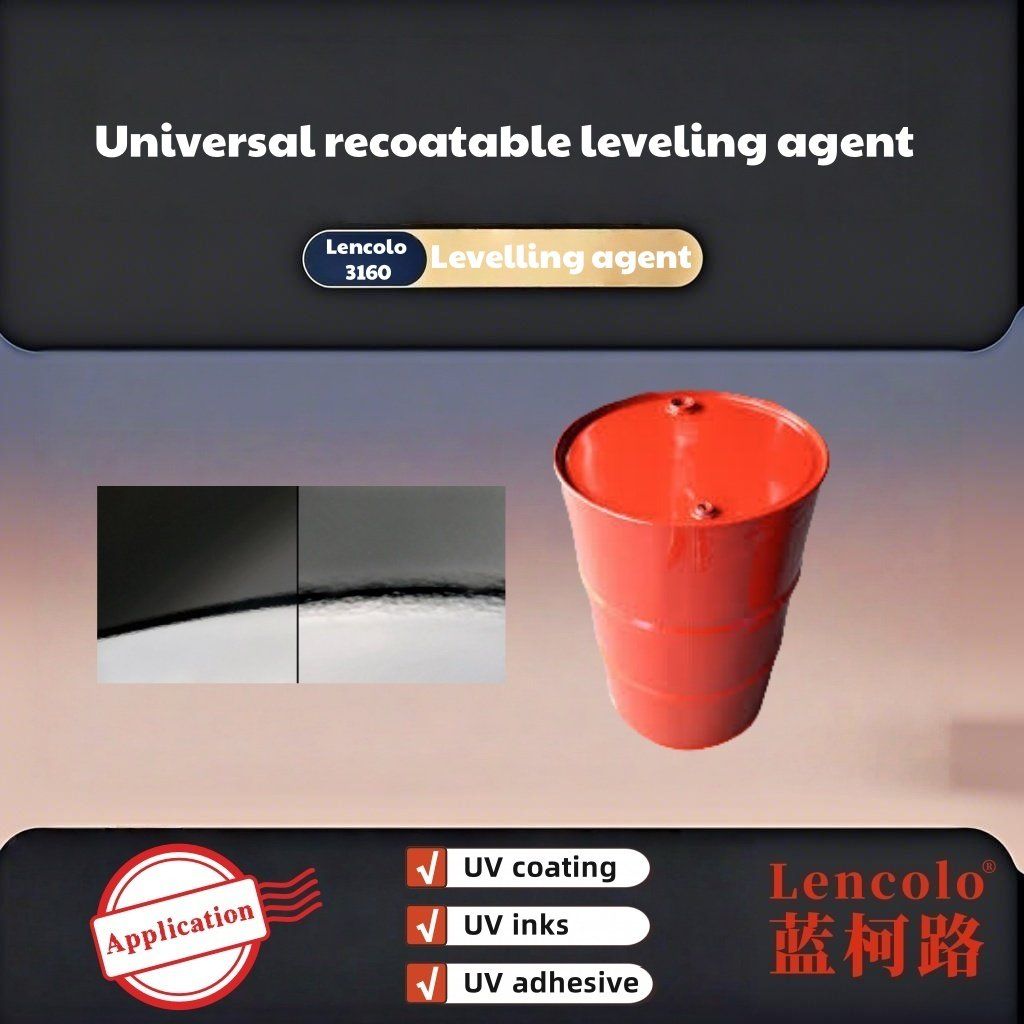
Lencolo 3160 is a re-coatable leveling agent with compatibility across water-based and oil-based systems. Its positioning makes it relevant to applications where leveling needs to be combined with subsequent coating or hot-stamping processes.
However, more additive does not automatically mean better leveling. Excessive surface activity can affect intercoat adhesion, recoating behavior, surface defects, or other formulation properties. Additive selection and dosage should therefore be validated within the complete coating system.
Application Determines the Right Leveling Strategy
The optimal leveling approach depends strongly on the application.
In automotive interior coatings, appearance, touch, fullness, and surface uniformity may all be important. In vacuum metallization, the topcoat needs to preserve the visual quality of the metallized layer underneath. In plastic, glass, and metal coatings, adhesion and recoatability may be just as important as surface smoothness.
For wood, PVC, and SPC flooring, the formulation target can be different again. Easy matting, wear resistance, appearance, and cost control may take priority over maximum leveling. Lencolo's L-6318 and L-6360, three-functional easy-matting UV resins, are examples of materials positioned around this type of performance balance.
It is also important to distinguish wetting from leveling. In vacuum metallization systems, for example, materials such as L-6300 and L-6411 may address wetting requirements in the color-coat layer, while leveling of the UV topcoat is a separate formulation objective. Similar-looking surface defects can therefore originate from different stages of a coating system.
A Formulation-Level Approach to Better UV Coating Surfaces
Reliable leveling is rarely achieved by changing one raw material without considering the rest of the formulation. Resin viscosity and functionality interact with monomers, photoinitiators, additives, pigments or fillers, film thickness, substrate surface, application method, and UV dose.
For this reason, leveling should be evaluated together with gloss, fullness, hardness, adhesion, curing speed, recoatability, and surface durability.
Lencolo's UV material portfolio includes polyurethane resins, functional additives, and finished UV products, allowing formulators to approach surface-quality problems from both the resin and additive sides. Products such as SQ-720003, a wear-resistant and easy-to-clean UV hard varnish, provide another option for customers seeking a finished UV coating rather than developing the complete formulation internally.
The practical goal is not to find one universal “best leveling resin” or “strongest leveling agent.” The more reliable strategy is to match resin flow, functionality, additive behavior, film build, substrate, application process, and curing conditions to the specific coating requirement.
In UV coatings, good leveling is ultimately the result of formulation balance. When resin selection and additive selection are made together with the substrate and application process in mind, surface defects can be reduced without sacrificing the hardness, adhesion, recoatability, and durability required from the final coating.
https://www.lencolo37.com/
Guangdong Lencolo New Material Co., Ltd.