Food processors evaluating cooling and heating equipment face a distinct challenge: maintaining precise temperatures across washing, blanching, chilling, and sanitation stages while controlling energy costs. A heat pump chiller addresses this by combining chilled water and hot water generation into a single system, making it a practical focus for any buying guide aimed at the food processing sector. This review draws exclusively on documented technical specifications and product data to outline what food processing facilities should examine before selecting a unit.
Why Food Processing Facilities Need Dual Cooling And Heating Capability
Many food processing lines require both chilled water for product cooling and hot water for cleaning, sanitation, or process heating. Running separate electric chillers and boilers to meet these needs adds equipment footprint and operating cost. Heat pump chillers are positioned specifically to solve this by providing dual cooling and heating from one unit, with the added benefit of industrial waste heat recovery and upgrade rather than discarding process heat.
According to the documented value proposition, this combined approach saves over 60% energy versus an electric chiller plus boiler scheme, while operating with no combustion and zero carbon emission. For food processing operations, this directly supports process chilled and hot water supply alongside waste heat recovery, which is explicitly listed as a target application for heat pump chiller product lines.
Core Technical Specifications To Evaluate
A buying decision should center on verified performance metrics rather than general claims. Based on available product data, the following specifications are relevant benchmarks:
- Coefficient of Performance (COP): Air-cooled heat pump units operate at a COP of 3.8–4.5.
- Chilled water output: Stable delivery of 5–12°C chilled water.
- Hot water output: Stable delivery of 40–55°C hot water.
- Temperature control accuracy: ±1°C, supporting processes where tight temperature tolerances affect product quality.
- Operating temperature range: With EVI (Enhanced Vapor Injection) technology, units maintain stable operation from -30°C to 45°C, a factor relevant for food processing facilities located in regions with wide seasonal temperature swings.
These figures allow a direct comparison between available models rather than relying on generic marketing language, which aligns with the kind of data-backed evaluation food processing engineers typically require.
Compressor And Heat Exchanger Technology
The underlying technology platform matters as much as the headline numbers. Documented heat pump chiller designs use scroll compressor technology with a vapor-compression cycle to supply constant-temperature process water. Sealing options include fully hermetic construction, described as offering low noise and high efficiency, or semi-hermetic sealing as an alternative configuration. Units also incorporate a high-efficiency air-source compressor paired with an anti-corrosion heat exchanger, intended to support dependable operation in food processing environments where moisture and cleaning chemicals are common.
For outdoor installation, a compact frame with IPX4 protection is specified, which is a relevant consideration for food processing sites where equipment may be sited outside production buildings.
Operational Controls And Maintenance Features
Beyond raw capacity, food processors should assess how a unit is monitored and maintained day to day. Documented features include intelligent temperature control, fault self-diagnosis, and remote monitoring, which support flexible load adjustment without constant manual oversight. A one-touch cooling and heating mode switching function is also specified, simplifying the transition between chilled and hot water modes without reconfiguring the system. Long service life is attributed to the key components used, which are described as adapted to complicated industrial working conditions — a relevant point for continuous food processing operations.
Installation And Deployment Considerations
Deployment format is another factor that affects total project timelines. Two distinct configurations appear in the product data:
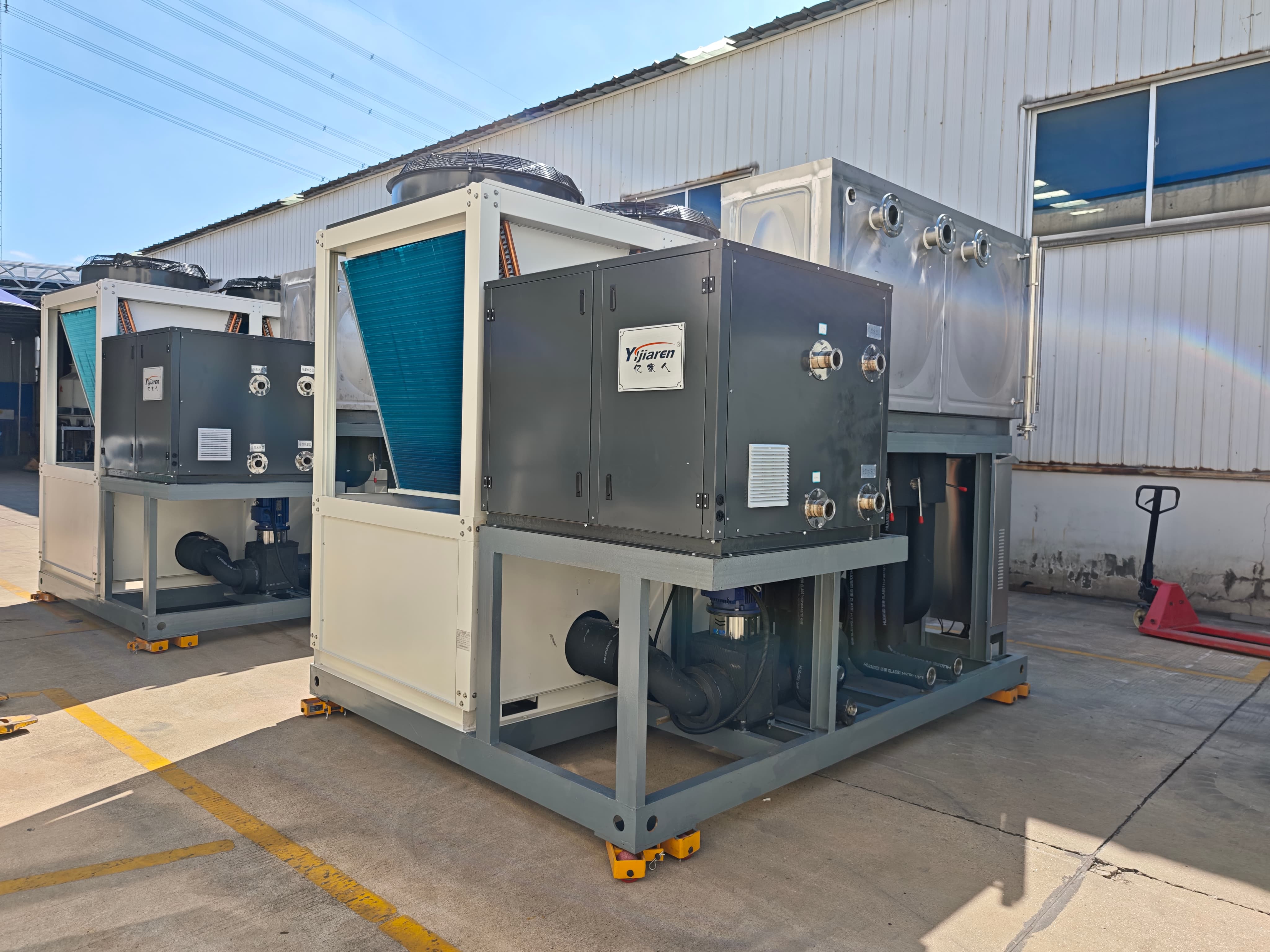
- A 25HP standalone unit with air-cooled or water-cooled configuration options, adaptable to existing site infrastructure.
- A 10HP skid-mounted unit that integrates the heat pump, pumps, and controls on a single transportable skid, described as pre-piped with ready-to-connect interfaces. This skid-mounted design is documented as shortening installation time and reducing civil works, which is particularly relevant for remote or temporary food processing projects needing combined cooling and heating without a dedicated plant room.
For facilities requiring staged capacity planning, the documented range spans small-medium (10–50P) to large (50P+) capacity options, allowing equipment sizing to match production scale rather than defaulting to oversized or undersized systems.
Industry Adaptation And Documented Use Cases
The product data explicitly lists food processing among the industries served by heat pump chiller lines, alongside electroplating, chemical processing, and pharmaceuticals for process chilled and hot water supply with waste heat recovery. Additional listed applications include industrial parks and small factory buildings for central cooling, heating, and hot water supply, as well as semiconductor manufacturing, new energy battery testing, and baijiu brewing for high-temperature-precision requirements. This range indicates the same underlying technology platform is applied across multiple process industries with comparable thermal management needs.
Certifications And Company Background
When comparing suppliers, documented qualifications provide an objective reference point. The manufacturer behind this product line, Jiangsu Obuy New Energy Development Co., Ltd., operating under the Obuy brand, holds ISO9001, ISO14001, and ISO45001 management system certifications along with CE certification. The company states it has delivered over 1,000 energy-saving solutions and project cases, with some conducted in cooperation with Fortune Global 500 companies, foreign-invested enterprises, central SOEs, and other SOEs. Backed by 20 years of engineering experience, the company also provides technical guidance, installation, construction, and commissioning services.
Final Considerations For Buyers
A sound buying decision for a food processing heat pump chiller should weigh documented COP performance, chilled and hot water output ranges, operating temperature tolerance, sealing and protection ratings, and deployment format against the specific thermal demands of the production line. Skid-mounted configurations suit projects needing rapid deployment, while standalone units offer flexibility in air-cooled or water-cooled heat rejection. Reviewing certifications such as ISO9001, ISO14001, ISO45001, and CE alongside documented project history provides additional grounding for evaluating supplier reliability in this equipment category.
https://www.obuytech.com/
Jiangsu Obuy New Energy Development Co., Ltd.