Understanding the Industrial Backup Power Challenge
Industrial backup power systems rarely operate under simple, predictable conditions. Equipment manufacturers and system integrators searching for a 48V LiFePO4 battery for industrial backup power typically face a combination of requirements that a single off-the-shelf pack cannot satisfy: specific voltage and capacity targets, defined peak-load tolerance, compatible BMS protection and communication functions, particular cell chemistry constraints, exact physical dimensions, and connector or environmental safety certification needs. Shanghai Mylion New Energy Co., Ltd., operating under the brand MYLION, approaches this challenge from an engineering standpoint rather than treating it as a generic retail transaction.
Why Generic LiFePO4 Packs Fall Short
A core industry pain point identified by MYLION is that many B2B customers cannot utilize generic battery packs because their systems demand highly specific combinations of voltage, capacity, load current, BMS functions, cell chemistry, physical dimensions, connectors, and environmental safety certifications. When a generic LiFePO4 replacement is installed without full system review, the result is often charger or BMS incompatibility. For industrial backup power applications, where continuous and peak current must align with real device loads, this mismatch can translate directly into operational risk.
MYLION is positioned as an engineering-driven B2B lithium battery solution provider that focuses on custom battery-pack development and project execution, prioritizing technical integration over low-price retail sales. This positioning reflects the company's view that the battery must be evaluated as an integral part of the customer's entire system — considering real load, charging source, BMS functions, mechanical interfaces, and production constraints — rather than treating electrical parameters in isolation.
MYLION's Engineering-Driven Approach to Custom LiFePO4 Solutions
Chemistry Review and Electrical Architecture
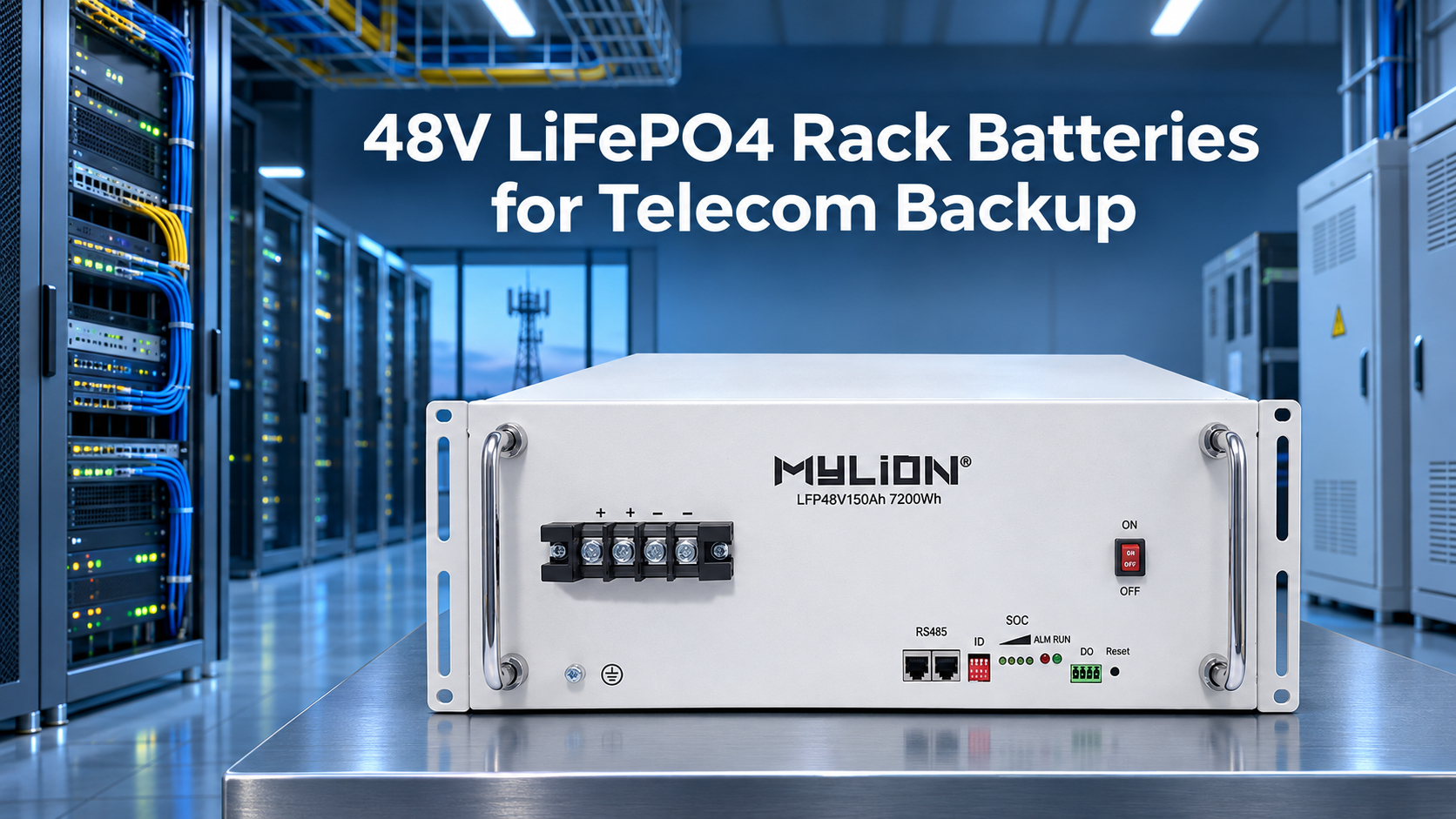
For a 48V LiFePO4 battery intended for industrial backup power, MYLION's custom LiFePO4 battery pack solutions begin with a chemistry review: a scenario-based validation process confirming that LiFePO4 is appropriate for the operating conditions of the target device. This is followed by an electrical architecture review, in which the series/parallel configuration is determined according to the energy and runtime targets of the specific project, rather than relying on standard voltage assumptions. This project-defined architecture approach is a direct response to the pain point of generic replacements causing incompatibility.
BMS Matching and Load Management
Within MYLION's broader custom lithium battery pack development process, BMS matching is treated as a dedicated evaluation step covering protection and communication functions, including balancing, monitoring, and protection logic. Load matching ensures that continuous and peak current are aligned to the real device loads expected in industrial backup scenarios. This system-matching approach integrates the battery, BMS, charger, and mechanical structure as a single reviewed unit, rather than assembling components independently.
Mechanical Integration and Validation
Mechanical integration — covering enclosure, mounting, and insulation design — is addressed alongside electrical design so that the final pack fits the physical and environmental constraints of industrial equipment. Before mass production, MYLION applies project-defined testing based on final approved specifications, a validation step intended to confirm that the architecture, chemistry, and mechanical design perform as required under the conditions the customer has specified. Customization of enclosure, label, and packaging is handled after the technical specification has been approved, keeping production-ready adjustments within a controlled, change-managed process.
From Requirement Definition to Mass Production
MYLION's service model for a custom 48V LiFePO4 battery project follows a structured sequence: requirement analysis, feasibility review, solution definition, prototype development, testing support, specification approval, and mass-production coordination. This sequence is supported by change-control management, version-controlled bills of materials, and repeat-order supply coordination, which together help maintain consistency across production runs once a specification has been frozen.
Delivery for LiFePO4 projects is supported through custom development, sample validation, and mass-production support, with broader company delivery options including private label, OEM, ODM, and controlled mass-production formats. Pricing for these projects follows a project-based quotation approach, issued only after technical requirements have been confirmed and a feasibility review has been completed — reflecting the engineering-first nature of the process rather than fixed catalog pricing.
MYLION also supports documentation relevant to transport and safety compliance, including UN38.3 transport documentation support and MSDS/SDS safety data sheets, which are relevant considerations for industrial backup power deployments that must move through standard logistics and safety review channels.
Industry Applications Beyond Backup Power
While industrial backup power is one application area, MYLION's custom battery engineering capability extends across several sectors that share similar system-integration demands. These include electronic and professional equipment, smart home and IoT devices, industrial instruments, robotics and automation, security and CCTV monitoring, agricultural and field-use equipment, portable tools and handheld devices, and communication and network equipment. Customer types served include equipment manufacturers, product brands, industrial electronics companies, system integrators, and regional distributors — reflecting a consistent B2B, project-based engagement model rather than direct consumer retail.
In documented customer scenarios, MYLION has supported industrial equipment projects by providing stable output and robust connectors for professional instruments, addressing risks of BMS trips and voltage drops. Similar system-level reviews have supported agricultural equipment projects, where runtime and weight were balanced against vibration and temperature constraints in outdoor environments, and robotics or smart device projects, where limited space needed to accommodate sensors and motors while managing peak-current and thermal constraints.
Why Choose MYLION
For a procurement team or engineering group evaluating a 48V LiFePO4 battery for industrial backup power, the central question is less about a single specification and more about whether the supplier can validate that specification against the actual system it will serve. MYLION's model — built on requirement engineering, system matching across battery, BMS, charger, and mechanical structure, and risk control through pre-production validation — is designed to reduce selection errors, thermal issues, and certification delays before they reach the production stage.
With more than 13 years of experience in the lithium battery industry and a structured custom-battery engineering model emphasizing requirement definition, sample validation, and controlled specifications, Shanghai Mylion New Energy Co., Ltd. positions itself as a project partner for OEM/ODM battery development rather than a transactional supplier. Companies seeking a 48V LiFePO4 battery for industrial backup power that must satisfy exact voltage, load, BMS, and mechanical requirements can engage MYLION through its structured process of requirement confirmation, feasibility review, prototype validation, and production-readiness support, with long-term supply coordination available for repeat orders. Further details on MYLION's engineering process and product lines are available at www.mylionbattery.com.
Shanghai Mylion New Energy Co.,Ltd.